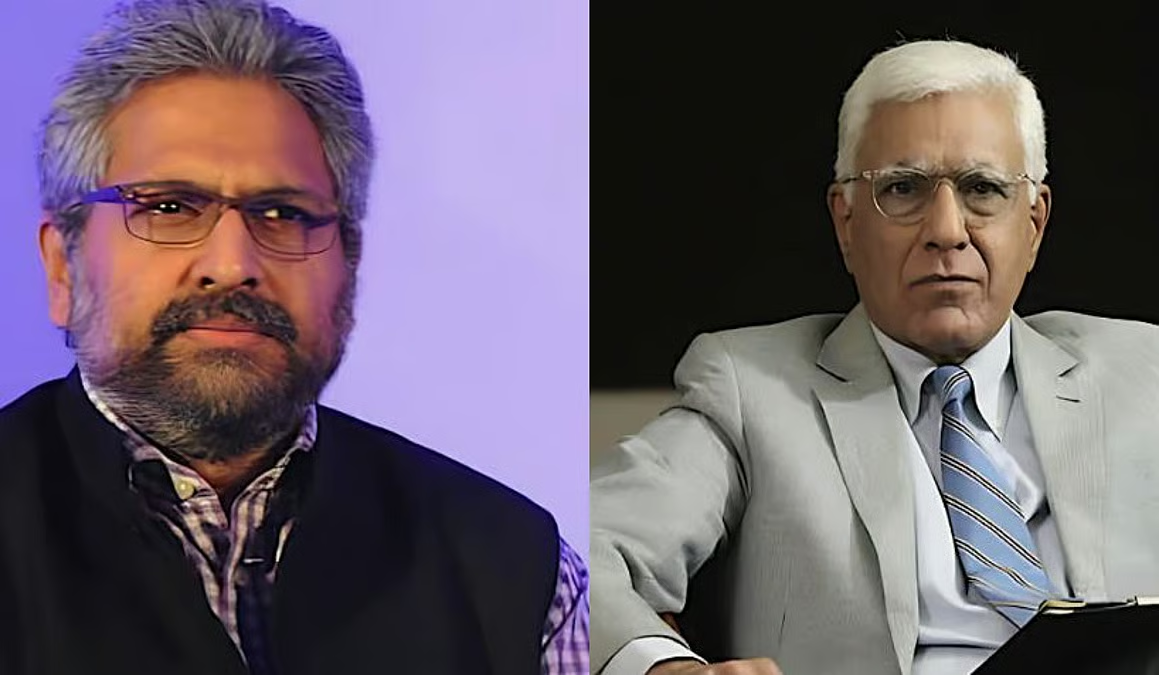
The FIR against Siddhartha Varadarajan and Karan Thapar By Justice Katju
An FIR ( First Information Report ) has been filed by the Assam police against the well known Indian journalists Siddhartha Vardarajan…
Keeping Pace with Legal Change
An FIR ( First Information Report ) has been filed by the Assam police against the well known Indian journalists Siddhartha Vardarajan…
Artificial intelligence exceeded an important threshold. Not only a device used to treat data, it is now a creative powerhouse,…
There was a twist of events in a Pune court where Congress leader Rahul Gandhi has presented an application before…
By Justice Katju Many people like Ajit Anjum, Ravish Kumar, Arfa Khanum Sherwani, Yogendra Yadav, Prashant Kishor, etc as well…
Independence Day for India is coming shortly on 15th August, but I will not be celebrating it as there is…
Recently US President Trump has issued a statement proposing to raise tariffs on Indian goods sold in USA above the…
The Supreme Court of India has turned down a legal petition filed by the head of Rashtriya Janata Dal (RJD)…
TRecently, the Supreme Court of India gave an important ruling in a complicated land case at the Civil Appeal No.…
The Supreme Court has reaffirmed the arrest of the son of the appellant in the Andhra Pradesh liquor scandal case, holding that the authorities had adhered to constitutional protections. The appellant had contended that the arrest did not involve proper communication of reasons, contravening Articles 21 and 22. Relying upon Vihaan Kumar Vs. State of Haryana, the Court reaffirmed that the arresting officers had given adequate information. It rejected the appeal and reaffirmed that arrests need to meet the test of meaningful communication and procedural fairness.
In Govt. of NCT of Delhi vs Udai Singh, the Delhi High Court upheld the termination of a constable who had been taking unauthorized leave repeatedly over the course of many years. Despite producing medical certificates, the Court held them vague and without corresponding procedures. It held habitual absenteeism in disciplined services such as the police as habitual misconduct. Overriding the CAT’s reinstatement order, the Court underscored the supremacy of discipline and strict adherence to leave procedures in police forces.