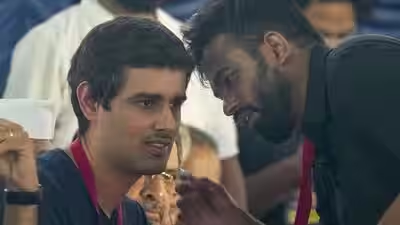
You Tuber Dhruv Rathee was detained by Gurugram police on October 10, 2026, before he could participate in a planned protest at Delhi’s Jantar Mantar against the Special Intensive Revision (SIR) of electoral rolls, which was to be held under the banner of the Cockroach Janta Party and related to the Chief Election Commissioner Gyanesh Kumar. The police asserted the protest was unlicensed, while the party and other activists panned the arrests as an effort to quash dissent. The episode has turned the spotlight back on two critical questions of law: whether the SIR is constitutional, and what authority the police have to curtail or prohibit protests.
What Is the Special Intensive Revision of Electoral Rolls?
Special Intensive Revision. This is a special exercise undertaken by the Election Commission of India for updating and verifying the electoral rolls. The said exercise aims at removing the names of those who have died or permanently shifted, eliminating duplicate entries, and so on, so that the electoral roll accurately reflects the list of eligible voters.
The Election Commission is constituted by virtue of Article 324 of the Constitution, and has “powers relating to the superintendence, direction and control of elections.” The power of the Election Commission to supervise the superintendence, direction and control of elections can also be found in Section 21(3) of Representation of the People Act, 1950. According to this section, the Commission has the power to hold a special revision of the electoral rolls, for a valid reason, at any time.
Supreme Court Has Already Ruled on the Legality of SIR
May 27, 2026 proved to be a milestone in the constitutional contest when the Supreme Court pronounced its verdict in the case of Association for Democratic Reforms v. Election Commission of India. The Court upheld the validity of the SIR exercise in Bihar and held that Election Commission had statutory authority as per Section 21(3) of Representation of the People Act, 1950, read with Article 324 of the Constitution.
The Court also looked at whether a valid reason existed for exercise, if the measures taken were proportionate and if voters could have access to procedural safeguards. It acknowledged the powers of the Commission in making a very narrow test of nationality in order to register to vote, stating that the Commission ‘cannot make a final decision on citizenship’ under the Citizenship Act and if an official decision is needed, this must be directed to the proper body. The judgment supports the legality of SIR but does not give the Commission carte blanche to remove voters without legal grounds.
Can SIR Lead to the Removal of Eligible Voters?
The main issue raised by opponents is that an election that purports to clean up the rolls may deprive eligible voters of their constitutional right to vote if they face documentation problems, have migrated or otherwise made administrative errors. Articles 326 and 328 prescribe elections to the Lok Sabha and State Assemblies by adults above 18 years of age, subject to constitutional and legal provisions regarding electoral registration.
Procedural safeguards such as marking entries as being suspect and allowing those registered to be notified and be heard before finally rejecting the suspected entry were also recognised by the Supreme Court. As described by the Election Commission, safeguards also include the use of draft electoral rolls, claims and objections, verification and appeals. The current electoral process provides remedies for a voter if, alleging their name has been wrongly erased, they approach the authorities. The constitutional issue, therefore, is not whether voter verification is lawful, but whether it insulates eligible voters from wrongful disenfranchisement.
Was Dhruv Rathee’s Detention Legally Permissible?
It is necessary to distinguish between the legality of Rathee’s arrest from the justification of the much-debated SIR. The police have alleged that they did not grant permission to the protest at Jantar Mantar, as had been requested by the organizers, for security reasons and to observe the prescribed procedure. The police then allegedly detained Rathee, as he was leaving his house in Gurugram to travel to Delhi. Although reports speak of it as a detention, that does not by itself imply that he was arrested, or that he was convicted of any crime.
The right to freedom of speech and expression is implied under the freedom of speech and expression granted under Article 19(1)(a) of the Constitution, and the right of peaceable and unarmed assembly is granted under article 19(1)(b) of the Constitution. The abovementioned rights are not absolute and can be curtailed to some extent. The State can levy reasonable restrictions on public meetings to protected by one of the constitutionally admissible reasons and police can control demonstrations for public safety and order.
Nevertheless, by denying permission for any protests, not all arrests could be deemed lawful. An arrest must be supported by law, a proper procedure must be adhered to, and the restrictions imposed should not be arbitrary or excessive. Whether an arrest is legal or not would depend on the circumstances, the legal provision invoked and the reasons written down by the authorities at the time of arrest. The protest was not conducted by use of force, and it’s criticism of the Election Commission or opposition to SIR cannot lead to criminal offence.
A Different Constitutional Inquiry Concerning the Election Commission
There have also been questions raised about decision-making processes in the Election Commission. In September 2026, the Supreme Court agreed to hear a petition that challenged some of the functioning of the Chief Election Commissioner, Gyanesh Kumar, and sought to quash the SIR exercise conducted countrywide. The petition claimed that key decisions had been taken without the involvement of the other Election Commissioners, which the petitioners argued was illegal; the matter was under consideration by the Court.
The Court on October 6, 2026, directed the Chief Election Commissioner and the other Election Commissioners to respond to allegations of largely unilateral taking of many important SIR decisions. The Court said that a decision taken otherwise than as per the decision making process prescribed by law can be stayed or set aside. This is different from the judgment passed in May upholding Bihar’s SIR: whether the legal and statutory authority was there for a revision and whether it was made within the law are different issues.
Hence the controversy relates to two separate constitutional issues. The Election Commission is empowered to correct the electoral rolls, with legal safeguards, and judicial review. At the same time voters have remedies against wrongful exclusion and on any subject citizens have the right to register disapproval and form peaceful assemblages to that end within the parameters of the law. If the question of the legality of Rathee’s detention requires consideration on its own facts and the conduct of SIR and the decision of the Election Commission require consideration in law.