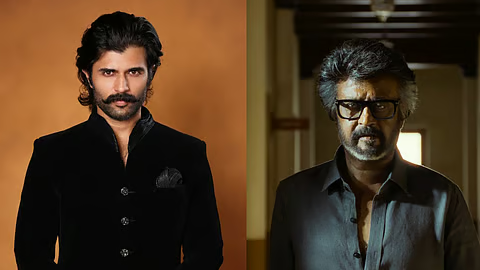
Vijay Deverakonda, actor on the controversy over Ranabaali and Rajinikanth’s Jailer 2 online protest Vijay Deverakonda, the actor of the movie’s trailer launch at Ranabaali in Hyderabad, stated that the social media row over the film was “manufactured”. “Some people are even being paid to push an agenda on the social media,” Deverakonda said. “But I will not change myself for online criticism to make others happy,” the actor added. Comments made by Deverakonda have raised the following broader query about social media marketing campaigns, paid criticism and the limits of liberty of expression. Under Indian regulation, criticism of actors, movies and public affirmation is allowed, but factually false defamatory allegations are not protected. (India today)
What Is the Jailer 2 vs Ranabaali Controversy?
The debate started as his Telugu film Ranabaali and Tamil film Jailer 2 of Rajinikanth were nearing release. The debate was centered on the characters of the two actors, and their fans. While there was some negative talk about Vijay, many who posted discussed the actor and how he was reportedly targeted on social media by an organized group of users.
But the actor’s assertion is an accusation that online abuse is happening – not proof that specific persons or organisation sponsored a campaign. It can be a matter of opinion that abusive reviews, disagreements between fans and who criticised the actor is. Was a campaign based on paid manipulation, impersonation, harassment or illegal content will hinge on evidence and conduct. (NDTV)
What Does Article 19 Say About Freedom of Speech?
Section 19(1) (a) of the Constitution provides that all citizens are free to have freedom of speech and expression. This right covers several shades of opinion which include criticism of governors, performances in the film, commercial decisions and the quality of entertainment. You may choose to dislike a film, denounce an actor’s role as disappointing, or say that one film is better than another.
The right is not absolute. Article 19(2) allows for proportionate restrictions on certain grounds including the protection of one’s reputation and honour or dignity; this balance is embedded in the constitutional scheme. Whilst fame cannot make a person immune from defamation, it does not mean that defaming a celebrity is always illegal.
When Can Online Criticism Become Defamation?
A statement or imputation which may be damaging to one’s reputation is the subject matter of defamation. Indian law – civil and criminal defamation: Criminal defamation is dealt with by section 356 of the Bharatiya Nyaya Sanhita, 2023. Civil defamation may also provide a person a cause of action, depending on the facts and law.
An ordinary opinion usually becomes libellous only when it is repeated in a post that repeats a libellous factual statement. An assertion that an actor’s performance was bad is just an expression of opinion. An untrue assertion that an actor committed a serious crime or committed a crime and was dishonest may be relevant to a different question of law. The meaning, or pub..lishing, or evidence or defences can be relevant.
In addition, Indian law permits statutory exceptions to the criminalisation of defamation, which include statements that a reasonable person would believe to be for the public good, expressions of honest opinion about public conduct, and fair reports of proceedings in a court of justice. Such exceptions are not unlimited permission to publish any allegation.
Are Paid Trolling and Coordinated Campaigns Illegal?
However, it is important to note that simply because multiple accounts denounced the same individual or group does not create an offence. The fact that a payment has been made for a fake review or advertising post does not automatically mean it is a criminal offence.
A coordinated campaign might also give rise to concerns under other legislation, depending on the content that is published and how the campaign is being orchestrated. A false and defamatory statement could give rise to defamation action, for instance, while a threat or any other criminal offence committed independently of the campaign might lead to prosecution under the applicable law. A coordinated campaign must be proved by evidence, not simply by the quantity or likeness of comments online.
Social media sites could also have their own rules to deal with fake engagement, harassing behaviour and other false acts. A platform taking down something or banning a user from its site is different from a court ruling that someone has defamed or committed another crime.
How Have Indian Courts Balanced Reputation and Free Speech?
The Supreme Court considered the freedom of speech and reputation in the case of Subramanian Swamy v. Union of India (2016). The Court ruled that criminal defamation sections under the old Indian Penal Code were constitutionally valid, and that reputation is a vital facet of the protection of life and dignity under Article 21. It was held that defamation might be a justified restriction under Article 19(2).
Recently, in January 2026, the Delhi High Court reiterated that a defence of freedom of speech per se will not be available in defamatory, malicious and abusive material spread through social media platforms. The Court highlighted the importance of striking a balance between the right to free speech and the right to reputation and dignity, and in considering online posts and online commercial goodwill, these factors ought to be given due consideration and an injurious statement does not be framed as ‘pithily positive’, when criticism is taken too far and the rights of a public figure are asserted with regard to questions of free speech. (Live Law)
The Jailer 2 and Ranabaali controversy shows why that distinction is important online. Viewers can compare films, or criticize, or disagree with actors, without fear of the comment devolving into a legal assault. Conversely, not every allegation that someone has committed serious wrongs in the world is automatically subject to the protections of a fan-battle, simply because it is said in a clash over a TV show. It isn’t the fact that it’s a crappy comment that makes the comment a libel, it’s the content of the libel.