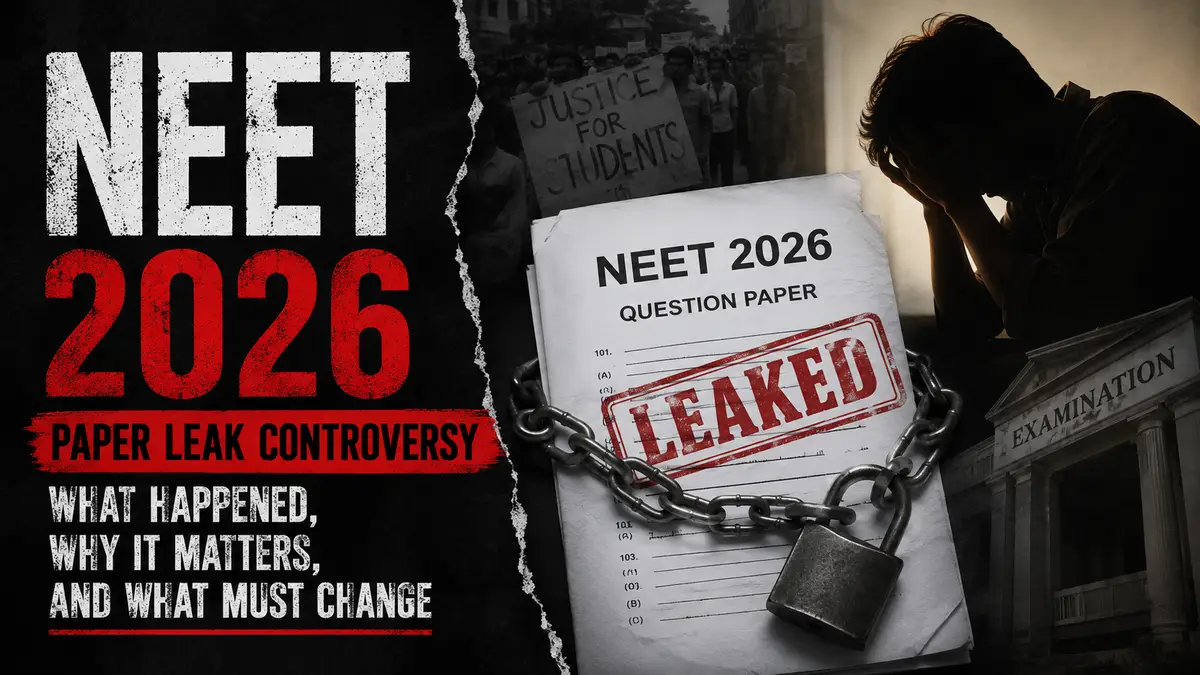
It is an annual event, but never comes easily. Millions of teenagers are locked up in narrow rooms in the likes of Kota or Thrissur. They study till their sight goes out of their head. Their future is on the stake of the National Eligibility Cum Entrance Test. But the news comes when the time is right. The night before the paper was sold for a few lakhs. It all comes to shatters.
The recent blip in the academic calendar wasn’t just for the NEET-UG. They broke people. Recently the Supreme Court of India had to reiterate the very obvious. The National Testing Agency faced the wrath of a bench of Justice P.S. Narasimha and Justice Alok Aradhe in late May 2026 for its obvious ad hocism. The court was not hesitant to speak its mind. They did recognize a paper leak is a very traumatic experience for the students who sacrifice years of their youth. There was a demand to hold people accountable on the bench. Committees lacking faces and bogged down in red-tape will not suffice
We’re talking about a system that is consistently pushing children to the very limit. The pressure cooker environment is fatal even if there’s no paper leaks. The harsh competition, mixed with administrative uncertainty, greatly hinders students’ response to pressure and directly affects their suicidal behavior, according to research (Kar et al., 2020). Throw in the big, cynical scam and you’ve got a lot of anxiety. The outcome is disastrous.
Reading Fair Exams into Article 21
The term “Right to Fair Examination” is not mentioned in the Indian Constitution. It’s not a specific provision. However, constitutional law is quite flexible. It grows, it puffs up. It’s all about Article 21.
Article 21 ensures that no one shall be deprived of his life or personal liberty other than in accordance with a law. The Supreme Court’s interpretation of the one sentence over the last few decades expanded it to include the right to live with dignity, the right to a livelihood and the right to a clean environment. If you think about it, the only way to become a doctor in this nation is to get in after passing a state required entrance exam. It decides the fate of a student for their life’s livelihood and social dignity. The State is playing with your life if it insists that you, at least in this instance, go through a single, giant choke point, and then it lets it get as much filth in as it can possibly. A rigged exam is an outright attack on equal opportunity. The trauma it causes and the futures it derails, put it well and truly in the category of Article 21 violations. The state has a positive duty to make sure the apparatus of testing is infallible. If it leaks, it’s a constitutional error.
Criminalizing the Aftermath: Abetment and Institutional Apathy
It is here that the legal fact meets head-on with public outrage. So when a student who bled on the test is discovered to have had a fake test, the first thought is, “Oh, they must have murdered him.” Or at least to incite towards suicide.
From a legal standpoint, it’s very hard to get that to stick. Abetment of suicide is covered under Section 108 of Bharatiya Nyaya Sanhita. Historically, the courts have been given a narrow definition of abetment. Often a clear intent or direct provocation is required to convince an individual to kill themselves. A corrupt official putting a document into the paper because he wants to make a quick buck doesn’t have it in mind that a kid a thousand miles away will be hanging from a ceiling fan. The criminal motive is not towards the suicide, so it is difficult for criminal courts to hold the death directly against the organisers of the leak.
Institutional accountability is slowly evolving though. The judiciary have had enough of the excuses! In January 2026, in a mammoth judgment, Justices J.B. Pardiwala and R. Mahadevan had ordered full implementation of certain measures to prevent student suicides in educational institutions. They attacked the institutionalization of the blame and its tendency to be blaming toward others.They attacked the individualization of the blame by the institutions and the tendency of blaming others. They flatly rejected the notion that there was a stressful situation and that the child simply could not deal with it. The court had ordered the registration of FIRs for all campus suicides and had emphasized on the necessity of providing safe and equitable campus. They essentially acknowledged that a failure of systems and lack of qualitative support is causing these tragedies. This was specifically targeting Higher Education spaces, but the legal thinking would apply to the NTA. The system alone is responsible.
The price of negligence, in constitutional torts.
The criminal code is too limited to reach the bureaucrats who killed the suicides, so there’s another hammer in civil law. The concept of constitutional torts.
If the State infringes upon your fundamental right guaranteed under Article 21 then you do not simply ask for an apology. You are entitled to exemplary damages. In case of the death of the student can be linked to the gross negligence on the part of NTA to hold the NEET examination, the state is responsible for the student’s death. It is a dereliction of their statutory duty. The recent Supreme Court effort to “define” duty bearers, rather than “blame the basket” is in this direction. When you’re clear on the exact official who wasn’t able to get the vault, you know who’s responsible for the spreading harm.
The law is changing. The removal of the integrity of an exam for a nation is not only a white collar crime of bribery or cheating. This precipitates a large-scale mental health emergency. It removes the constitutional right to a life worth living. We are no longer allowing paper leaks to be a paper problem. They are increasingly acknowledged as attacks on the youth, as a system. The legal charge may be having trouble securing a murder conviction on a corrupt clerk, but the web is spreading. The state is increasingly playing the game of making a fair examination a right and not a privilege for the students.
References
Kar, S. K., Rai, S., Sharma, N., & Singh, A. (2020). Analysis Study of the media report on student suicide linked to NEET examination in India. Indian Journal of Psychological Medicine, 43: 183-185. https://doi.org/10.1177/0253717620978585
Cited by: 30