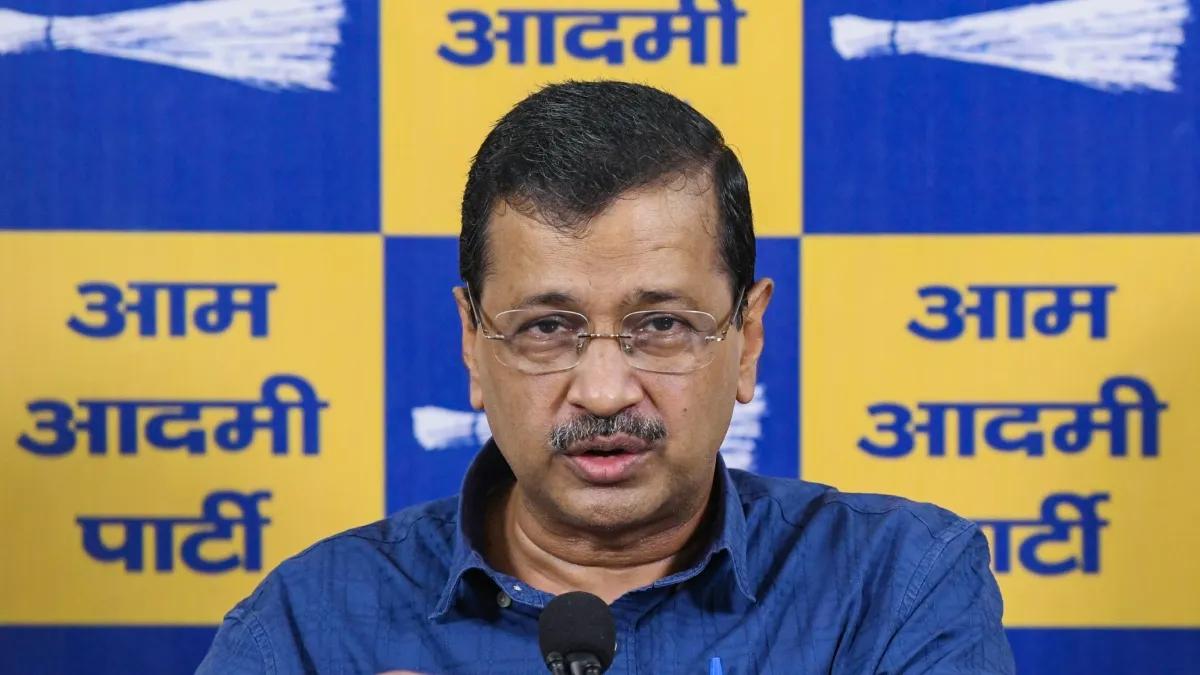
The Aam Aadmi Party’s legal woes have taken a complex and complicated turn around. A division bench of the Delhi High Court was scheduled to issue the criminal contempt notices to former Delhi Chief Minister Arvind Kejriwal and top party leaders on Tuesday.The division bench of the Delhi High Court had issued the criminal contempt notices to Delhi former Chief Minister Arvind Kejriwal and other party leaders on Tuesday. This comes as they were alleged to have engaged in a systematic online campaign against and questioning the integrity of an incumbent High Court Judge, Swarana Kanta Sharma
The matter was flagged up as a serious issue which tarnishes the dignity of the legal system and the division bench comprising Justice Navin Chawla and Justice Ravinder Dudeja took up the issue. They have provided the politicians with just four weeks to respond formally with their legal reply. The court registry has also been directed to keep all electronic records, social media posts, and digital information related to the alleged comments for in-depth scrutiny at the next hearing on August 4, 2026.
It was the Genesis that sparked the Excise Policy Dispute.The Excise Policy Dispute got its genesis from this Genesis.
To see how a routine legal battle went into a full-blown criminal contempt case, the Delhi excise policy case has to be revisited. This controversy has been working its way through the courts for months. On February 27, a trial court had completely acquitted Arvind Kejriwal, former Deputy Chief Minister Manish Sisodia and 21 others in the case. At the time the trial judge commented that the prosecution’s claim simply cannot withstand serious scrutiny and had no strong bases.
Need Help With Your PhD or LLM Thesis?
Explore our thesis and dissertation writing support services for PhD and LLM students. Get subject-specific academic assistance for your research project.
Explore Our Services →This setback was not to be for the Central Bureau of Investigation. The central agency promptly filed a revision petition with the Delhi High Court for setting aside the discharge order issued by the trial court. This appeal was filed in Justice Swarana Kanta Sharma’s courtroom.
The boycott was raised at a public meeting called by the Recusal Request and The Boycott Letter.
The case when presented to Justice Sharma made the courtroom tense. On April 5, Kejriwal, Sisodia, and party colleagues filed an application, in which they formally asked the judge to recuse himself from the hearing of the CBI’s appeal. They expressed worries about possible bias. Their plea was, however, rejected by Justice Sharma on April 20, giving it a clear and definite answer that the application did not demonstrate any ‘reasonable apprehension of bias’ in the strict sense of the term
The Aam Aadmi Party leaders decided to take a very unusual route – rather than going to the Supreme Court to petition for her recusal, they petitioned to recuse her. Arvind Kejriwal has issued a formal letter to the judge saying that he will not appear before her, or through his lawyers, for any of the proceedings. He was taking this step as a peaceful protest, in keeping with Mahatma Gandhi’s philosophy. Soon, Manish Sisodia and party leader Durgesh Pathak did the same by filing similar letters to the court
It has been suggested that there may have been an organised social media campaign.
What actually flipped the script wasn’t the letters, but what was taking place at the same time on the internet. The court records show that the campaign to attack Justice Sharma went on and on via various internet sites. The single-judge bench said that the content being circulated on digital platforms was highly defamatory and intended to help bring public faith into disrepute.
Justice Sharma commented that the political leaders had abandoned the search for a proper legal remedy and had now changed their tactics to public intimidation. The posts on the Internet allegedly charged the judge with certain partisan and political affiliations. The video clip of Justice Sharma’s speech was heavily edited and “misused” to make it seem as if she was politically compromised, and this was a matter that the court was very particular about.
Additionally, excerpts and abridged versions of the actual court proceedings were streamed on-line. The judge noted that the actions were clear evidence of a parallel public narrative that was being constructed outside the court. Her order, issued on May 14, says a failure to counter such a concerted attack would not be a sign of judicial restraint, however, but would constitute “a surrender to a powerful and influential litigant.
The splitting of the legal proceedings.The division of the legal proceedings.
Justice Sharma decided to separate the two cases, when she had to take the initiation of the criminal contempt proceedings against persons whose main case was also to be heard by her. She removed appeal of the core excise policy from the CBI’s list of cases on strict observance of judicial discipline and propriety. She said that the rule is that a judge cannot sit on a criminal contempt proceeding against the same parties who are involved in a main case against the same parties in respect of personal vilification.
Because of this separation, the principal issue in the excise policy was turned over to the Chief Justice for reassignment to another courtroom entirely. That case has now been taken up before a single-judge bench of Justice Manoj Jain. At the same time, the tracking of criminal contempt has been shifted to the division bench of Justice Chawla and Justice Dudeja for an independent assessment of the social media usage.
Political Disqualification, Parallel Demands.
This judicial battle has already spread into other areas of the judiciary. A separate bench of the Delhi High Court, headed by Chief Justice DK Upadhyaya and Justice Tejas Karia, was to consider a new PIL filed on Wednesday. This petition asks for the absolute disqualification of Kejriwal, Sisodia and Pathak from contesting for future elections.
In the petition, these leaders have been addressed as those who had sworn to uphold the Constitution of India when they took the oath as per Section 29A of the Representation of the People Act, 1951. The leaders have given a public and open boycott to a sitting judge and initiated open campaigns against the court, the petitioner argues, which has taken them to a fundamental breach of that constitutional oath. The position taken is that if one selects not to recognize constitutional institutions one should be ineligible to hold public office.