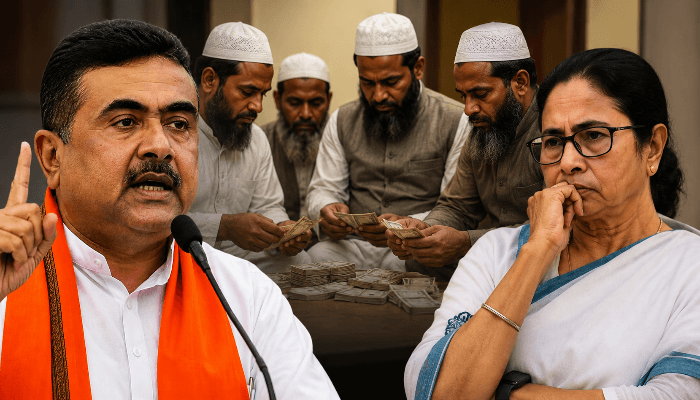
The new government of West Bengal just threw down a huge policy bomb in the state. The state cabinet led by chief minister Suvendu Adhikari met for just the second time on Monday. They agreed to abolish all and sundry of pay from the state treasury to religious officials. This means that the money that is currently going to Muslim imams, muezzins and even Hindu purohits will come to an end from June the first.
What a political turnaround this is! It is a complete reversal from the operations of the Trinamool Congress of Mamata Banerjee who have been in power for more than 10 years. The extreme measure was justified by Adhikari as a choice between money for religion or money for the future. “Why the state should be paying religious stipends, when it could be paying school kids?” he asked reporters.
The money saved from these discontinued allowances will be immediately channeled into the fund of Vivekananda Meritorious Scholarship, said the administration. This will render the welfare system “totally transparent,” the government said. It is so easy to understand today that any student can obtain it. Whether they are from a Hindu, Muslim, Sikh, Jain or political family, it will be of no consequence.
The arguments of the Constitution are laid on the table.
This mammoth administrative rollback is being directly linked to the essence of secularism that is present in the Constitution of India, by legal luminaries. In particular, Articles 14, 15 and 27 are the ones that have been at the forefront of this debate. Everyone within the country is equal before the law, as guaranteed by Article 14. Article 15 takes it a step further. It definitely prohibits the state from discriminating against any citizen on the basis of religion, race, caste, sex and birth.
The previous government was criticized for paying stipends to particular religious leaders, which is deemed a violation of these rules. Its opponents have always insisted that it was an unfair system which used public money to benefit some groups in preference to others.
If that’s not the case, then you have Article 27. When it comes to taxes and religion, this is the one biggie. The text clearly states that no person may be compelled to pay any taxes if the money will be used “for the promotion or maintenance of any particular religion or religious denomination”. The new administration is claiming that it is a direct violation of this article to be paying stipends to imams and/or priests monthly with public tax dollars. Thus, by reducing the money, they say, they are putting West Bengal back on track with the real spirit of secularism as spelled out in the Constitution.
A look back at the numbers.
This allowance system wasn’t small. It was well entrenched in the political scene of the state. It all began in 2012. It was a time when Mamata Banerjee was just taking power and implementing a monthly allowance for registered imams. In later years muezzins (men to call the prayer at mosques) were added to the payroll. The imams were earning 3,000 rupees and the muezzins 2,000 rupees per month after a recent hike, just this past March.
The system was subjected to a barrage of legislation almost right away. In fact, the initial scheme of imam stipend was struck down by Calcutta High Court years back as unconstitutional. The previous government began to send the money through the Waqf Board and other state ministries such as the Information and Cultural Affairs wing to avoid that, thereby ensuring the money keeps flowing.
The TMC government introduced a parallel arrangement for the Hindu priests during the COVID-19 lock down in September 2020 to quell the growing allegations of appeasing minorities. The 2,000 rupees a month were also allotted to those purohits. However, the new BJP led cabinet has decided that the addition of more and more religions into the payroll does not make the system constitutional. The schemes of the Madrasa Department and Cultural Department have been completely discontinued during the next two weeks, said the Women, Child and Social Welfare Minister Agnimitra Paul.
Sweeping Political Changes Follow
This intense Monday’s cabinet meeting wasn’t the only dramatic move. The Suvendu Adhikari government has also decided to completely abandon the list of OBCs. This is to target various communities who have been added to OBC category between 2010 & 2024. Many of those additions were by the Muslims. The cabinet is implementing this rollback in implementation of a huge judgment delivered by the Calcutta High Court in 2024 which had declared these classifications unconstitutional and illegal.
The state is also throwing out the sub-categorization system adopted by the previous administration to allocate quotas. To offset these highly sensitive decisions, the government quickly came out with huge universal welfare programmes catering to the needs of female voters throughout the state. They gave the green light to the “Annapurna Yojana.” West Bengal’s women will receive a monthly monetary assistance of 3,000 rupees from the government from June 1st through direct bank transfers. The ones already enrolled in the old Lakshmi Bhandar scheme will be automatically shifted to the new one with no need of re-application. The cabinet further agreed to free travel for women on all state-owned buses.
The new administration is obviously eager to engage with a strong push for a governance other than religious. They are only interested in secular, gender and merit based state welfare. For now, the roads of Kolkata are silent, but the implications of this policy and its effects on the legal and social landscape will reverberate for years to come.