National Testing Agency has just wreaked havoc in the life of more than 22 lakh medical aspirants. They withdrew NEET-UG 2026 exam completely on May 12, due to inputs of investigation about a huge paper leak. Everyone is taken aback by this decision. The crazy thing about this situation is that it’s in perfect opposition to what the government and the NTA said exactly two years ago
In the past during the big controversy about the NEET-UG 2024 paper leakage, the Agency didn’t falter in the Supreme Court of India. They simply refused to do away with the test. They literally stated that canceling a national exam would be a serious and irresponsible measure which would destroy the careers of many innocent students. They informed the judges that you cannot treat wrongdoers the same way as an innocent candidate. As it happens, the agency did what it had promised the top court it wouldn’t do, even in this day and age. This amazing flip flop has caused legal experts and boiling-over parents to re-think the earlier suggestion and decisions of the Supreme Court on the cancellation of exams.
What has occurred in the Supreme Court all the way back in 2024?
We need to take a back step and go back to the summer of 2024 to recognize our current predicament. The case between Vanshika Yadav and the Union of India was before the Supreme Court. The whole year was marred by reports of paper leaks, grace mark issues, and inter-state cheating gangs in the NEET exam. Protestors were calling for a re-test. The central government’s resistance was so strong, however
Their advocates appeared before Chief Justice D.Y. Chandrachud and made a case for separating the blemished students from the honest students. The Centre argued that public institutions were required to do “justice. They said discarding the whole test will affect the admission schedule, delay the medical education and lead to a scarcity of competent doctors in the coming years. Basically they were saying that it’s a bad idea to throw the baby out with the bathwater.
The Supreme Court considered these arguments and ultimately agreed. This is because the judges decided that the 2024 exam should not be cancelled. They put a very high hurdle before themselves, and said that an exam should only be cancelled when there is “hard proof” of a “systemic breach” in the sanctity of the test. The court urged the NTA to beef up their security measures and cautioned against administrative flip-flops. The judges told the world “The prime condition was the separation of the guilty from the innocent. Today, two years later, the entire theory of law has been sent back to the wood pile by the same group that extolled it.
It took place during the 2026 exam period.It happened at the end of the 2026 exam period.
What’s going on here today is terrible. The May 3 exam was seriously leaked. Weeks before the test, a so-called “guess paper” with more than 400 questions was passed around on WhatsApp and Telegram. Investigators discovered that almost 120 of those questions were in every respect the same as the real biology and chemistry questions
It was handed over to the Central Bureau of Investigation. They have already arrested several individuals, like a coaching center owner from Maharashtra and a retired professor in Latur (Maharashtra) in the field of Chemistry. Police believe that a huge scheme of cheating went awry in the tightly guarded chain of custody.
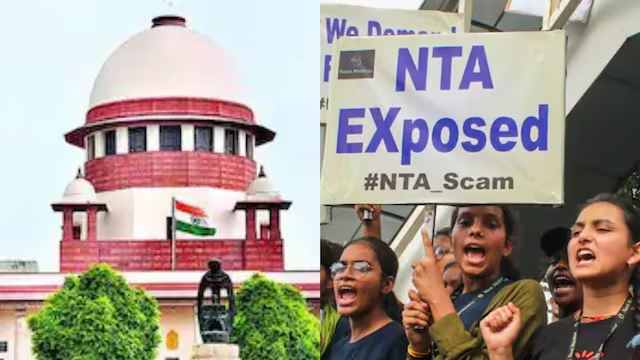
The NTA discovered the extent of the leak and panicked. They didn’t try to determine whether they could differentiate the cheaters from the honest ones, but they did pull the plug. They said the test would be canceled and instead would be retested on June 21. When students of years have been grinding through textbooks, it is now they are protesting in the streets. The demonstrations are taking place in various cities by the National Students’ Union of India (NSUI). Anger is so far beyond. They are simply frustrated by an uninterruptible examination of the system, which they feel they have been fooled and cheated by.
Why Canceling Now goes against their own logic
This is an area that is being closely watched by the legal community with serious confusion. NTA is now a subject of fresh petitions in the Supreme Court. Medical associations such as Federation of All India Medical Association are practically pleading with the court to discontinue the NTA or completely revamp it.
So the big question on the table at the moment is why it’s being cancelled while the original was celebrated. The government informed the Supreme Court that the new Public Examinations Act in 2024 was a reliable indicator that it was taking exams security seriously. They vowed to create a strong, clear system. However, the 2026 leak still occurred.
So why didn’t they use that logic this time, if the NTA truly believed they were supporting the cause of innocent students not paying the price for criminals? Has the CBI discovered any evidence of that “systemic breach” the Supreme Court was referring to? Or was it simply the agency’s panic button due to another protracted legal battle? These questions are being prepared by lawyers for their petitions to the Supreme Court. The medical associations have called for a judge who had served on the Supreme Court to oversee the re-test, as none can be trusted by the organisation.
A view of the Road Ahead for students
Medical entrance exams in India are all set to go digital in the future. The after the disaster, formed by the Radhakrishnan Committee, strongly advocated for the movement away from pen-and-paper tests. Printing, packing and shipping trunks across thousands of miles all around the country for physical question papers. Each and every one of those trips is a chance for a leak.
The Health Ministry is considering a hybrid model at the moment. The concepts are that question papers are electronically distributed to exam centers just prior to the exam. These would be printed locally by high-speed printers under tight security conditions. “It sounds good on paper.” The implementation of that to 22 lakh students in rural and urban regions, however, poses a lot of logistics challenges. The infrastructure just has not been developed to be able to conduct a complete, one-day exam on-line for that many people.