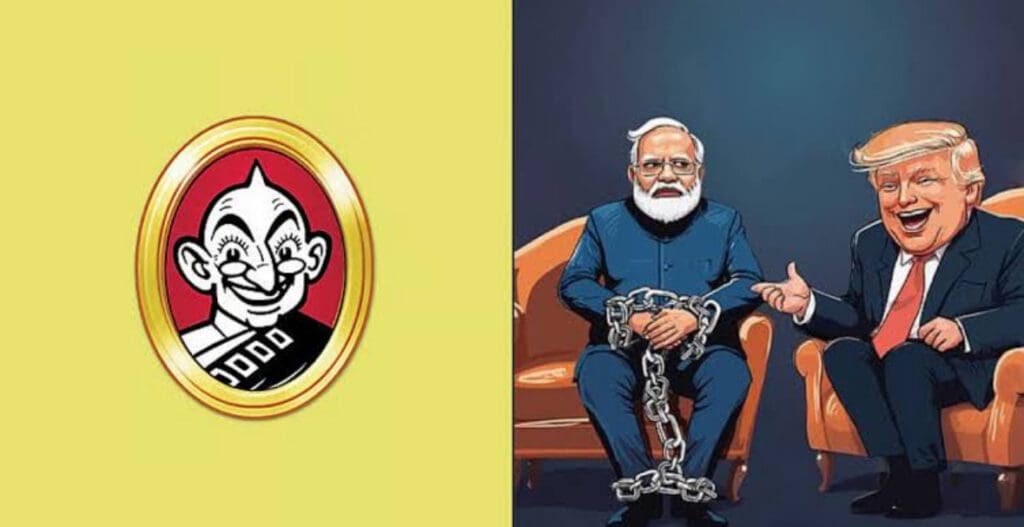
A great Norwegian newspaper, Aftenposten, dropped a controversial cartoon just as PM Narendra Modi landed in Norway for a state visit. He was drawn as a snake charmer. However, the “snake” out of the woven basket was a fuel pump hose, not a real snake. The opinion piece that was beside the drawing read, “A clever and slightly annoying man” in a rather rough Norwegian translation. There was a lot of “sadaqah jareyah” online. There was an immediate and overwhelming public rejection. The drawing was dubbed by social media users as “100% racist” and “fettered in colonial eras”. India was greatly stereotyped as a backward land of snake charmers centuries ago. In fact, Modi himself had made this observation in 2014 with a tongue in cheek remark that Indians used to charm snakes and now computer mice. That’s why it seemed like an intentional insult to millions of citizens when that trope was brought up in May 2026.
The timing itself made it go off even quicker. A Norwegian journalist named Helle Lyng had just become internet-famous. While the two leaders walked away from a joint press conference with the Norwegian PM, Jonas Gahr Store, she shouted a question at Modi. She fired questions at the will of the freest press in the world, one after another, asking him why he was not willing to answer the questions. India’s Ministry of External Affairs immediately got involved. Diplomat Sibi George, in fact, had a separate briefing to rebut the charges made on human rights and press freedom. After the cartoon appeared on the internet. The indignation became a huge discussion of whether it happens to be a legal boundary. Would a drawing like this violate the law? To understand what options are available, we need to consider the legal framework which underlies the concepts of defamation and hate speech.
Understanding Defamation Limits
Defamation is a tricky thing in the legal world. In the most basic sense, defamation involves the publication of a false statement which damaged your reputation. It must have some actual measurable harm. You lose money, you lose your job or you’re completely excluded from society because of a lie that was paraded around as fact. However, cartoons fall into an odd gray zone. The protection of political cartoons is virtually always in the hands of the principle of satire and fair comment. They are aimed at mocking. They enlarge and feature things and circumstances in order to make a pointed political statement.
Anyone who attempts to sue Aftenposten for defamation would land a huge brick wall in no time. Why? It will be difficult to prove that a cartoon is a “false statement of fact. Judges usually read cartoons and take the point that no sane person would believe it to be a real picture of reality. The newspaper did not publish an article one would call “Modi is sitting on the ground, charming fuel pipes”. They used a visual metaphor. His headline was “clever but annoying. That’s definitely a point of view. The laws of defamation vigorously defend opinions. Don’t be able to sue somebody because he or she thinks you’re annoying or cunning. The legal rule requires malicious lying in the guise of absolute truth. In almost all democratic courts satires are exempt from justice.
Is This Hate Speech
Defamation is a very different thing to hate speech. Acquiring the label of “hate speech” requires no proof that the statement is false. The only thing that needs to be proved is that it incites violence or hatred toward a particular group of people because of their ethnicity, religion or nationality. The image of the snake charmer is today being described as “blatantly racist”. They are saying it is throwing a colonial stereotype at Indians which they don’t want to get rid of. The legal issue is whether an “offensive stereotype” is considered to be hate speech under the strict legal definition.
Generally, in a legal system the reason why someone is convicted of a crime is not because he/she offends deeply enough. The law is very rigorous. Hate speech laws typically mandate that the intent to cause harm, violence or serious discrimination be clearly stated. It is not the norm for a seemingly tired and un-culturally sensitive criticism to be aimed at a world leader’s geopolitical strategy. The cartoon obviously criticizes the Prime Minister’s approach to addressing global problems, his political tactics and playing. It is a humorous story that’s based on a cultural stereotype. Courts typically distinguish the insulting of a strong political leader from the insulting of an entire people. A judge would consider the state visit and the fuel pipe. They would most likely have been described as political satire and not an incitement to racial hatred against Indians residing in Norway.
The Problem With International Borders | The New Yorker
Then there’s the huge hassle of jurisdiction. So where can you even file a lawsuit? Aftenposten is a Norwegiens newspaper, which is run in accordance with the Norwegiens law. Norway is literally in the #1 position on the World Press Freedom Index. Journalists, cartoonists and publishers are under intense protection by their legal system. Any attempt to initiate a criminal or civil action in Oslo, the Norwegian courts, would face almost instant dismissal. They defend freedom of speech to the limit, particularly in terms of criticizing foreign politicians.
The possibility to file a case in India is available. Indian legislation on speech and offendings of religious/cultural sentiments is much stricter. What good does that do? A case could be filed in an Indian court. They may even issue a legal notice. They, however, have no power to make a Norwegian newspaper editor appear in a New Delhi court. A local defamation order is not easily enforceable abroad without the co-operation of the foreign country. Norway would simply ignore the summons. Legal documents will simply sit on a desk. No international police force exists to arrest cartoonists who draw foreign leaders.
The first edition of Cases and Legal Realities was published in 2005.
.This is an exact scenario that we have encountered before in the media. A significant Spanish newspaper, La Vanguardia, featured a cartoon in late 2022 depicting India’s rapidly-expanding economy. They used the same snake charmer pictures as well. The Internet was the rage then too. There was a lot of yelling about racism and colonial thoughts. But a huge worldwide lawsuit never came about from it. The rage remained limited to social media sites.
Loksatta
Political leaders and governments must simply take this kind of news.International law reality is that political leaders or government must take this kind of media. When it comes to legal remedies, the choices are virtually limited with foreign press outfits in countries with strict free speech guarantees. Government statements of condemnations can be made. With a press conference, diplomats can be as tough as Sibi George in Oslo. Citizens can boycott the publication or simply overrun social media with complaints, thus applying external pressure to the publishing house. However, by entering a courtroom and demanding the payment of a fine for a racist cartoon by a foreign newspaper, you are heading up a dead-end street. In such international conflicts the law sides almost always with the publisher.
YouTube