Introduction
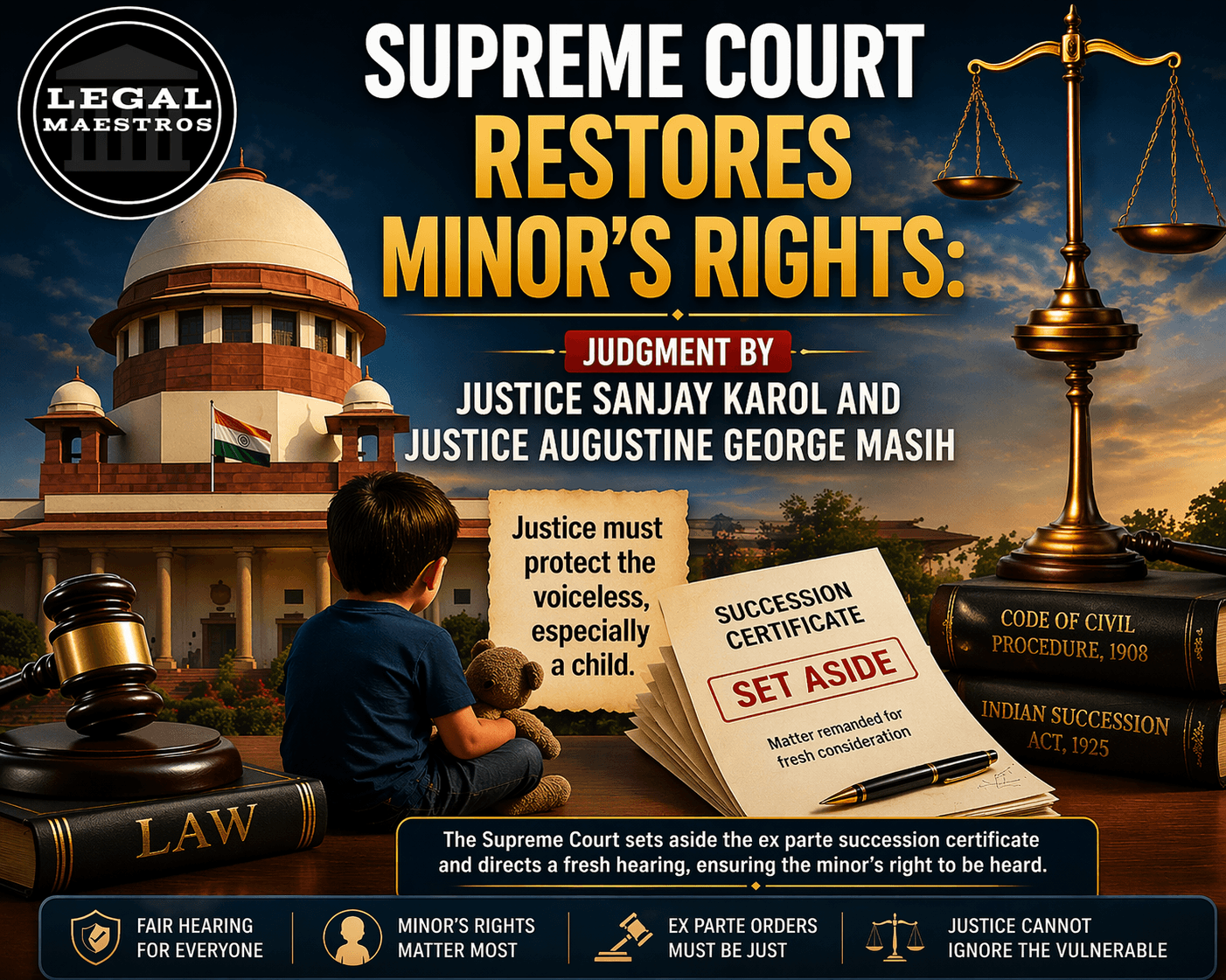
The Supreme Court of India made significant ruling in defense of the rights of a minor in a minor succession case. The situation of Deepesh Maheswari and Anr. v. Renu Maheswari and Ors. (2026 INSC 306) points to the fact that the courts have to be fair and particularly in cases where the minor is concerned.
Justice Sanjay Karol and Justice Augustine George Masih gave the judgment.
The specifics of the case are as follows.
The conflict started due to the death of Mr. Omprakash Maheshwari. His daughters submitted a petition under section 372 of the Indian Succession Act, 1925 to receive a succession certificate of his retiral benefits.
The succession certificate was awarded to them by the court.
Need Help With Your PhD or LLM Thesis?
Explore our thesis and dissertation writing support services for PhD and LLM students. Get subject-specific academic assistance for your research project.
Explore Our Services →But this order was subsequently appealed by another claimant, who was a minor child. They claimed that they too were legal heirs yet the process was not done to them appropriately.
In order to appeal against the previous order, they applied under the Order IX Rule XIII of the Code of Civil Procedure, 1908 to set aside the ex parte order.
Lower Courts Decisions.
The Trial Court denied the application saying that the party had already been heard in an appeal and could not appeal the order a second time.
Appellate Court concurred and ruled that appropriate notice had been provided and no valid excuse of absence presented.
The High Court too struck out the case noting that the applicants had not been prejudiced by the case and that they were not even necessary to the case.
<|human|>Underlying Case Before the Supreme Court.
The central issue before the Supreme Court was whether ex parte succession certificate ought to be put aside particularly whereby one of the parties that were affected was a minor who was not properly represented.
The legal rights of a minor in court proceedings are as follows:
The Supreme Court was keen on investigating the facts and discovered that one of the appellants was a minor during the initiation of succession proceedings.
The Court determined that a minor is not supposed to know what legal notices are or make actions to defend oneself.
It was also observed that the respondents knew of the existence of the minor but failed to act in order to place a guardian to represent the minor in court.
This was viewed as a critical weakness in the proceedings.
A weakness of the Succession Proceedings is indicated by the presence of defects in the Succession Proceedings.
The Court also discovered that there were several irregularities in the earlier proceedings.
The nature of the case was not clearly laid out in the notice that was issued to the public.
Misleading information was also present in the application such as description of relationships being wrong.
The minor was not brought to the proceedings, and this denied them a chance of arguing out their claim.
These flaws rendered the whole process unjust and unlawful.
Categorization of activities and transactions.<|human|>### Rule XIII Scope of Order IX CPC
The Court clarified that Order IX Rule XIII CPC permits a party to overturn an ex parte decree when there was no due service of notice or when there was substantial reason as to why one failed to appear.
The Court in this instance believed that being a minor was a valid and adequate reason in itself.
The Court also made it clear that an appeal could not bar a party to seek relief under Order IX Rule XIII since the two remedies are not the same.
Supreme Court’s Observations
The Supreme Court condemned the arguments of the lower courts.
It was believed that it is entirely unreasonable to demand a minor to act out of a public notice or initiate legal proceedings by himself.
The Court also said that the High Court findings were defective in law and failed to take into consideration facts that were significant.
The omission of the minor in the process resulted in severe bias and defied the natural justice principles.
The Supreme Court of the United States of America released a final ruling.
The Supreme Court allowed the appeal and set aside all the previous orders.
It also quashed the ex parte succession certificate.
The case was returned to the qualified court to be reconsidered again.
The Court instructed that the parties ought to be accorded a fair chance to argue their case.
It also directed the lower court to finish the proceedings in a year.
Conclusion
The rule of fair and inclusive justice is strengthened by this judgment, particularly when it comes to minors.
The Supreme Court clarified the fact that vulnerable parties cannot be overridden by legal procedures.
The Court overturned the previous order and reinstated the case because it would guarantee that the rights of the minor are not violated.
Keywords
Justice Sanjay Karol, Justice Augustine George Masih, succession certificate, minor rights, Order 9 Rule 13 CPC, Indian Succession Act, ex parte decree, natural justice, civil procedure, inheritance law.