Introduction
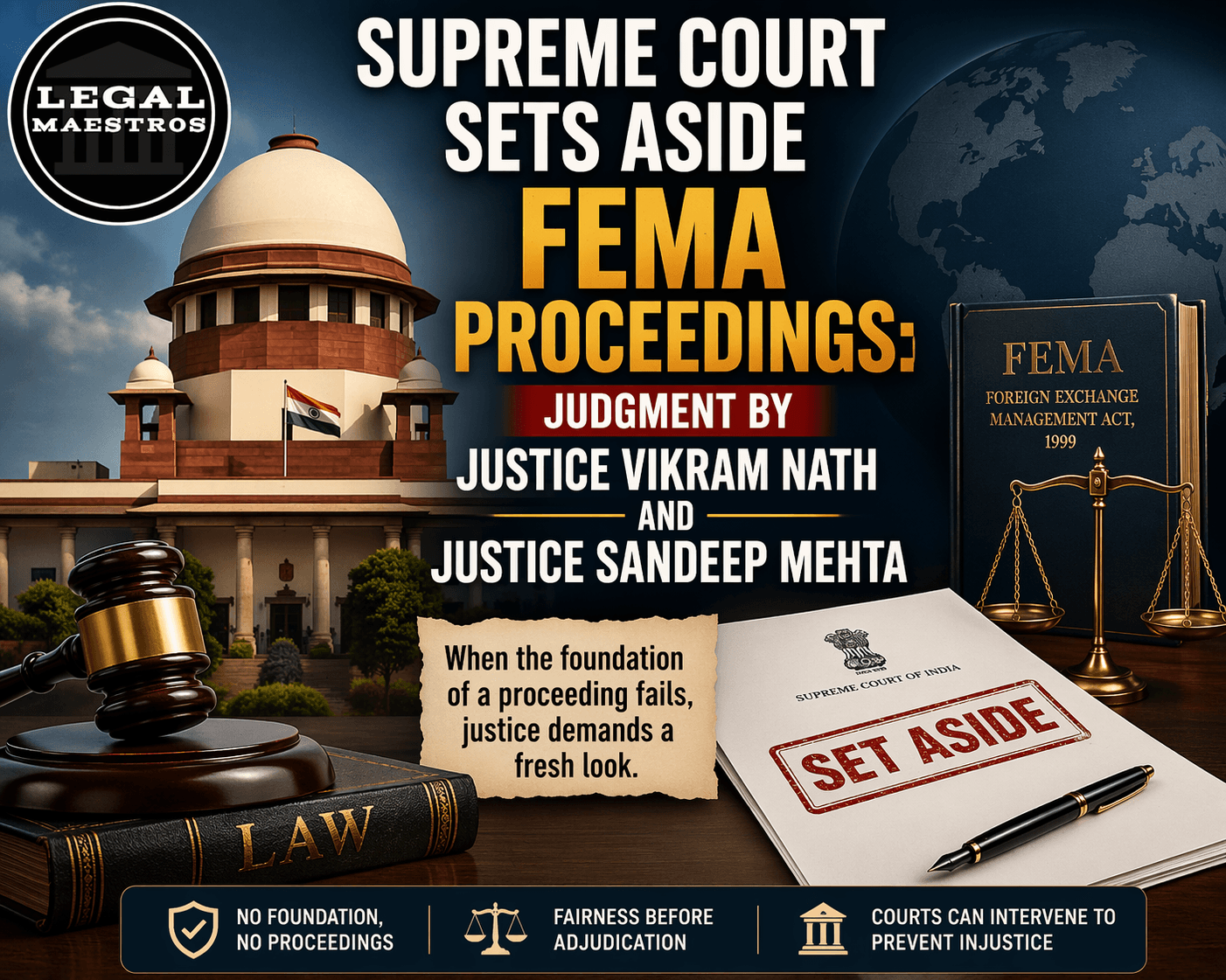
In a significant ruling, the Supreme Court of India ruled in J. Sri Nisha v. Special Director, Directorate of Enforcement and Ors. (2026 INSC 309). The case is about whether a show cause notice issued under the Foreign Exchange Management Act, 1999 is legal or otherwise and whether proceedings may proceed once they are weakened in foundation.
This was decided by the Justices Vikram Nath and Sandeep Mehta.
The case background will explain the background of the case.
The case was as a result of the action that was taken against a company, M/s. Accord Distilleries and Breweries Pvt. Ltd., and directors.
The government accused the appellants of having purchased shares in a foreign firm, M/s. Silver Park International Pte. Without the consent of the reserve bank of India, Ltd. These shares were later given out to the family members without proper approval.
Need Help With Your PhD or LLM Thesis?
Explore our thesis and dissertation writing support services for PhD and LLM students. Get subject-specific academic assistance for your research project.
Explore Our Services →According to such claims, the action was taken in the context of FEMA. In Section 37A of the Act, the authorities also confiscated properties of the appellants.
Order of the Competent Authority.
The Competent Authority looked at the seizure and discovered that there was no evidence that the appellants had indeed paid the shares or owned any valuable foreign securities.
It concluded that there was no violation of FEMA and refused to confirm the seizure of assets. This was an important discovery as it implied that even the minimum condition was not met that of reason to believe.
This order was, however, appealed to the Appellate Tribunal by the Enforcement Directorate where the appeal was awaiting completion.
The issuance of Show Cause Notice.
Irrespective of the above discovery, a show cause notice was given pursuant to Section 16 of FEMA claiming the violations.
The appellants appealed against this notice to the High Court on the ground that when Competent Authority had ruled that no violation was committed, the very foundation of the show cause notice was lost.
But the Single Judge and Division Bench of Madras High Court did not interfere and left the proceedings to proceed.
The Appellants argued as follows:
The appellants put forward that the show cause notice was not legally based since the Competent Authority had already dismissed the warning of infraction.
They also argued that the High Court made a mistake when it rejected their petition and that proceeding with the case without sufficient ground would be inappropriate.
The other significant objection was that it was unwise to proceed with the case before the Appellate tribunal awaited the result of the appeal that was pending.
The Respondents argued as follows:
The Enforcement Directorate submitted that there is a distinction between seizure proceedings and adjudication proceedings.
They asserted that the Adjudicating Authority could issue the show cause notice by itself even in circumstances where the seizure has not been verified.
Another argument they made was that the courts should not intervene at the show cause notice level.
Supreme Court’s Analysis
Section 37A of FEMA was reviewed keenly by the Supreme Court.
It provided that the seizure made under this provision is purely a proactive measure and premised on a reason to believe that there has been a violation.
The Competent Authority denied the confirmation of the seizure and this was a clear indication that there was no material even at a preliminary level.
This implied that the fundamental principle on which subsequent actions could be taken was feeble.
The Court pointed out that the ruling of Competent Authority was not a mere formality but an assessment of evidence.
The stage of show cause notice is an aspect of interference.
The Court explained that in most cases, the stage of show cause notice is not interfered by the Court.
Nonetheless, it is not a universal rule.
In case the notice is issued in the absence of the jurisdiction, lacks foundation or causes the injustice, the courts may interfere.
In the present case, the Court declared that the case was extraordinary since the nature of the notice was questionable.
Incorrect ruling by the High Court.
The Supreme Court was able to determine that the High Court erred when it considered the seizure proceedings irrelevant to adjudication.
Another thing that the High Court did not take into consideration was that the seizure was yet to be confirmed.
In addition, the Adjudging Authority used the observations of the High Court and did not consider the results of the Competent Authority.
This was deemed unseemly and in the case where an appeal against the order of Competent Authority was still pending.
The Supreme Court ruled that the petitioner was not guilty of any crime.
The Supreme Court quashed the decisions of the High Court and the ultimate decision made by the Adjudicating Authority.
It believed that the action was to be reverted to the phase of the show cause notice.
The Court instructed the Appellate Authority to initially determine the appeal of the order of the Competent Authority.
Only after that, the proceedings based on the show cause notice should continue.
This will be fair and it will not draw hasty conclusions.
Conclusion
This ruling brings to the fore an important legal rule that proceedings should not go on when they are weak or suspect.
The Supreme Court clarified that although authorities have the powers under FEMA, the powers should be used cautiously and with valid evidence.
Another important implication of the decision is that the court may act at a very young age in the event that proceeding with the case would create injustice.
Keywords
Justice Vikram Nath, Justice Sandeep Mehta, FEMA, show cause notice, Enforcement Directorate, foreign exchange violation, Section 37A, adjudication proceedings, assets seizure, RBI approval, administrative law.