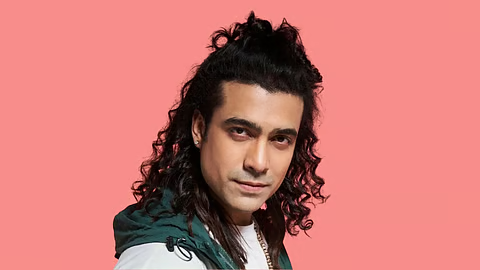
The Delhi High Court recently passed an order to protect the personality rights of popular singer Jubin Nautiyal. The court acted after it was informed that some unknown persons were misusing his name, voice, image, and identity on online platforms without permission. These materials were being used to mislead the public and to gain money or attention by pretending to be connected with the singer. The court recognized that such actions could harm his reputation and career.
What Led to the Court Case
Jubin Nautiyal approached the court claiming that several fake accounts, videos, and digital content were circulating on the internet using his identity. Some of these included manipulated audio, edited visuals, and unauthorized promotional material. The singer stated that he had not approved these uses and that they created confusion among fans. He also argued that such misuse could damage his public image and cause financial loss.
After hearing the matter, the court found that there was a strong need to prevent further misuse. It noted that celebrities are especially vulnerable because their identity has commercial value and public influence.
Court’s Direction to Remove Misleading Content
The Delhi High Court directed online platforms and unknown persons involved to stop using the singer’s name, image, voice, or likeness without authorization. It also ordered the removal of existing infringing content. The court allowed the singer to inform authorities about any new violations so that action could be taken quickly.
This type of order is often called an injunction. It is a legal direction that prevents someone from doing a particular act. In this case, it prevents others from exploiting the singer’s identity for commercial or misleading purposes.
Understanding Personality Rights
Personality rights refer to a person’s right to control how their identity is used. This includes their name, face, voice, signature, and other personal attributes that make them recognizable. These rights are especially important for public figures such as actors, singers, athletes, and influencers because their identity has economic value.
In India, personality rights are not written in a single specific law. Instead, they are protected through a combination of constitutional rights, privacy principles, intellectual property laws, and court decisions. Courts have repeatedly stated that unauthorized commercial use of a person’s identity can violate their right to privacy and dignity.
Importance of Protection in the Digital Age
The court observed that technology has made it easier to create fake or manipulated content, including deepfakes and edited media. Such content can spread quickly on social media and streaming platforms. Once circulated, it can mislead millions of people in a short time.
Because of this risk, courts increasingly grant protection to celebrities to prevent misuse before serious damage occurs. The order in this case aims to stop impersonation, false endorsements, and deceptive promotions using the singer’s identity.
Legal Significance of the Decision
This decision reinforces the growing recognition of personality rights in Indian law. It shows that courts are willing to protect individuals against digital misuse of identity even when the offenders are unknown. It also highlights that online platforms may be required to act promptly when informed about such violations.
The case demonstrates how the law is adapting to new forms of harm created by the internet, artificial intelligence, and digital media manipulation.
Keywords: Delhi High Court, Jubin Nautiyal, personality rights, right to publicity, celebrity rights, misuse of identity, injunction order, fake content, digital impersonation, privacy rights India