A Musical Masterpiece Faces a Legal Challenge
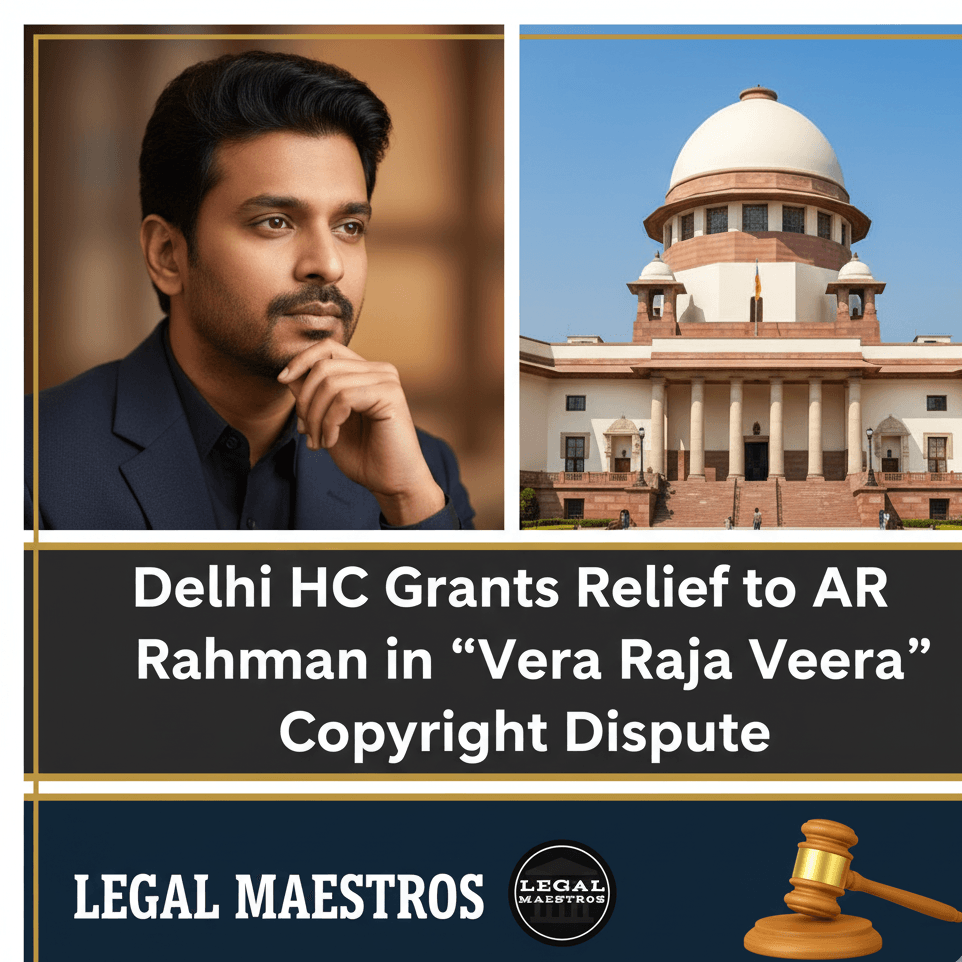
The Delhi High Court has given interim relief to renowned music composer A.R. Rahman in a copyright case about his catchy song, Veera Raja Veera. The song, which was heavily featured in the blockbuster movie Ponniyin Selvan by Mani Ratnam, was the object of a law suit by Association of Right Holders of Music Composers of India. The association claimed that the song was a violation of the copyright of an old composition.
The suit alleged that the song by Rahman was an adaptation of a religious song of the same name, Veera Raja Veera, that was used in the 1950s film Ponniyin Selvan. That composition was attributed to another composer and the association claimed that the new version was infringing their rights. They wanted an injunction to prevent the publication of the song, to be given credit and royalties, and it placed a contemporary blockbuster in a copyright confrontation with a music history object.
This legal battle put one of the most well-known musicians in India in the middle of discussion over creative inspiration and ownership of art. The case captured the interest of a great number of people, setting the creative team behind one of the most successful films against an organization striving to defend the rights of the legacy composers. This intervention of the High Court played an important role in determining whether or not the popular song would be released.
This ruling by the court to grant relief to A.R. Rahman is a major turn in the current case. Although this is not a definite conclusion, it will enable the song to stay on all platforms in the meantime. This indicates that the court, at this initial level, saw some strengths in the line of arguments by the defense side of Rahman, staying the criminal action against the well-known composition.
An Allegation of Copyright Infringement
The principal basis of the suit was the allegation that there was great similarity between the two songs. The Association of Right Holders of Music Composers of India representing the estate of the original composer argued that the melody, form and the entire ambiance of Rahman composition Veera Raja Veera was a direct copy of the 1950s composition. They performed both pieces of music in the presence of the court in order to point out the supposed similarities.
They argued legally that the protection of copyright of a musical work lasts a period of sixty years after the death of the creator, and as such the older song was still under protection. The makers of Ponniyin Selvan had committed copyright infringement by producing a version without permission and without credit. The objective of the association was to gain acknowledgement and monetary restitution to the heirs of the original creators claiming that they were misusing their legacy.
Need Help With Your PhD or LLM Thesis?
Explore our thesis and dissertation writing support services for PhD and LLM students. Get subject-specific academic assistance for your research project.
Explore Our Services →Such lawsuits are frequent with respect to the creative business, where the distinction between inspiration and imitation may be unclear. The association serves to provide a check and balance on composers, so that their compositions are not used without permission. This time, they were protesting on behalf of a smaller known work against a world-renowned artist and a huge film production.
The petitioners wanted an injunction in the form of an immediate stop of a certain activity. They demanded that the song be taken off the streaming service platforms, movie prints, and any other platform where the song was being played. This order could have imposed a tremendous financial and publicity cost on the producers of the film and on A.R. Rahman himself, and the stakes in the first hearing were enormous.
The Defense: Inspiration, Not Imitation
To counter the accusations, the legal team of A.R. Rahman was offering strong defense based on the fact that difference lies in copying a definite song and tapping into a collective cultural and musical heritage. They claimed that the song, Veera Raja Veera is founded on a traditional Carnatic raga. A raga, in Indian classical music, is a melodic structure that is ancient and falls under the public domain, i.e. it cannot be owned by a particular individual.
The defense claimed that the similarity between the two songs was not the result of plagiarism but both of the works were based on the same traditional raga. They argued that hundreds and thousands of songs have been written with the help of this structure throughout centuries and they are all regarded as original. They said that Rahman, himself had composed his own version and orchestration of this traditional musical scale, which was the piece called they.
This argument re-packages the problem, which is the theft, as legitimate artistic practice. Ragas have served to form the basis of new works by composers ever since time immemorial, and this is where his team placed Rahman. They claimed that his composition was a novel art piece, which honored a long history of music, as opposed to a duplicate of an existing song.
Moreover, they also probably have emphasized the variations in the orchestration, vocal performance, and the contemporary production that make the new song and the old one different. Focusing on these peculiarities, the defense tried to demonstrate that Veera Raja Veera by Rahman is the work of transformation, not mere imitation. This defense contradicted the basis of the infringement claim by the association.
Delhi High Court Grants Interim Relief
The Delhi High Court made a monumental decision after listening to the arguments which were brought forth by the two parties. The court decided against the injunction demanded by the Association of Right Holders of Music Composers. Such refusal to grant the injunction is the interim relief awarded to A.R. Rahman and the producers of the film. It was a turning point in the legal action.
According to the court ruling, the song will still be present in the soundtrack of the movie and will be accessible on any streaming and broadcasting platform at the moment. The court also suggested that the plaintiff did not have a strong case to justify such a drastic and immediate action by refusing to order the removal of it. This gives the status quo the chance to be preserved as litigation of the case continues.