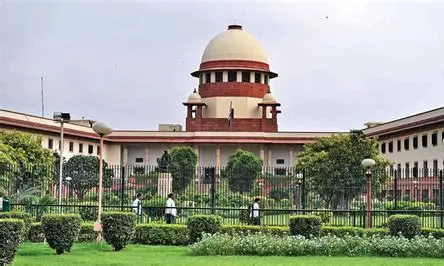
Supreme Court

No Stay on Convictions for Corrupt Public Servants, Says Supreme Court

In this article, the author focuses on the decision of the Supreme Court in a Special Leave Petition where conviction of a public servant was not stayed under Prevention of Corruption Act. It explores the reasoning of the Court in opposing convictions that are stayed with respect to cases in which the charges against a public servant relate to corruption, strengthening the rule of the courts and citing the principles that apply of accountability and good citizenship in public service. It discusses the actual background, the legal provisions at stake, and the underlying facts brought to request by the Court.

Supreme Court

God Knows How Many Languish in Jails Over Technicalities: Supreme Court Rebukes UP, Directs ₹5 Lakh Payout

This article is an abstract of a Supreme Court case based on which the liberty of an individual had to be delayed due to a minor technicality in a release order. It reviews the vigorous reproach of such developments expressed in the judgment of the Aglo/Buhari case: the principle of substance over form in the judicial order, and strong consequences for the protection of the fundamental rights. The case stresses the importance of the judiciary in aspects of timely execution of orders of release and responsibility for negligence of duty.

Current Legal Update

Pankaj Bansal Verdict: Karnataka Contends ED’s Obligation to Supply Written Arrest Reasons Applies Only Prospectively in Supreme Court

The Supreme Court is hearing an important legal issue which is pressed out because of the arrest of Pankaj Bansal by the Enforcement Directorate (ED). Karnataka states that the ED is only liable to give reasons for its arrest in written form prospectively as held by the Supreme Court in Pankaj Bansal v. Military of India. This might influence many current probes that are going on under the Prevention of Money Laundering Act (PMLA).

Supreme Court

The Supreme Court’s Stance on Tender Cancellation: Insights from Justices Trivedi and Varale

This paper will analyse a ruling of the Supreme Court that was given against a ruling of the High Court in a case that concerned cancellation of a government tender. It notes how the Court has attached importance to issues of public interest, administrative discretion and little judicial review in contractual circumstances, particularly in the event of the unavailability of mala fides.

Current Legal Update

3-Year Mandatory Practice Challenged in a Review Petition.

Advocate Chandra Sen Yadav has filed a review petition in the Supreme Court challenging its May 20 judgment reinstating a mandatory three-year legal practice requirement for civil judge (junior division) exams. The petition argues this rule violates Articles 14 (equality) and 16 (equal opportunity in public employment) of the Indian Constitution, disproportionately excluding recent graduates who prepared under prior eligibility criteria.