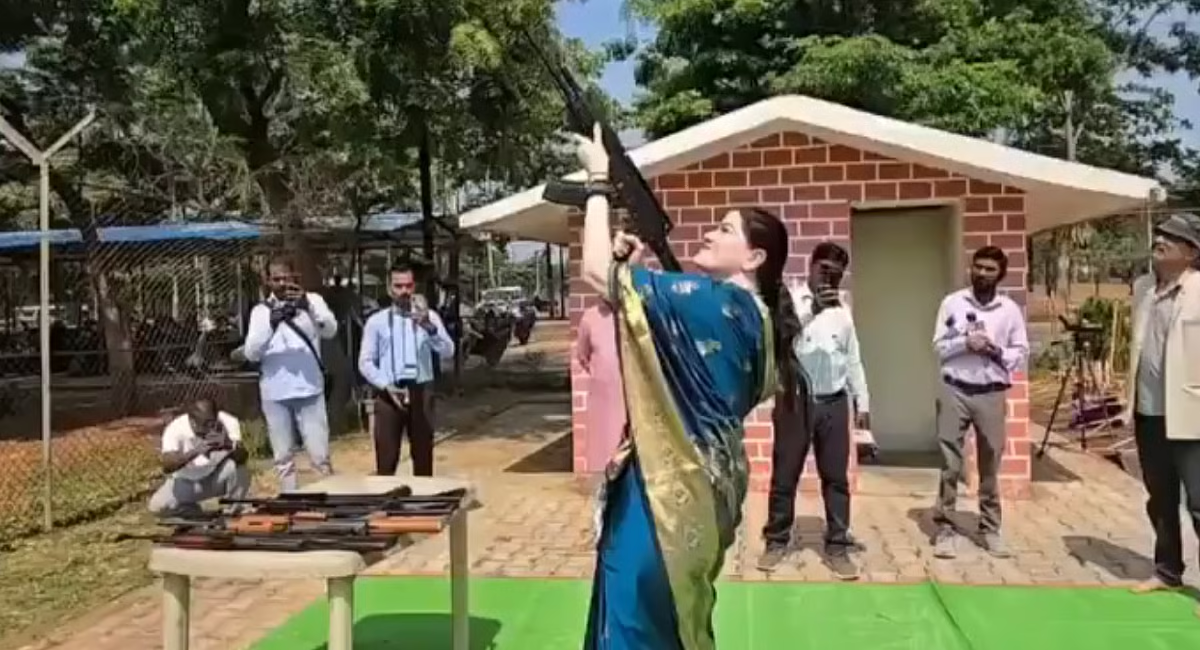
A video of a Chhattisgarh IPS officer Ankita Sharma firing an AK-47 rifle during Dussehra celebration has put the spotlight on the conduct of police personnel, handling of firearms and the permissible extent of religious/cultural expression.
The incident occurred on October 20, 2026, during the Shastra Puja function at Police Lines, Rajnandgaon district. Interestingly, at the event, SSP Sharma was visible shooting few rounds in the air with an AK-47 rifle.
The video went viral on social media, with some commenters defending the cop and explaining the shooting as a ‘ritual’. Others questioned if an active police officer should fire a gun that is being used for religious or ritualistic reasons.
In the wake of the controversy, the Chhattisgarh Police Headquarters issued a show-cause notice to Sharma asking for an explanation as to how the incident occurred and on the breach of weapon-handling norms.
But some legal questions are raised. Is it enough for a religious or cultural practice to justify discharging an official firearm, or must police officers adhere to firearms laws no matter the situation?
What Happened During the Shastra Puja Ceremony?
Shastra Puja. This convention is followed in many regions of the country and by some police or army forces on Vijayadashami.
Need Help With Your PhD or LLM Thesis?
Explore our thesis and dissertation writing support services for PhD and LLM students. Get subject-specific academic assistance for your research project.
Explore Our Services →As reported by PTI, during the function at Rajnandgaon Police Lines, police guns and vehicles were worshiped on the occasion of Dussehra festival.
The video, shot in the viral, showed a woman in a blue saree, Ankita Sharma, shooting a few rounds in the air with an AK 47.
A third clip purportedly shows Rajnandgaon Additional Superintendent of Police Kirtan Rathore firing an AK-47 after Sharma.
These types of videos of police personnel firing guns at Shastra Puja from other districts of Chhattisgarh, such as Raipur, Bilaspur, Raigarh, Durg, Kabirdham and Bastar, also surfaced.
After police and military veterans raised concerns about the safety of the firing and if the firing followed all procedures for handling guns, the incident drew criticism.
Why Did Chhattisgarh Police Issue a Show-Cause Notice?
Chhattisgarh Police Headquarters sent note to Ankita Sharma for clarification.
Rajnandgaon Range IG Ajay Yadav said an explanation had been called from the police officer. He said her reply would be studied and she would be sent to her higher-ups with his comments.
The police headquarters was reportedly worried about the alleged “lack of awareness” of the duty of weapons handling and the shame the video brought on the force.
It is said that Sharma was asked to explain the firing within three days of the notice.
A show-cause notice does not amount to a charge or finding of guilt. It is merely an initial administrative procedure to let her show cause before the competent authority.
Information is available on this final discipline against Sharma has not been reported as of 24 October 2026.
Firing of Gun During Religious Worship?
(iv) Right to freedom of conscience and free profession, practice and propagation of religion: Article 25 of the Constitution of India.
This is however qualified by express. (a) that it is subject to public order, morality, health and other provisions of Part III of the Constitution.
So Religious Freedom does not mean you can freely do whatever you want with other people to endanger public safety.
One may partake in a religious rite, so long as the manner of their participation is in accord with all applicable laws and lawful safety regulations.
Worshiping a weapon in a ceremonial setting, and firing ammunition from the weapon, are two legal distinctions.
One could be considered a religious or cultural practice. The other is a situation where a potentially dangerous firearm is being used and could be regulated due to the danger inherent to its use.
In Acharya Jagadishwarananda Avadhuta v. Commissioner of Police, Calcutta (1983), the court considered the extent to which religious practice can be regulated in public. This was a case where a religious act was not so protected that it was immune to every regulation.
The constitutional question in the case is not whether Shastra Puja can be performed or not. The question is whether firing an official gun at the time was an authorized act, and was carried out in terms of the safety requirements.
What Does the Arms Act, 1959 Say About Celebratory Firing?
The provision related to the dangerous or unlawful carrying or possession of firearms in the Arms Act, 1959.
25(9)proscribes firing a gun in a negligent, rash or celebratory way that risk human life or safety of others, this subsection was inserted by the Arms (Amendment) Act, 2019.
The punishment this section lays down is a term of imprisonment which may extend to two years, or with a fine which may extend to₹1 lakh, or with both.
The law defines celebratory gunfire as shooting off your firearm into a gathering, a religious function, a bridal or other social event.
Nevertheless, Section 25(9) may be used depending on the nature of the fact situation and if the s.25(9) requisites are present.
The absence of evidence that a gun was fired in the course of a religious processional does not, of itself, amount to an offence under this provision.
They would consider where, type of ammunition, the way it was fired, it if others were present and if anybody was at risk.
Another aspect that could be considered to be irrelevant is that the weapon was an official police firearm.
There has been no reported conviction of any criminal offence or final finding of guilt under the Arms Act in regard to Sharma.
Police Officers Cant Use Their Standard Guns for Personal or Ceremonial Reasons
Police officers carry firearms on duty to perform their function, to keep the peace and to respond to situations when the lawful use of force may be required.
Having an weapon does not naturally lead to the right to use it for whatever aim.
Each police department has regulations and orders about the use, custody, handling and release of service weapons. Such regulations might specify where a weapon may be fired, by whom, and under what conditions safety rules apply.
Official drills and sanctioned ceremonial events may be subject to departmental guidelines.
One does not get a free pass on all of these requirement given the previous status as a police officer.
In the case of an authorised ceremonial shot, with due consideration to the relevant rules, the legal analysis would be different to one in which there was an unauthorised discharge of ammunition.
As for Sharma, the departmental inquiry must find out whether the firing was a part of an approved ceremony, ammunition was allowed and the precautionary measures were adopted.
A local tradition can never automatically justify tolerance.
Does Firing Blank Ammunition Make the Practice Legal?
One of the questions raised post-video was regarding the kinds of ammunition used for the ceremony.
An IPS officer, who did not wish to be named while talking to the media, said blanks are employed locally known as awazi kartoos during Shastra Puja, a customary ritual performed in areas of Chhattisgarh.
An ordinary projectile is not discharged in the same way as a live round in these types of firearms to produce the sound and effect of a gun shot.
Nevertheless, the use of blank ammunition is not entirely safe. Blank ammunition can still harm people at close range and safety measures should be adopted.
Additionally, the firing of blank cartridges does not, by itself, prove that firing was authorised by departmental procedures.