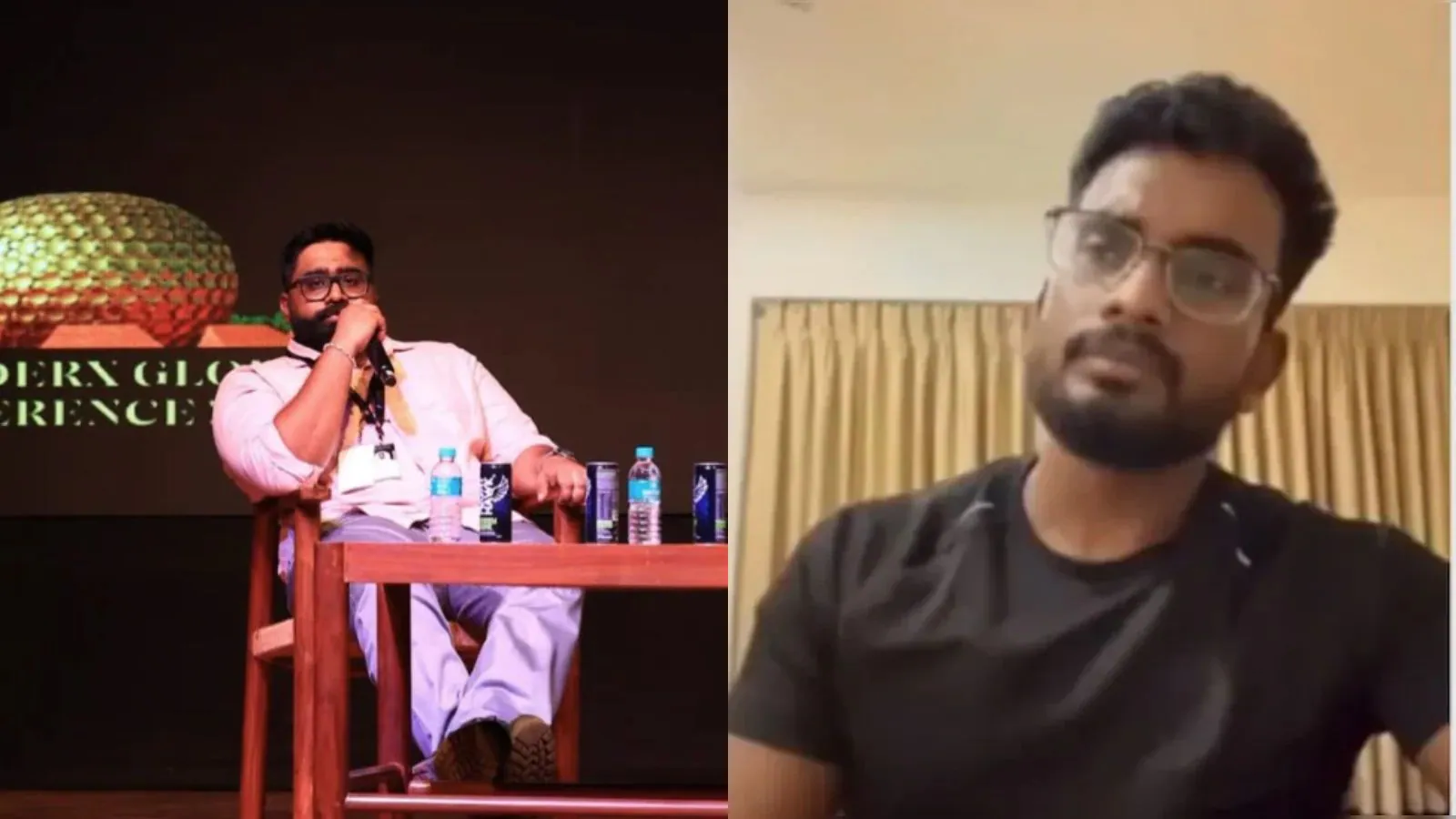
Finance Influencer Harish’s Death Sparks Criminal Investigation
What we know so far about the death of 27-year-old financial content creator V Harish in a Chennai suburb has thrown the spotlight on the role of online abuse, public labels and criminal culpability in the country. Jason Samuel Vijayakumar, another popular You Tuber, has been held in custody.
Harish, who ran the social media account Finance with Harish which amassed more than one million followers was known for sharing finance and investment news.
His body was recovered at a rented place in Kanathur area, a suburb near Chennai, in 2026. Police had started looking into the death after his father claimed that the victim had been subjected to harassment and threatening calls over the internet for a prolonged period.
Jason Samuel Vijayakumar, a 30-year-old You Tuber and tech entrepreneur was arrested by Tambaram City Police for abetment of suicide under Section 108 of the Bharatiya Nyaya Sanhita, 2023.
Samuel refutes the claim. He claims that the videos were meant to challenge the authenticity of Harish’s financial authority and not harassment.
This case highlights an issue of law. At what point does criticism or troll harassment online reach the level of abetment of suicide, which is a criminal offence, and what must the prosecution prove to sustain a conviction?
Need Help With Your PhD or LLM Thesis?
Explore our thesis and dissertation writing support services for PhD and LLM students. Get subject-specific academic assistance for your research project.
Explore Our Services →What were the accusations against Jason Samuel?
The complaint by Harish’s father, J Vinayagam, alleged that Samuel had posted videos asking if Harish was a legally qualified person to give financial advice.
According to the report, the dispute was over Harish’s registration with the Securities and Exchange Board of India (SEBI), and his association with the Association of Mutual Funds in India (AMFI), he told.
Harish’s father claimed Samuel’s internet posts were also part of a campaign of harassment, threats and libel.
Police claimed that Samuel had taken advantage of Harish by asking for money and also had uploaded derogatory videos which further added to the suffering of Harish.
However the police statement did not reveal if they had obtained witness statements or documentary evidence prior to the arrest, and did not reveal the nature of the purported demand for money or detail of all evidence against the accused.
Samuel said he did not ask for money, nor did he bully. He said he merely questioned whether he was engaging in an unlawful financial activity.
These are conflicting claims that are still being investigated and will be tested in court. Samuel’s detention does not mean Samuel committed the offence.
What Is Section 108 of the Bharatiya Nyaya Sanhita, 2023?
Abetment of suicide The offence of abetment of suicide has been dealt with under this section of the Bharatiya Nyaya Sanhita, 2023. This offence was previously present in section 306 of the Indian Penal Code, 1860.
Section 108 defines that if a person is found guilty of aiding suicide, he shall be punishable with imprisonment for ten years and shall also be liable to a fine.
But murder does not automatically follow if a person subjected to negative criticism, disagreement, or harassment is dead.
The prosecution will need to prove the accused did acts towards abetment and that these acts had the requisite legal connection with the act of suicide.
Section 45 of the BNS. It says that abetment is when a person instigates someone else to do that act, or when they are a member of a conspiracy with the required act or illegal omission, or intentionally aids the commission of the act.
Thus, section 108 has to be read along with the section 45.
Prosecutors in an online harassment case need to find evidence that the defendant encouraged or encouraged the suicidal act, not just that the defendant created a piece of content that offended, or embarrassed, the deceased.
Can Online Trolling and Cyberbullying Amount to Abetment of Suicide?
Online trolling, repeated humiliation, threatening posts and coordinated harassment can all lead to victims suffering serious harm. The problem is, not every case of cyberbullying will meet the requirements of Section 108.
The difference lies in the nature of the act, the accused’s mental state and the link between the alleged harassment and the suicide.
For instance, a repeat pattern of threats that seem intended to isolate a person, along with evidence that the threats were intentionally instigated, could give rise to different legal issues than one pivotal social media post.
In order to establish a charge of incitement to commit suicide, the courts will consider whether the conduct is of an abusive nature and continues for some time, whether the conduct was intended to drive the deceased to the act of suicide and whether there is a sufficiently proximate link between the conduct and the act.
The offence must be established to the satisfaction of the court at trial.
While evidence of a person experiencing mental anguish because of receiving negative comments is relevant to the allegations, it is not evidence of every element of abetment.
Investigators are looking into harassment, public abuse, blocking of an account and the details of his last communication in the case of Harish.
What Has the Supreme Court Said About Abetment of Suicide?
The Court has clarified multiple times that an offence of abettor of suicide is not constituted on proof of a disagreeable relationship or offensive act.
In M. Mohan v. State (2011), the Court pointed out the requirement of positive instigation or aiding and abetting and nexus with the act of suicide.
In Gurcharan Singh v. State of Punjab (2016), the Supreme Court noted the life link that must be established between the conduct of the accused and the act of suicide. The Court also observed that no criminal liability could be fastened on remote circumstances or on friendship.
In the latter case, for instance, R. Shashirekha v. State of Karnataka (2025), the Court observed that in prior Section 306 of the IPC cases, a proximate and positive act of instigation was necessary to buttress the charge.
The relevance of these principles for construing the new Section 108 of the BNS appears to be even more apparent where the new provision is almost identical to the earlier offence.
The courts cannot isolate one other than evidence. A person’s or person’s distress; whenever accused of another person and particular time may be relevant but not necessarily amounts to positive evidence of intentional abetment.
Can Publicly Questioning a Finance Influencer’s Credentials Be a Crime?
Harish’s case also explores the line between rightful reproach and illegal harassment.
Financial influencers that share information about investments might be regulated depending on what actions they are taking.
Exempt under SEBI regulatory on business registration and provide regulated investment advice.
Publishers, other content creators and journalists have an overall right to make legitimate inquiries about whether a person is following financial rules.
Article 19(1)(a) of the Constitution. This includes criticism of professional conduct and any other subject of public interest.
Nevertheless, freedom of expression does not extend to threats, extortion, denigrations or other unlawful actions carried out independently.
So the key question is not necessarily whether Samuel, in fact, was critical of Harish’s credibility on the financial side.
Does what he did constitute reasonable criticism or is there enough other behavior to add up to criminality?
An accusation of regulatory misconduct does not imply that harassment is justified. Conversely, even if criticism damages reputation, it does not mean the criticism is criminal.
Does a Video Recorded Before Death Prove Abetment?
Harish’s father allegedly told police that the boy took a video before he died, in which he accused Samuel of the situations he was dealing with.
This could be used as evidence in the investigation.