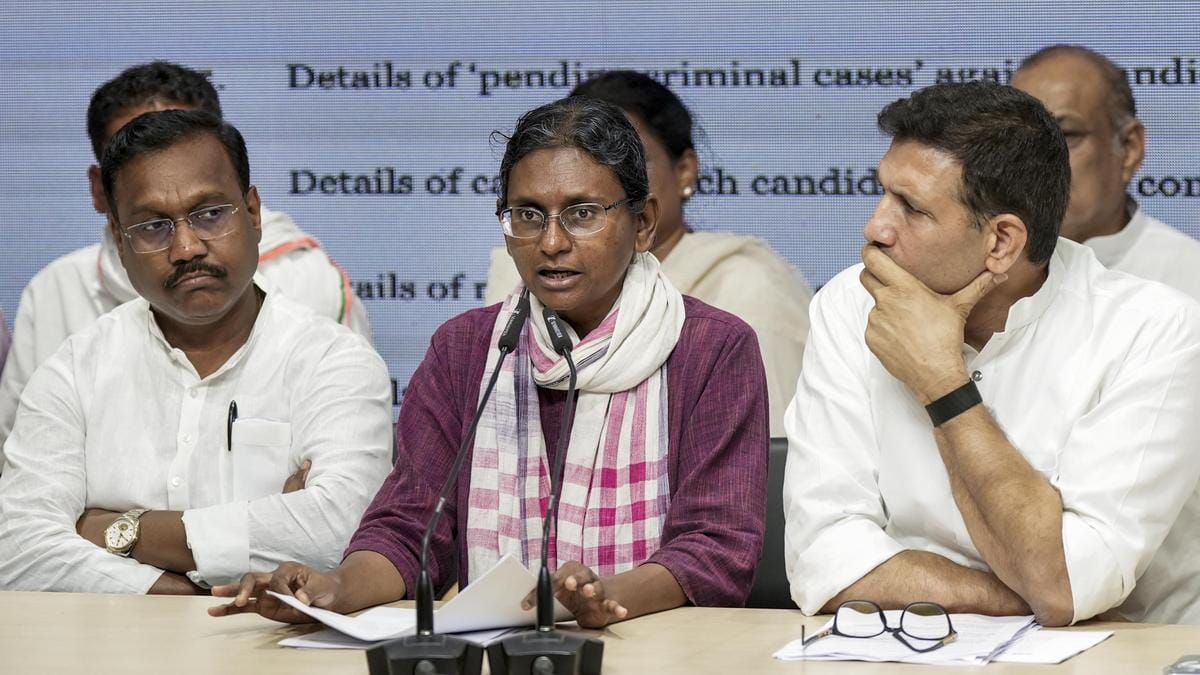
The Supreme Court of India delivered a stern blow on Friday, dismissing the petition of Congress leader Meenakshi Natarajan, who was seeking to challenge the sudden cancellation of her Rajya Sabha nomination papers for Madhya Pradesh. The move effectively ended her chances of entering the upper house in the short term.
Sitting for a partial working day, Justices Prashant Kumar Mishra and A.S. Chandurkar refused to hear her plea on strictly constitutional grounds. They upheld the long-standing principle that courts cannot interfere in the election process once it has commenced. Citing Article 329(b) of the Constitution, they stated that any dispute or irregularity concerning the election has to be resolved through a formal election petition filed only after the election process is complete
The Genesis of the Controversy
The tumultuous events began a few days earlier in Bhopal when the Returning Officer formally rejected Natarajan’s nomination on June 9.
The Bharatiya Janata Party (BJP) had pointed out a serious flaw during the scrutiny of her papers. Mahesh Kewat, another BJP candidate also contesting for a Rajya Sabha seat, filed a direct written complaint against Natarajan, accusing her of deliberately concealing a pending criminal case from Telangana. Candidates are required to file Form 26, an election affidavit, listing their assets, liabilities, and criminal records. The BJP alleged that Natarajan had failed to disclose a significant detail of a court case in Hyderabad
Need Help With Your PhD or LLM Thesis?
Explore our thesis and dissertation writing support services for PhD and LLM students. Get subject-specific academic assistance for your research project.
Explore Our Services →The Returning Officer, after reviewing the documents, observed that summons had been issued to her by the court and that she had filed a written statement, indicating her awareness of the proceedings. He declared her affidavit incomplete and thus her nomination invalid.
The Telangana Notice: A Non-Case?
The Congress camp was livid, terming the entire incident a deliberate political witch-hunt or a colossal misunderstanding. They maintained that the so-called criminal case was not a registered crime but rather a civil matter
According to them, a former Congress worker in Telangana had filed a private complaint alleging harassment by another party worker. Natarajan was the then All India Congress Committee (AICC) in-charge for Telangana, and the complainant stated she had brought the matter to Natarajan’s attention, but to no avail. Consequently, a magistrate court in Hyderabad issued a routine notice to Natarajan in 2025 under Section 223 of the Bharatiya Nagarik Suraksha Sanhita, for preliminary inquiry.
The Congress argued that it was simply a summons for a preliminary investigation and no actual crime or first information report (FIR) had been registered against Natarajan. They stated that the court had not taken cognisance of any crime and no charges had been framed against her. Furthermore, Section 33A of the Representation of the People Act clearly states that a candidate is required to disclose a pending criminal case only if they are facing charges for a crime punishable by imprisonment for two years or more, and only if the charges have been framed by a competent court
The Courtroom Debate
Senior advocate Abhishek Manu Singhvi, representing Natarajan, strenuously argued in the Supreme Court that the Returning Officer’s decision was a glaring illegality and an interference in the level playing field for elections. He sought a rare exception to rectify the “manifest injustice” to a deserving candidate.
On the other hand, senior advocate Mukul Rohatgi for the BJP candidate and Solicitor General Tushar Mehta for the Madhya Pradesh government argued that post-2018, candidates are obligated to disclose all pending cases, even if charges have not been framed.
The judges remained unmoved. They held that making exceptions for apparent mistakes would lead to courts constantly having to arbitrate which cases deserve immediate attention and which can wait for an election petition, a task not sanctioned by the Constitution. When asked if he could cite even a single precedent of the Supreme Court intervening in a rejected nomination during an ongoing election process, Singhvi failed to provide one. This principle, they noted, has been firmly established since a landmark six-judge bench ruling in 1952: no writs after the polls.
Political Implications in Madhya Pradesh
The incident sent shockwaves through Madhya Pradesh’s political landscape. Voting for the three Rajya Sabha seats was scheduled for June 18.
With 164 MLAs in the 230-member state assembly, the BJP was set to win two seats comfortably and still have a surplus of 48 votes. The Congress, with 63 MLAs (two were ineligible to vote, reducing their effective strength to 61), was vying for the third seat, a contest that was expected to be extremely close. Cross-voting was a significant concern, and the Congress had even arranged for a special flight to ferry its MLAs to Karnataka to prevent any defections by the BJP. However, Natarajan’s nomination rejection altered the dynamics entirely, and the special flight was cancelled as the main opposition candidate was effectively out of the race before voting even began, tipping the scales in favour of the BJP.
Reactions from the Sidelines
The ramifications of the Supreme Court’s decision extended beyond Madhya Pradesh. Congress leaders Jairam Ramesh and Sachin Pilot rushed to the Election Commission in Delhi to protest the rejection, but to no avail. They voiced their discontent to the media, arguing that a nomination had been unfairly cancelled.
Meanwhile, political rivals took jabs at the Congress. Bharat Rashtra Samithi (BRS) leader K.T. Rama Rao publicly blamed internal factionalism within the Telangana Congress, suggesting that someone had leaked the details of the Hyderabad court notice to the BJP. He acknowledged that the Election Commission had acted incorrectly in rejecting Natarajan’s papers, but insisted that the underlying issue stemmed from a betrayal within her own party.
The Supreme Court’s verdict was clear that it was not commenting on the merits of Natarajan’s case regarding the election affidavit but rather on its lack of jurisdiction. The door for Natarajan remains open, however; she can still pursue her case by filing a regular election petition in the High Court now that the electoral process is complete.
Supreme Court Rejects Meenakshi Natarajan Plea In Rajya Sabha Nomination Case
This news broadcast outlines the Supreme Court’s dismissal of Meenakshi Natarajan’s petition regarding the cancellation of her Rajya Sabha nomination.