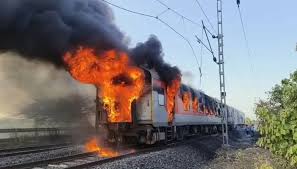
It occurred before the sun had risen. The Thiruvananthapuram-Hazrat Nizamuddin Rajdhani Express was on its way through Ratlam district at around 5.15 am this Sunday. A problem occurred in the B-1 AC coach. Heavy smoke was seen coming out from near the seating area and luggage area by the train guard
He quickly went onto the air. The loco pilot applied the brakes somewhere between the stations Luni Richha and Vikramgarh Alot. This is under the Kota railway division. That particular coach, 68 people woke up, choking on fumes, and absolute panics.
However, there was actually no disaster. The railway personnel and the local protection force evacuated everyone onto the railway in just about 15 minutes. Nobody died. No one suffered serious burns. The local commercial manager, Sourbah Jain, confirmed that the overhead electrical supply was turned off at the time of the incident so as the fire will not spread to other cars. They detached the burning part of the B-1 and abandoned it. After some hours the train was only able to crawl ahead with the diesel engine.
The Bizarre Secondary Crash
Need Help With Your PhD or LLM Thesis?
Explore our thesis and dissertation writing support services for PhD and LLM students. Get subject-specific academic assistance for your research project.
Explore Our Services →The passengers stayed safely by the tracks, while another drama was unfolding on a nearby road. A railway maintenance crew received the distress call and put their heavy equipment in a van. They hurried to the scene to repair the power lines and assist with securing the area.
Then an old cow strayed into the gloomy road, in the vicinity of Alot.
The driver veered off the road. The van capsized all the way. Five railway workers, who were in a hurry to assist the man with the fire in their train, are in need of rescue themselves. One of them is now in a hospital in critical condition. It only compounds the weirdness and chaos of the morning. A big piece of railway equipment was attempting to react to a fault in the track, and a wandering animal had its real-life mishandling on the day.
Would You Rather Sue the Railway Minister?
People are always at the top when a train catches fire, jumps the tracks. Ashwini Vaishnaw has been the Minister of Railways for some time now. He bears the brunt of all politics on TV and social media. However, there is a huge disconnect between popular sentiment and legal accountability.
If a passenger wanted to file a case against Vaishnaw for the Ratlam fire, the case will get rejected on the first day of court.
Indian law just doesn’t work that way. The Railways Act, 1989, gives the Union Government the powers to own and run the train network. The Ministry of Railways is the administrative head. The one you would sue is the “Railway Administration” and not the man in the minister’s chair in New Delhi.
It is in the spirit of the basic framework of the Indian Constitution. A minister is answerable to the legislatures. The remedy for a minister who is not doing his job is NOT a criminal trial; it is the ballot box. Only if the political pressure is intolerable does a resignation occur. This was a thing decades ago when pastors left the ministry over moral failings in the wake of high death tolls. Moral responsibility is far different from legal responsibility.
A minister would only be held legally responsible for a fire if he caused it by interfering with a safety practice, or specifically ordered someone to ignore a safety practice. This is obviously not the case. The law realizes that the network is huge and is based on the work of millions of people. A branch manager can goof up once every few years and the CEO can’t get in trouble for it. The same applies to cabinet.
Has the law been applied to railway failures?Have the law been put into practice for railway failures?
So who does the fall when a coach burns?
It always goes down hill. The Commissioner of Railway Safety comes into the picture whenever there is a lapse of safety as happened in the case of the Rajdhani fire. Performs a thorough audit. They examine the records of maintenance for the same yard where that B-1 was last maintained. They refer to wiring diagrams. The railway authorities have already notified that there will be an audit of all the fire safety systems in all the coaches across the country. They are asking whether the fire detection systems activated or whether it was a manual fire response that saved the day.
In such a case, if the fire broke out due to a technician’s failure to spot a frayed wire, that technician is in trouble, as he could be suspended and even charged with criminal negligence. A supervisor, who signed off on a bogus safety check, is dragged in to court. The contractors that provided the smoke sensors could be in trouble legally if the sensors failed. The system is aimed at a specific vendor, engineer, or on-the-ground employee to take the legal hit.
The legal route for those who have lost their luggage and/or suffered emotional distress is the Railway Claims Tribunal. It is a quasi-judicial body, established specifically for compensation. They pay a set amount following a fixed schedule of damages as per the law. The funds are not from the minister’s account but from the government treasury.
The Political Shield and Changing Numbers
Having an AC coach turn into a fireball is never good optics for Vaishnaw. He’s been ultra-aggressive in recent months in protecting the overall safety record.
He released a huge public declaration just last month. He asserted that the train accident rate in India has significantly reduced by 89 per cent in the past decade. He came out with the numbers. There were 135 major accidents in 2014. But that number dropped to 16 in 2025-26. He noted that the government has been spending more than one lakh crore rupees on safety measures such as GPS fog devices, improved welding methods on the tracks.
They’re good numbers on a spreadsheet. They provide a convenient shield for the minister when a question invariably arises in Parliament about this incident in the Rajdhani.
However, macro statistics can’t put out fires. They don’t calm a family when they are awakened by a thick black smoke in a locked compartment. The official investigation into the blast on Sunday is already underway. We’ll just have to wait and see in a few weeks what it was, may it have been a short circuit, a smuggled cigarette or a mechanical malfunction in the undercarriage. It is likely that someone in the lower ranks will lose his/her job over it. In the next session, the minister will be faced with some demanding questions, refer to his statistics, and proceed. This is ensured by the legal framework of the country.