Introduction
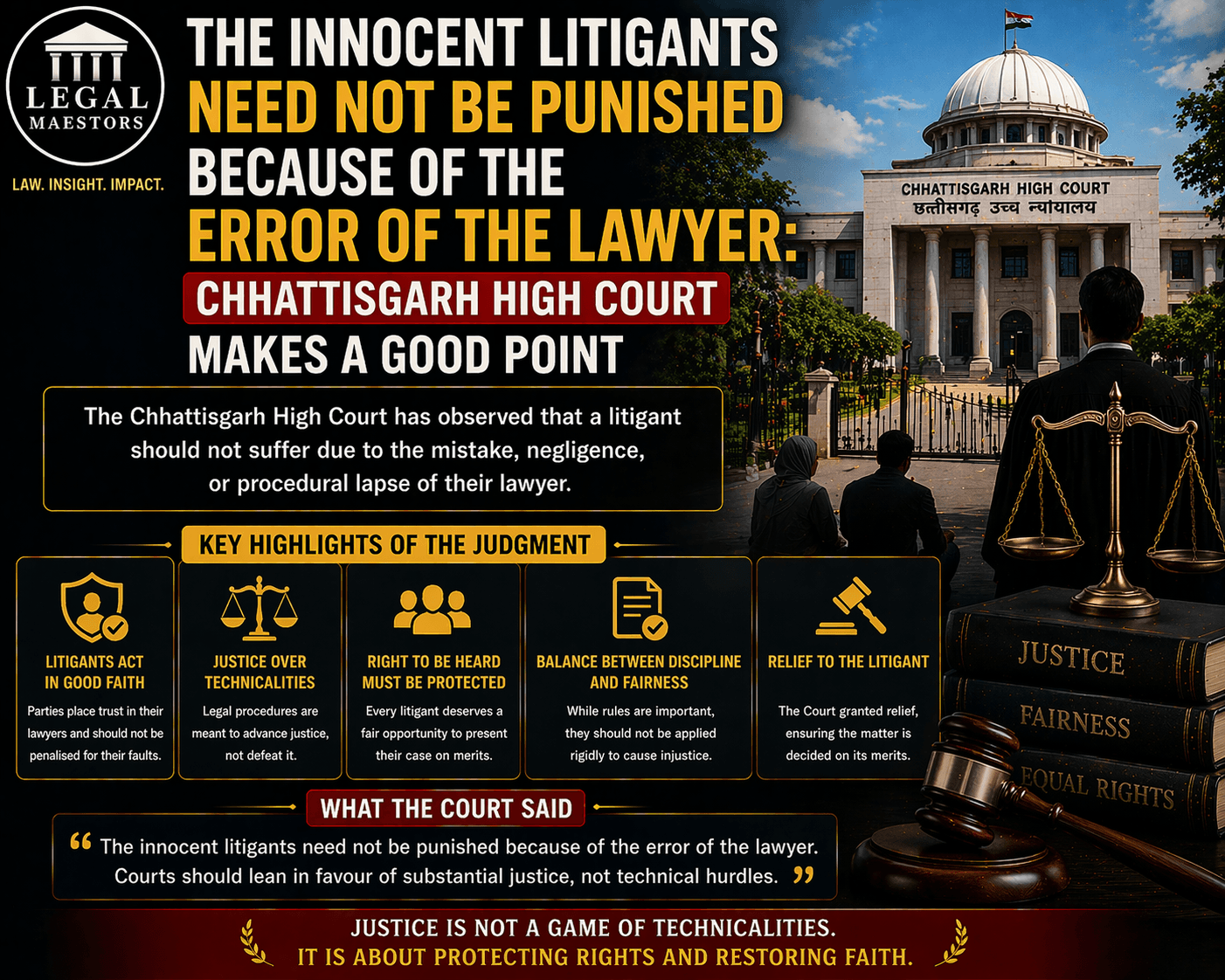
The Chhattisgarh High Court made a significant and humane ruling that a litigant is not to suffer due to the mistake or negligence of his lawyer.
This decision underlines a basic doctrine of justice- of the existence of courts to defend rights rather than to punish innocent parties who commit procedural errors outside of their control.
Factors Leading to the Case.
The case emerged when a litigant suffered negative effects as a result of lack of proper representation of the case by his or her lawyer in court.
Due to the negligence of the lawyer, the case was affected in terms of delay, non-appearance, or flaws in the procedure.
Consequently, the litigant risked missing out on the chance to have the case heard on merits.
Matter of Law.
The primary issue in the Court case was whether a litigant is entitled to be held legally liable because of the negligence of his or her lawyer.
The Court needed to determine which should prevail between procedural discipline and the need to provide substantive justice.
Court’s Observations
The Chattisgarh High Court had made very emphatic remarks in favour of the litigant.
It held that:
One party that has acted in good faith is not supposed to suffer as a result of negligence of their counsel.
Courts need to employ a justice approach as opposed to a technical approach.
The aim of legal procedures is to facilitate rather than impede justice.
The Court realised that litigants had faith in their attorneys and they should not be made to suffer due to errors that they did not make.
Substantial Justice.
The Court stressed the necessity to make decisions on merits.
It observed that:
It would be a blow to justice to dismiss a case on the basis of a lapse on the part of a lawyer.
Courts should make sure that technicalities do not prevail over fairness.
All litigants should have an equal chance of presenting their case.
This method is indicative of the larger fact that justice should be a reality and significant.
Finding a balance between Discipline and Fairness.
Although the Court emphasised that procedural rules are crucial, it brought out another point that procedural rules must not be applied strictly.
It noted that:
Courts need procedural discipline so that they may run smoothly.
But application of rules strictly should not end into injustice.
There should be a balance between courts upholding order and court upholding fairness.
Court Relief.
The Court made a sympathetic and just decision in favor of the litigant.
It enabled the issue to be reinstated or revisited so that the party can have a chance to be heard.
The Court made it clear that justice can not be denied because of the situation that the litigant cannot control.
Importance of the Judgment.
This ruling is important as it:
Prevents innocent litigants to suffer because of professional negligence.
Strengthens the principle that the cases are to be decided by merits.
Promotes the use of liberal and justice-oriented approach by courts.
Emphasizes the obligation of lawyers to be diligent.
The ruling by the Chhattisgarh High Court is a wake-up call to the legal system that it should be humane and just.
The Court maintained the real meaning of justice by saving litigants the impact of the errors of their lawyers.
Such a verdict reinforces the trust of the people in the courts and makes justice relevant and affordable.
Keywords
Chhattisgarh High Court, negligence of lawyers, innocent litigant, lapse in procedure, substantial justice, legal representation, fair trial, Indian judiciary.