Supreme Court Takes Stern Action on Stray Dog Issue
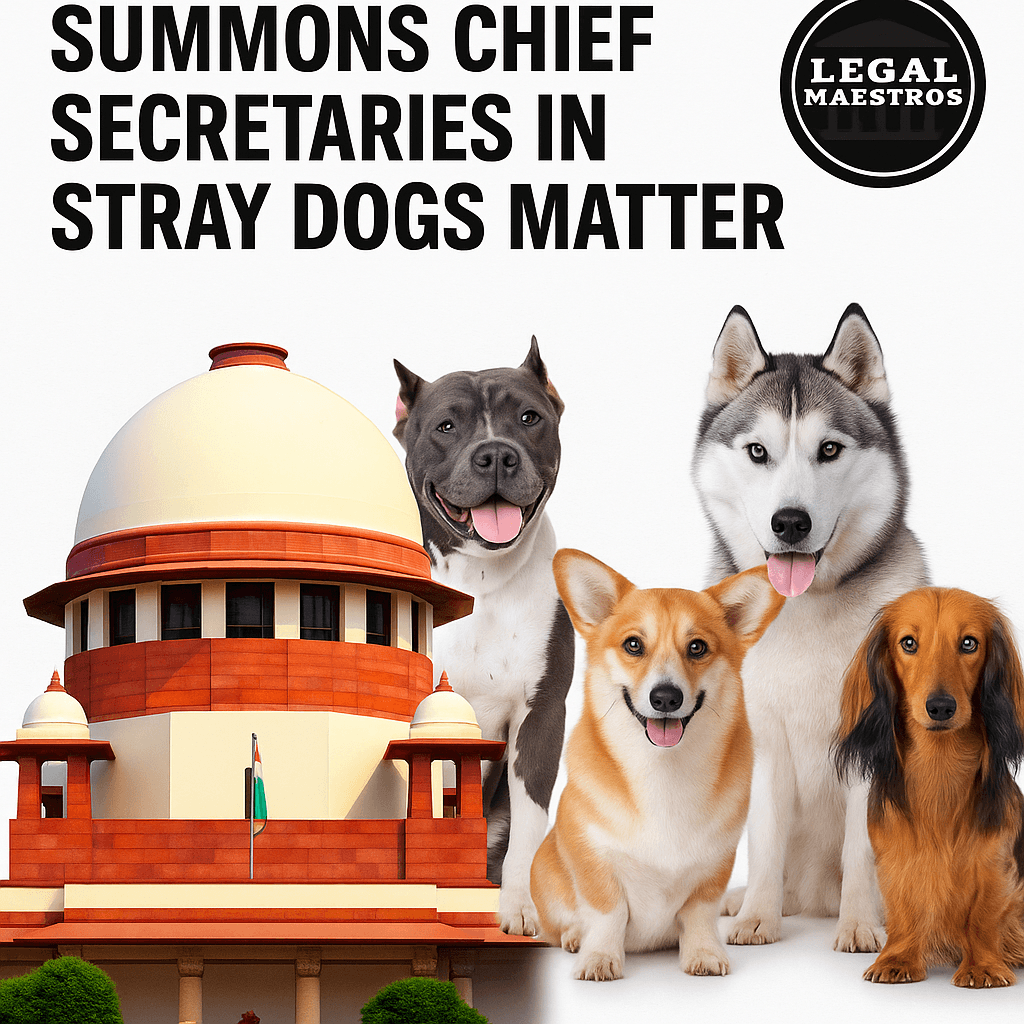
The judgment of the Supreme Court of India has been very important and harsh towards the national issue of stray dogs. One of the sitting benches led by Justice Vikram Nath and Justice Sandeep Mehta gave a strict order. The Chief Secretaries of the different states have also been ordered to appear in person by the court. This invocation is one of the signs of a deep discontent of the court with the manner in which the state authorities are addressing the problem.
Such an order was not a typical one as it was a very powerful indicator of the increasing impatience of the court. The judges did not hide their dissatisfaction with the careless demeanor of most state governments. These states had never been able to obey the previous orders by the court. A group of petitions is currently being heard by the Supreme Court and are related to the dilemma of conflicting interests between the welfare of stray animals and the safety of the people.
The short-term explanation of this harsh measure was the constant inability of states to provide the necessary reports. The court had previously ordered all the states and union territories to submit comprehensive status reports, affidavits. They were reports to give the particular work done in the enforcement of the Animal Birth Control Rules. The court chose to make the situation very serious when the majority of states were unable to supply this essential data.
This court action underscores one of the recurrent issues in the country. The situation is quite complicated as it involves the public health, municipal authorities, and animal rights. The Supreme Court is trying to get a moderate and functioning solution. The court aims at not only making sure that citizens are not subjected to the dangers of dog bites but also making sure that the animals are treated humanely and it is currently holding the top command of administration in the state liable.
The Core Conflict: Human Safety vs. Animal Welfare
The hardest and emotional dilemma lies at the heart of this legal battle. On the one hand, one can speak about the undoubted danger of stray dogs that can be dangerous to humans. The cases of dog bites, in some of the dreadful events, fatal attacks have become a common report in different parts of the country. This gives a real fear among the inhabitants and more particularly the security of children and the elderly.
These are genuine and pressing issues in the field of public safety. Dog attacks are accompanied by severe physical injuries and psychological trauma to its victims. Another layer of fear which is crucial to the panic of the population is the risk of getting the dangerous illness of rabies which is fatal. Local municipal corporations are frequently blamed in not bringing about safety in the public spaces. This has caused petitions to be made to have serious controls, and some have gone further to insist on the culling of dangerous dogs.
Need Help With Your PhD or LLM Thesis?
Explore our thesis and dissertation writing support services for PhD and LLM students. Get subject-specific academic assistance for your research project.
Explore Our Services →Animal welfare groups and activists are on the other extreme of this heated discussion. They vehemently state that there is a right to live of stray dogs which are commonly termed as community dogs. They are strongly against killing or culling of these animals as one of the population control mechanisms. They, on the contrary, promote scientific, systematic and humane management of the dog population.
These organizations draw their arguments of the Indian animal protection laws, including Prevention of Cruelty to Animals Act. They also claim that dogs are not violent in their nature and the conflict is a human factor. Such factors are poor dumping of garbage that results in the dogs scavenging and the inability to carry out sterilization programs. They ask the court to implement such human means instead of allowing cruelty.
The ABC Rules require one, accepted approach: the strategy of Catch-Neuter-Vaccinate-Release. This involves local governments to get stray animals in a particular area. These dogs are then to be neutered so that they can not be able to produce. After the surgery and a resting period, the dogs are vaccinated against rabies after which they are released into the same territory in which they were captured.
This approach is known the world over as the most humane and effective way to deal with stray dogs. It balances the population by not allowing more births, but instead leaving a vacuum without which the new un-vaccinated dogs fill. The first direct impact on the first major threat to the general population is mass vaccination to develop herd immunity against the rabies. The regulations also insist that states have to open Animal Birth Control centers and surveillance committees in each district.
The orders of the Supreme Court are directed at making the states comply by the actuality of these rules. The court itself is interested in knowing what each of the states has done on the ground. It contains the information about the number of operational ABC centers and the number of the dogs, which are sterilized and vaccinated. This is the reason why states failed to provide this basic data in full and this is what prompted the recent summons.
Focus on the Animal Birth Control Rules 2023
Justice Nath and Justice Mehta clearly showed their frustrations with the actions of the states at the hearing. They indicated that a lot of state governments were merely submitting adjournment slips. This is a legal strategy of seeking an extension of time in court yet the judges interpreted it as an evasion technique. The judiciary commented that it was too serious a case to just keep postponing it at that rate.
The Supreme Court is sending a clear message by calling the Chief Secretaries to their side. The Chief Secretary is the most senior civil servant of a state, who is in charge of the whole administration. The personal responsibility will put this top official in charge in a position to no longer hear excuses of junior levels. This supreme appeal is a strong one to make the whole state apparatus into motion.