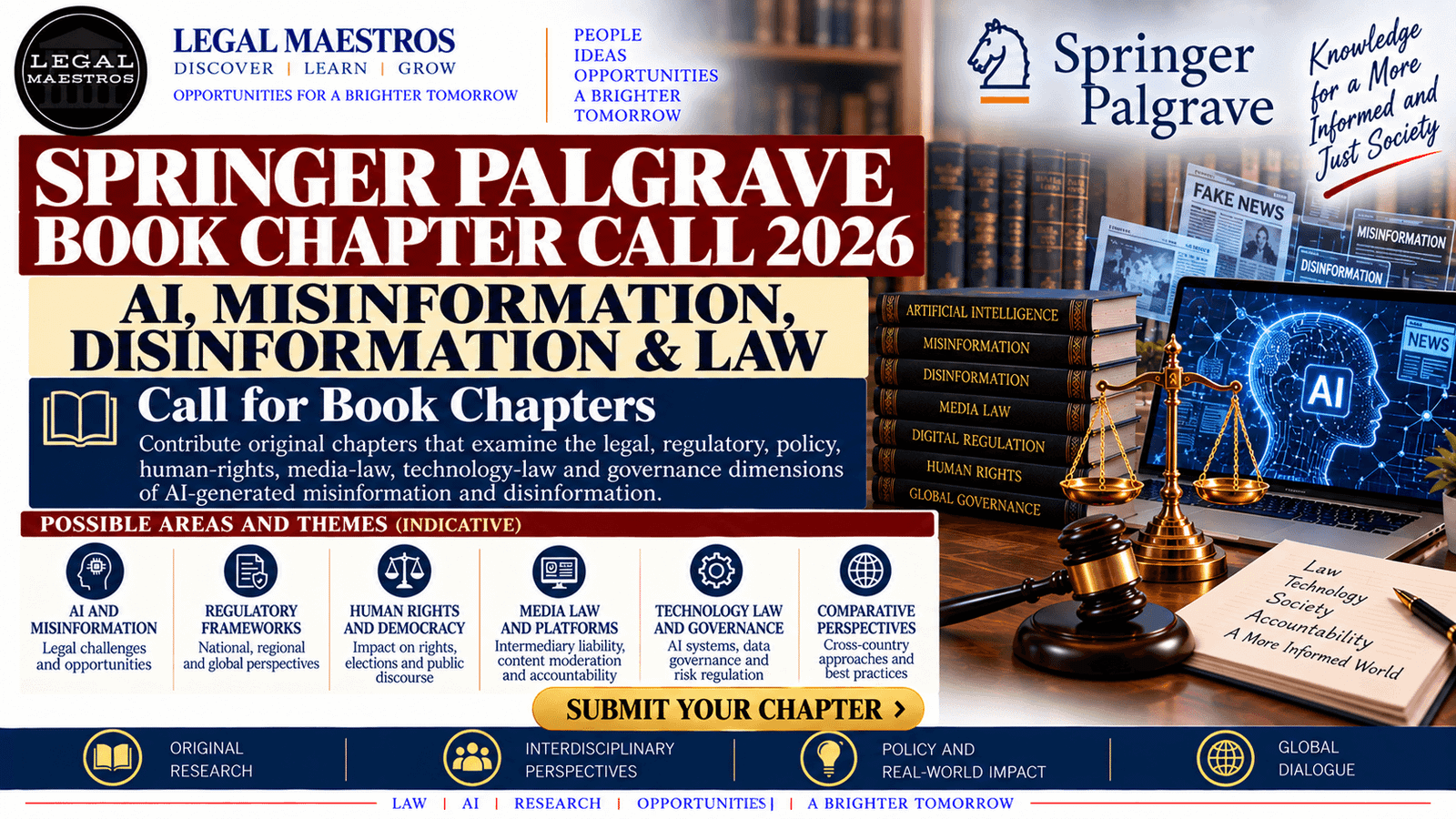
Palgrave Macmillan, part of Springer Nature, has announced a Call for Book Chapters for an edited volume titled “Artificial Intelligence and the Architecture of Deception: Misinformation and Disinformation in Digital Media.” The volume will examine the growing relationship between artificial intelligence, misinformation, disinformation and digital media.
The book is intended to bring together interdisciplinary research on how AI and digital technologies are changing the creation, spread, detection and regulation of misleading information. Contributions are invited from researchers working in Law, Communication, Media Studies, Psychology, Technology, Political Science, Governance, Sociology and related disciplines.
About the Edited Book
The proposed volume will examine emerging challenges created by artificial intelligence and the rapidly changing digital information environment. It will also explore approaches to detecting and verifying misleading content, strengthening information integrity and developing appropriate governance and regulatory responses.
The editors are Dr. Abhishika Sharma, Deputy Registrar, CDOE, Manipal University Jaipur, and Dr. Asha Mamraj Sharma, Associate Professor, CDOE, Manipal University Jaipur.
The book will consider the implications of misinformation and disinformation for democracy, public health, scientific communication, conflict, crisis communication and the wider digital society. Researchers are encouraged to submit original theoretical, empirical, methodological, interdisciplinary or critical contributions.
Themes for Law and AI Researchers
The Call for Chapters covers a wide range of themes, including artificial intelligence and generative AI, synthetic media, machine generated falsehoods, algorithms and digital platforms. Contributions may also examine AI based detection, verification and fact checking, as well as the role of media and information literacy in addressing information disorder.
For law researchers, the volume specifically includes Law, Regulation, Ethics and AI Governance. Potential research may examine platform governance, content moderation, information integrity, regulatory frameworks for generative AI, liability for AI generated misinformation, freedom of expression, privacy, election related disinformation and emerging questions surrounding digital regulation.
Other areas include political communication and democracy, health and science communication, conflict and humanitarian communication, psychology and human behaviour, research methodologies and approaches for building an epistemically resilient digital society.
Submission Requirements
Authors are required to submit their abstracts by 30 September 2026. Abstracts will be reviewed and authors whose proposals are accepted are expected to submit their full chapters by 31 October 2026.
The proposed chapters should have a length of approximately 5,500 to 6,500 words. Contributors should ensure that their submissions maintain a similarity index below 10 percent and present original research relevant to the scope of the edited volume.
Following full chapter submission, the review and revision stage is scheduled for 11 to 20 November 2026. The final chapters are expected to be submitted by 30 November 2026.
How to Submit
Researchers, academics, doctoral scholars and professionals working in relevant fields can submit their abstracts and subsequent chapter contributions for consideration. The interdisciplinary scope makes the Call particularly relevant for researchers examining the intersection of artificial intelligence, digital media, law, regulation and governance.
Submissions and enquiries can be sent to misinformation.ai.book@gmail.com. Interested contributors should ensure that their proposed chapters address an original research question and clearly connect with the broader focus of the edited volume.
If you want, I can also prepare 5 Lawctopus style titles with a strong focus on Springer/Palgrave, Call for Chapters, AI and Law, and the 30 September 2026 deadline.