About the National Scholarship for Higher Education of ST Students
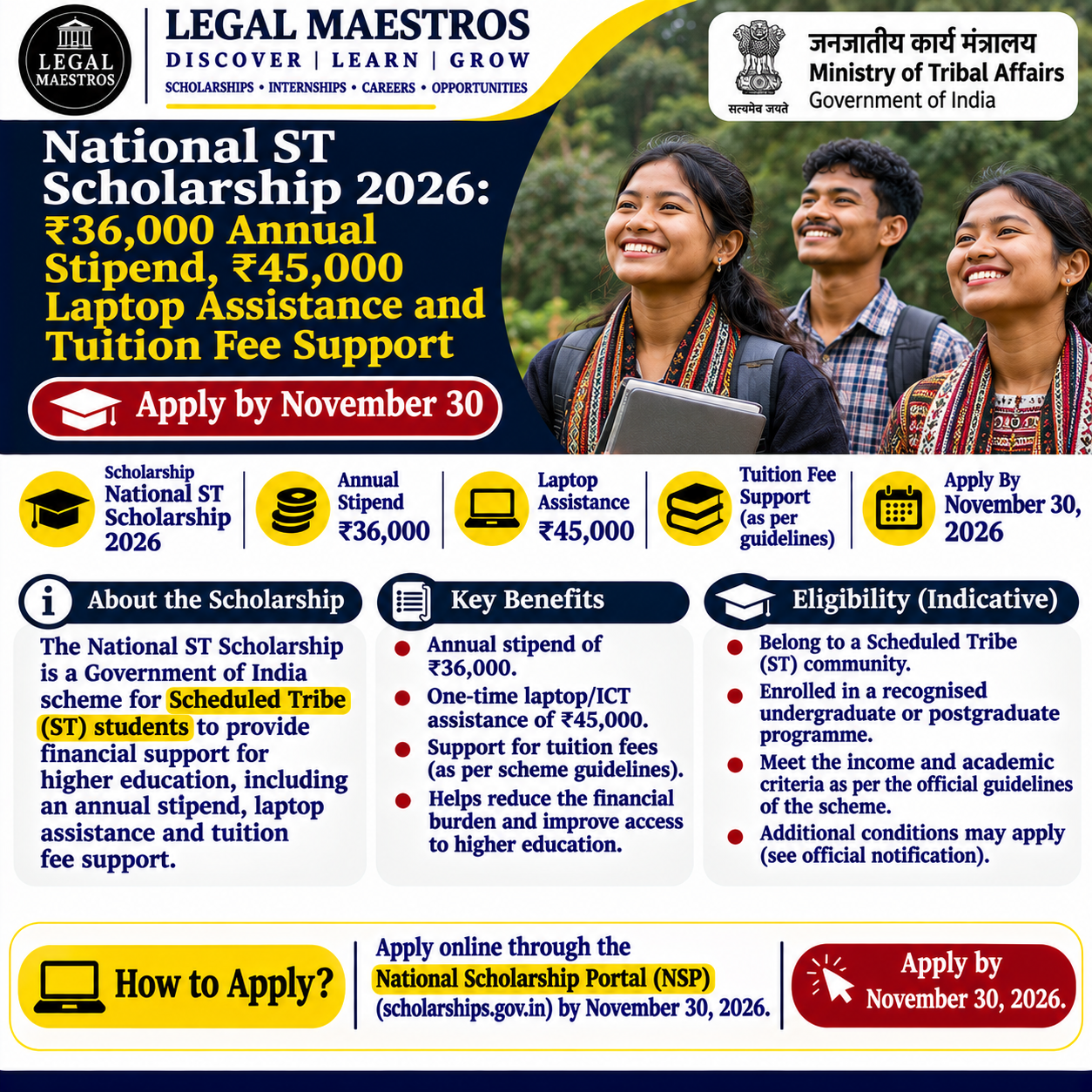
The Ministry of Tribal Affairs, Government of India, has invited applications for the National Fellowship and Scholarship for Higher Education of ST Students under its Scholarship Component for the academic year 2026–27.
The scheme provides financial assistance to eligible Scheduled Tribe students pursuing undergraduate and postgraduate courses at selected educational institutions across India.
Students enrolled in approved law programmes, including eligible courses at National Law Universities, can also apply.
Selected students receive support towards tuition fees and admission charges, along with an annual stipend of ₹36,000, ₹5,000 for books and stationery, and one-time laptop assistance of ₹45,000.
The last date for submitting applications through the National Scholarship Portal is 30 November 2026.
About the Scholarship Scheme
The National Scholarship for Higher Education of ST Students is a Central Sector Scheme implemented directly by the Ministry of Tribal Affairs.
Need Help With Your PhD or LLM Thesis?
Explore our thesis and dissertation writing support services for PhD and LLM students. Get subject-specific academic assistance for your research project.
Explore Our Services →It is also known as the Top Class Education Scholarship for Scheduled Tribe Students.
The scheme aims to support students from Scheduled Tribe communities who have secured admission to recognised higher education programmes at institutions identified by the Central Government.
It covers selected undergraduate and postgraduate courses in professional fields such as law, engineering, medicine, management and information technology.
The Ministry currently identifies 265 institutions under the scheme.
Students must be studying at one of these notified institutions and satisfy the other eligibility conditions.
Scholarship Amount and Financial Benefits
The scheme provides support under two broad categories.
The first category covers financial assistance paid directly to selected students.
The annual stipend is ₹36,000. Students also receive ₹5,000 annually towards books and stationery.
A one-time allowance of ₹45,000 is available for purchasing a laptop or computer during the course, subject to the applicable conditions.
Together, these benefits can amount to ₹86,000 in a year when the full laptop allowance is provided.
In subsequent years, the annual stipend and books allowance together amount to ₹41,000.
The second category covers tuition fees and eligible admission charges.
For government institutions, the Ministry provides the eligible tuition and admission fees according to actual charges.
For private institutions, tuition fee assistance is subject to a ceiling of ₹2.5 lakh per student per year.
The exact financial assistance depends on the institution, applicable fees and scholarship conditions.
Family Income Requirement
Applicants must belong to the Scheduled Tribe category.
The total annual parental or family income from all sources must not exceed ₹6 lakh.
Students must provide valid income information to establish eligibility.
An income certificate issued by the competent authority may be required during application or verification.
Candidates should ensure that their income details match the information contained in the supporting documents.
The ₹6 lakh limit is different from the income limits prescribed for several other government scholarship schemes.
Students should therefore check the rules for this particular scholarship rather than rely on eligibility conditions for other schemes.
Eligibility Criteria
Applicants must possess a valid Scheduled Tribe certificate issued by the competent authority.
They must have secured admission on merit to an eligible undergraduate or postgraduate course at an institution notified by the Ministry of Tribal Affairs.
The institution and the course must both be covered under the scholarship scheme.
Students pursuing recognised professional programmes may apply if they satisfy these conditions.
The scheme provides support for the prescribed duration of the approved course, subject to satisfactory academic progress and renewal requirements.
Applicants must also comply with the National Scholarship Portal’s registration and verification procedures.
Admission to an institution that is not included in the notified list does not establish eligibility, even if the institution is otherwise recognised by a statutory body.
Can Law Students Apply?
Yes. The Ministry of Tribal Affairs specifically includes law among the professional disciplines supported under the scheme.
Several National Law Universities appear in the government’s list of eligible institutions.
The notified list includes National Law University Delhi, NALSAR University of Law Hyderabad, National Law University Jodhpur and the West Bengal National University of Juridical Sciences, Kolkata.
It also includes Gujarat National Law University, Hidayatullah National Law University, National Law University Odisha and other law institutions.
The government list specifies that covered programmes at these universities include integrated law courses.
This makes the scheme relevant to students pursuing BA LL.B., BBA LL.B. and other approved legal education programmes.
Students enrolled in LL.M. courses may also qualify where the institution and course are covered.
However, not every law college or university is included in the scheme.
Applicants should check the current institution-wise list before applying.
Scholarship for LL.M. Students
The scholarship is not restricted to students pursuing their first undergraduate degree.
The Ministry has confirmed that the Top Class Scholarship covers eligible graduate and postgraduate programmes at notified institutions.
This means that Scheduled Tribe students pursuing an LL.M. at an approved institution may also seek financial assistance.
The eligibility of a particular LL.M. programme depends on the Ministry’s institution and course list.
For example, where a notified National Law University is listed as covering all law courses, the institution can verify whether the student’s postgraduate law programme qualifies.
LL.M. students should contact their university’s scholarship office to confirm the course information available on the National Scholarship Portal.
List of Eligible Institutions
The Ministry of Tribal Affairs has published a list of 265 institutions eligible under the scheme.
These include leading institutions offering law, management, engineering, medical and other professional courses.
For legal education, the list contains several National Law Universities.
The official institution list identifies the university, its location and the courses covered.
Students should review this document carefully before submitting their applications.
The presence of an institution in the notified list is an essential requirement for receiving the scholarship.
Official List of Eligible Institutions: https://tribal.nic.in/downloads/guidelines/Top-Class/Revised265-InstituteListTopClassScholarship2023-24onwards.pdf
Number of Scholarships
The Ministry’s current description states that all eligible fresh students at the notified institutions can receive the scholarship, subject to verification and scheme requirements.
Older versions of the scheme referred to a limit of 1,000 fresh scholarships annually.
However, the Ministry’s updated information reflects changes introduced from the 2023–24 academic year.
Students should rely on the current eligibility conditions rather than older notices mentioning the previous limit.
Applications still undergo verification by the institution and the Ministry before financial assistance is approved.
Selection and Verification Process
Applicants must submit their scholarship forms through the National Scholarship Portal.
After submission, the concerned university or college verifies the student’s admission, academic qualifications, category and financial eligibility.
The institution also checks whether the course is covered under the scholarship scheme.
Verified applications are forwarded for further consideration by the responsible government authorities.
The Ministry examines the applications according to the scheme guidelines.
An application may be marked defective if supporting information is incomplete or does not match the records.
Students must correct such deficiencies within the prescribed time.
Final approval depends on successful verification and satisfaction of the scholarship conditions.
Documents Required
Applicants should keep their Scheduled Tribe certificate and valid family income certificate ready.
They may also need a domicile certificate, academic marksheets and proof of admission to the eligible institution.
Class 10 records may be required to establish date of birth.
Students should keep their bank account information and Aadhaar details available for registration and payment verification.
The Ministry’s official guidance identifies these documents among the records relevant to its scholarship schemes.
The precise upload requirements will be displayed on the National Scholarship Portal.
Applicants should also check whether their university requires physical copies of documents for institutional verification.
Scholarship Renewal
The scholarship is intended to support eligible students throughout the approved duration of their course.
However, continued assistance depends on satisfying the scheme’s renewal requirements.
Students must maintain satisfactory academic progress and comply with their institution’s academic and disciplinary rules.
Renewal applications must be submitted through the National Scholarship Portal during the relevant academic year.
The institution will verify whether the student continues to satisfy the eligibility conditions.
The Ministry may cancel an award if a recipient becomes ineligible, provides false information, commits misconduct or fails to maintain satisfactory academic progress.
Students must also disclose other financial assistance in accordance with the applicable scholarship rules.
How Will the Scholarship Be Paid?
The Ministry provides financial assistance through separate payment arrangements.
The annual stipend, books and stationery allowance, and laptop allowance are released directly to the bank accounts of eligible students through Direct Benefit Transfer.
Tuition and admission fee assistance is released to the concerned institution through the Public Financial Management System.
Students should ensure that their bank details are correct and that the account meets the applicable Aadhaar-linking requirements.
Incorrect bank account information may cause delays in receiving the scholarship.
Applicants can track their payment status using the facilities available on the National Scholarship Portal and the PFMS website.
How to Apply?
Interested and eligible students must apply through the official National Scholarship Portal.
Candidates should first visit the portal and complete the One-Time Registration process if they have not already registered.
One-Time Registration, commonly called OTR, provides a unique identification number that can be used throughout the student’s academic career.
Applicants who already possess an OTR number can log in using their existing details.
After logging in, students should select the scheme titled National Fellowship and Scholarship for Higher Education of ST Students – Scholarship.
They must complete the online form with their personal details, category information, family income, institution, course and admission details.
Applicants should provide the required supporting documents and verify the information before submitting the form.
Once submitted, the application must be verified by the concerned university or college.
Official Application Portal: https://scholarships.gov.in/
Official Scholarship Listing: https://scholarships.gov.in/All-Scholarships
Official Student Registration: https://scholarships.gov.in/Students
Ministry of Tribal Affairs Scholarship Information: https://tribal.nic.in/Scholarship.aspx
Official Institution List: https://tribal.nic.in/downloads/guidelines/Top-Class/Revised265-InstituteListTopClassScholarship2023-24onwards.pdf
Official Ministry Website: https://tribal.nic.in/
Important Dates
Applications for the academic year 2026–27 opened on 1 June 2026.
The last date for fresh and renewal student applications is 30 November 2026.
The deadline for correction of defective applications is 15 December 2026.
Institutional verification must also be completed by 15 December 2026.
The deadline for district, state and ministry-level verification is 31 December 2026.
Students should complete the application before the closing date and contact their institution’s scholarship office to ensure timely verification.
Difference Between the Scholarship and Fellowship Components
The National Fellowship and Scholarship for Higher Education of ST Students has two distinct components.
The Scholarship Component supports eligible undergraduate and postgraduate students studying at notified institutions.
The Fellowship Component is intended for eligible research scholars pursuing doctoral-level studies under a separate selection and application process.
A student seeking support for a BA LL.B. or LL.M. degree should therefore select the Scholarship Component on the National Scholarship Portal.
Candidates interested in doctoral research fellowships should review the separate National Fellowship for ST Students programme.
The two components have different eligibility requirements, financial benefits and application procedures.
Application Deadline
The last date to apply for the National Fellowship and Scholarship for Higher Education of ST Students under the Scholarship Component is 30 November 2026.
Eligible Scheduled Tribe students pursuing approved undergraduate and postgraduate courses at the 265 notified institutions can submit their applications through the National Scholarship Portal.
The scheme provides an annual stipend of ₹36,000, ₹5,000 towards books and stationery, one-time laptop assistance of ₹45,000, and eligible tuition and admission fee support.
Law students enrolled at approved National Law Universities and other notified institutions may also apply