About the European Master in Law and Economics
The European Master in Law and Economics (EMLE) has invited applications for its 2027–2028 academic programme. The one-year postgraduate course allows students to study law and economics at different universities through an international academic consortium.
The programme is open to eligible students from different countries, including India. Law graduates, economics graduates and candidates from related academic disciplines may apply.
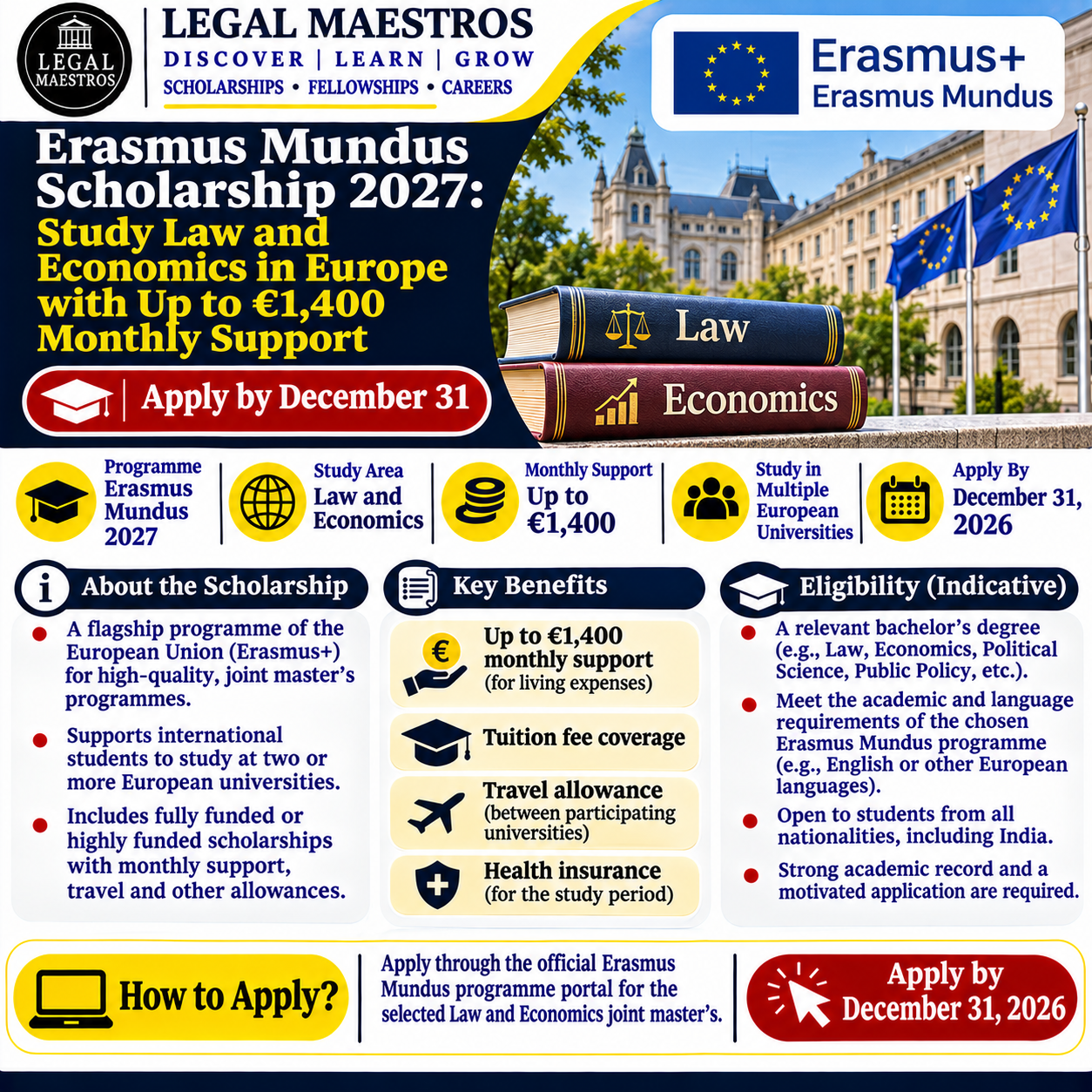
Selected students can receive Erasmus Mundus scholarships providing financial assistance of up to €1,400 per month.
The scholarships are awarded competitively on the basis of academic performance, motivation and the applicant’s suitability for studying law and economics.
The last date for Indian applicants is 31 December 2026.
About the EMLE Programme
The European Master in Law and Economics is an international postgraduate programme supported under the Erasmus Mundus framework of the European Union.
Need Help With Your PhD or LLM Thesis?
Explore our thesis and dissertation writing support services for PhD and LLM students. Get subject-specific academic assistance for your research project.
Explore Our Services →The programme has offered education in the economic analysis of law for more than three decades.
It examines how legal rules affect economic behaviour and how economic principles can be used to understand legal institutions.
Students study legal systems alongside subjects involving markets, business, public policy and economic regulation.
Unlike a conventional postgraduate law course, EMLE combines legal education with economic theory and analytical methods.
The programme is particularly relevant for candidates interested in competition law, corporate governance, regulation, international trade, public policy and interdisciplinary legal research.
Participating Universities
One important feature of EMLE is that students study at different universities during the academic year.
The programme includes institutions such as Erasmus University Rotterdam in the Netherlands, the University of Hamburg in Germany, Ghent University in Belgium and Pompeu Fabra University in Spain.
Other consortium partners offer additional academic opportunities according to the programme’s available study locations.
Students may spend different terms at different universities.
Every student must study at least two universities, following the mobility requirements prescribed under Erasmus Mundus.
The actual university allocation depends on the applicant’s preferences, available places and programme requirements.
Admission does not automatically guarantee placement at the student’s preferred university.
Programme Duration and Course Structure
The European Master in Law and Economics is a full-time programme lasting one academic year.
It carries 60 ECTS credits and is divided into three academic terms.
The first term generally takes place from October to December.
Students begin by studying the foundations of law and economics and the principal methods used in economic legal analysis.
The second term runs from January to March and provides opportunities for more specialised study.
The final term begins in April and includes advanced coursework and preparation of the master’s thesis.
The academic year continues until September.
The programme’s international structure allows students to experience different universities and legal systems during their studies.
Academic Subjects
The EMLE curriculum covers several subjects relevant to legal education.
These include the economic analysis of private law, property rights, contract law, competition law and corporate governance.
Students may also examine regulatory policy, public law, financial markets and international legal institutions.
The programme introduces methods for understanding how individuals, businesses and governments respond to legal rules.
For example, students studying competition law may examine how market structures and economic evidence influence regulatory decisions.
Those interested in contract law may explore the economic consequences of contractual obligations and legal remedies.
The subjects offered in each term depend on the university and academic track allocated to the student.
Eligibility Criteria
Applicants must have completed previous higher education equivalent to at least 240 ECTS credits.
Under the European credit system, this generally corresponds to four years of full-time higher education.
The requirement may be satisfied through a four-year undergraduate degree or a combination of undergraduate and postgraduate qualifications.
Preference is given to students with an academic background in law or economics.
However, graduates from other disciplines may also apply.
Such candidates must demonstrate a clear interest in the economic analysis of law and explain why they are academically prepared for the programme.
A previous master’s degree is desirable for certain scholarship considerations but is not compulsory for admission.
The programme does not prescribe a general age limit.
Can Indian Law Graduates Apply?
Yes. Indian law graduates are eligible to apply for EMLE.
Candidates holding a five-year integrated law qualification, such as BA LL.B. or BBA LL.B., may satisfy the educational duration requirement, subject to the consortium’s assessment of academic equivalence.
Candidates who completed a three-year LL.B. after an earlier undergraduate degree may also be eligible based on their combined qualifications.
Applicants should not assume that every Indian degree automatically satisfies the 240 ECTS equivalency requirement.
The EMLE admissions team assesses the academic qualifications and supporting documents submitted by each candidate.
Indian students who are still completing their law degrees may also apply if they expect to graduate before the programme begins.
They must subsequently provide the required degree certificate within the prescribed period.
Erasmus Mundus Scholarship Amount
The European Master in Law and Economics offers competitive Erasmus Mundus Joint Masters scholarships supported by the European Commission.
Selected scholarship recipients can receive a monthly contribution of up to €1,400.
The amount is intended to help cover expenses relating to travel, visas, settling into a new country and day-to-day living costs.
The duration of payments depends on the recipient’s participation in the programme and the applicable mobility conditions.
Scholarship recipients must comply with the programme’s requirements concerning study at different universities.
Failure to satisfy those requirements may affect scholarship payments.
The programme also provides insurance coverage to EMLE students during the academic year.
Applicants should review the individual scholarship offer for the exact financial arrangements.
Number of Scholarships
The EMLE consortium has funding for up to 90 Erasmus Mundus scholarships across six academic intakes, from 2022–2023 to 2027–2028.
This corresponds to approximately 15 scholarships each academic year.
Around ten scholarships annually are awarded to the highest-ranked applicants in the overall selection process.
Approximately five additional scholarships are reserved for candidates from designated target regions under the Erasmus+ programme.
These targeted awards support applicants from particular countries and regions identified by the European Commission.
Indian applicants are eligible to compete for the general merit-based scholarships.
However, they should not assume that they qualify for additional awards reserved for specific regions.
The actual distribution remains subject to the scholarship rules.
EMLE Outreach Scholarship
Apart from the regular Erasmus Mundus scholarships, the programme offers a separate Outreach Scholarship.
This award is intended for applicants affiliated with higher education institutions who want to introduce or strengthen teaching and research in law and economics.
The consortium provides full tuition fee waivers to up to two eligible candidates annually.
Applicants interested in this scholarship must submit a short project plan.
The plan should explain how they intend to incorporate law and economics into teaching or research at their institution after completing the programme.
A letter of endorsement from the applicant’s institution is also required.
The letter should demonstrate the institution’s interest in developing education or research in law and economics.
Indian law teachers and researchers affiliated with universities may consider this opportunity if they satisfy its conditions.
The additional documents must be submitted to application@emle.org before the regular application deadline.
Tuition Fees
Students who do not receive scholarship funding may still be offered admission to EMLE.
However, they must arrange the necessary financial resources.
The published tuition fee for non-European students is €12,000 for the academic year.
The fee for students in the European application category is €7,500.
Indian applicants generally fall within the non-European category.
Successful self-funded candidates are required to pay an initial non-refundable tuition instalment of €800 after accepting admission.
The remaining tuition fees are payable according to the programme’s prescribed schedule.
Students must also arrange funding for accommodation, travel, visa expenses and other living costs unless these are covered by their scholarship or other financial arrangements.
English Language Requirements
The EMLE programme requires applicants to demonstrate sufficient English-language proficiency.
For IELTS Academic, the minimum overall score is 7.0, with at least 6.0 in every component.
The programme also accepts TOEFL iBT and certain Cambridge English examinations.
For TOEFL iBT tests taken under the previous scoring system, the published minimum overall score is 95, together with prescribed section-wise requirements.
For the revised TOEFL iBT scoring system introduced in 2026, EMLE requires an overall score of 5.0, with specific minimum scores for individual sections.
English-language test results must not be older than two years, measured from the application deadline.
An important point is that candidates do not need to submit English-language test results with their initial application.
The programme requires proof of English proficiency from admitted students during the subsequent admission process.
Indian applicants should not assume that completing a law degree in English automatically provides an exemption.
The programme has specific rules concerning accepted English-language qualifications and exemptions.
Documents Required
Applicants must submit their academic degree certificates and transcripts.
For each completed degree, they must provide the relevant certificate and an official record of grades.
Candidates who have not yet graduated may submit their available academic transcripts.
A one-page motivation letter is compulsory.
The letter should explain the applicant’s interest in studying law and economics and their reasons for selecting the EMLE programme.
Applicants must also arrange at least one recommendation letter.
Two recommendation letters are preferred, but the programme does not accept more than two.
Referees must submit their recommendations directly through the online application system using the standard EMLE form.
Candidates must provide proof of residence containing their name and current address.
A passport alone is not accepted as proof of residence.
The residence document must have been issued within the twelve months preceding the application deadline.
Selection Process
Admission and scholarship selection are based on a common academic assessment process.
EMLE evaluates applicants using four principal criteria.
Academic qualifications and university performance account for 40% of the assessment.
The motivation letter contributes 25%.
Another 25% is based on the applicant’s previous academic connection with law and economics and their demonstrated interest in the subject.
Recommendation letters account for the remaining 10%.
Applications are ranked according to these criteria.
Admission offers and Erasmus Mundus scholarships are awarded competitively on the basis of the ranking and applicable programme requirements.
The consortium expects to communicate admission decisions in March 2027.
How to Apply for the Erasmus Mundus Scholarship?
Candidates must first apply for admission to the EMLE programme through the official online application system.
Applicants should complete the form and upload their academic documents, motivation letter and proof of residence.
They must also provide the professional email addresses of their referees.
The referees will receive instructions for submitting their recommendation letters directly.
Applicants interested in an Erasmus Mundus scholarship should indicate their interest in the relevant section of the application form.
There is no separate scholarship application that must be completed before the initial EMLE admission deadline.
Eligible admitted applicants are considered for scholarship allocation, and the programme may contact interested candidates regarding subsequent requirements.
Candidates should ensure that their application is complete before the closing date.
At least one recommendation letter must have been submitted for the application to be considered complete.
Important Requirement for Indian Students Choosing Hamburg
Indian applicants who wish to study at the University of Hamburg should be aware of an additional requirement.
The programme states that applicants whose relevant degrees were awarded by Indian universities may generally need an APS certificate for study periods in Hamburg.
This requirement concerns the verification of academic qualifications.
Certain exemptions may apply, including for recipients of specified publicly funded scholarships.
Applicants should check the current rules before arranging the certificate.
Obtaining an APS certificate does not guarantee allocation to Hamburg.
However, where the certificate is requireThe actual university allocation depends on the applicant’s preferences, available places and programme requirements.
Admission does not automatically guarantee placement at the student’s preferred university.
Programme Duration and Course Structure
The European Master in Law and Economics is a full-time programme lasting one academic year.
It carries 60 ECTS credits and is divided into three academic terms.
The first term generally takes place from October to December.
Students begin by studying the foundations of law and economics and the principal methods used in economic legal analysis.
The second term runs from January to March and provides opportunities for more specialised study.
The final term begins in April and includes advanced coursework and preparation of the master’s thesis.
The academic year continues until September.
The programme’s international structure allows students to experience different universities and legal systems during their studies.
Academic Subjects
The EMLE curriculum covers several subjects relevant to legal education.
These include the economic analysis of private law, property rights, contract law, competition law and corporate governance.
Students may also examine regulatory policy, public law, financial markets and international legal institutions.
The programme introduces methods for understanding how individuals, businesses and governments respond to legal rules.
For example, students studying competition law may examine how market structures and economic evidence influence regulatory decisions.
Those interested in contract law may explore the economic consequences of contractual obligations and legal remedies.
The subjects offered in each term depend on the university and academic track allocated to the student.
Eligibility Criteria
Applicants must have completed previous higher education equivalent to at least 240 ECTS credits.
Under the European credit system, this generally corresponds to four years of full-time higher education.
The requirement may be satisfied through a four-year undergraduate degree or a combination of undergraduate and postgraduate qualifications.
Preference is given to students with an academic background in law or economics.
However, graduates from other disciplines may also apply.
Such candidates must demonstrate a clear interest in the economic analysis of law and explain why they are academically prepared for the programme.
A previous master’s degree is desirable for certain scholarship considerations but is not compulsory for admission.
The programme does not prescribe a general age limit.
Can Indian Law Graduates Apply?
Yes. Indian law graduates are eligible to apply for EMLE.
Candidates holding a five-year integrated law qualification, such as BA LL.B. or BBA LL.B., may satisfy the educational duration requirement, subject to the consortium’s assessment of academic equivalence.
Candidates who completed a three-year LL.B. after an earlier undergraduate degree may also be eligible based on their combined qualifications.
Applicants should not assume that every Indian degree automatically satisfies the 240 ECTS equivalency requirement.
The EMLE admissions team assesses the academic qualifications and supporting documents submitted by each candidate.
Indian students who are still completing their law degrees may also apply if they expect to graduate before the programme begins.
They must subsequently provide the required degree certificate within the prescribed period.
Erasmus Mundus Scholarship Amount
The European Master in Law and Economics offers competitive Erasmus Mundus Joint Masters scholarships supported by the European Commission.
Selected scholarship recipients can receive a monthly contribution of up to €1,400.
The amount is intended to help cover expenses relating to travel, visas, settling into a new country and day-to-day living costs.
The duration of payments depends on the recipient’s participation in the programme and the applicable mobility conditions.
Scholarship recipients must comply with the programme’s requirements concerning study at different universities.
Failure to satisfy those requirements may affect scholarship payments.
The programme also provides insurance coverage to EMLE students during the academic year.
Applicants should review the individual scholarship offer for the exact financial arrangements.
Number of Scholarships
The EMLE consortium has funding for up to 90 Erasmus Mundus scholarships across six academic intakes, from 2022–2023 to 2027–2028.
This corresponds to approximately 15 scholarships each academic year.
Around ten scholarships annually are awarded to the highest-ranked applicants in the overall selection process.
Approximately five additional scholarships are reserved for candidates from designated target regions under the Erasmus+ programme.
These targeted awards support applicants from particular countries and regions identified by the European Commission.
Indian applicants are eligible to compete for the general merit-based scholarships.
However, they should not assume that they qualify for additional awards reserved for specific regions.
The actual distribution remains subject to the scholarship rules.
EMLE Outreach Scholarship
Apart from the regular Erasmus Mundus scholarships, the programme offers a separate Outreach Scholarship.
This award is intended for applicants affiliated with higher education institutions who want to introduce or strengthen teaching and research in law and economics.
The consortium provides full tuition fee waivers to up to two eligible candidates annually.
Applicants interested in this scholarship must submit a short project plan.
The plan should explain how they intend to incorporate law and economics into teaching or research at their institution after completing the programme.
A letter of endorsement from the applicant’s institution is also required.
The letter should demonstrate the institution’s interest in developing education or research in law and economics.
Indian law teachers and researchers affiliated with universities may consider this opportunity if they satisfy its conditions.
The additional documents must be submitted to application@emle.org before the regular application deadline.
Tuition Fees
Students who do not receive scholarship funding may still be offered admission to EMLE.
However, they must arrange the necessary financial resources.
The published tuition fee for non-European students is €12,000 for the academic year.
The fee for students in the European application category is €7,500.
Indian applicants generally fall within the non-European category.
Successful self-funded candidates are required to pay an initial non-refundable tuition instalment of €800 after accepting admission.
The remaining tuition fees are payable according to the programme’s prescribed schedule.
Students must also arrange funding for accommodation, travel, visa expenses and other living costs unless these are covered by their scholarship or other financial arrangements.
English Language Requirements
The EMLE programme requires applicants to demonstrate sufficient English-language proficiency.
For IELTS Academic, the minimum overall score is 7.0, with at least 6.0 in every component.
The programme also accepts TOEFL iBT and certain Cambridge English examinations.
For TOEFL iBT tests taken under the previous scoring system, the published minimum overall score is 95, together with prescribed section-wise requirements.
For the revised TOEFL iBT scoring system introduced in 2026, EMLE requires an overall score of 5.0, with specific minimum scores for individual sections.
English-language test results must not be older than two years, measured from the application deadline.
An important point is that candidates do not need to submit English-language test results with their initial application.
The programme requires proof of English proficiency from admitted students during the subsequent admission process.
Indian applicants should not assume that completing a law degree in English automatically provides an exemption.
The programme has specific rules concerning accepted English-language qualifications and exemptions.
Documents Required
Applicants must submit their academic degree certificates and transcripts.
For each completed degree, they must provide the relevant certificate and an official record of grades.
Candidates who have not yet graduated may submit their available academic transcripts.
A one-page motivation letter is compulsory.
The letter should explain the applicant’s interest in studying law and economics and their reasons for selecting the EMLE programme.
Applicants must also arrange at least one recommendation letter.
Two recommendation letters are preferred, but the programme does not accept more than two.
Referees must submit their recommendations directly through the online application system using the standard EMLE form.
Candidates must provide proof of residence containing their name and current address.
A passport alone is not accepted as proof of residence.
The residence document must have been issued within the twelve months preceding the application deadline.
Selection Process
Admission and scholarship selection are based on a common academic assessment process.
EMLE evaluates applicants using four principal criteria.
Academic qualifications and university performance account for 40% of the assessment.
The motivation letter contributes 25%.
Another 25% is based on the applicant’s previous academic connection with law and economics and their demonstrated interest in the subject.
Recommendation letters account for the remaining 10%.
Applications are ranked according to these criteria.
Admission offers and Erasmus Mundus scholarships are awarded competitively on the basis of the ranking and applicable programme requirements.
The consortium expects to communicate admission decisions in March 2027.
How to Apply for the Erasmus Mundus Scholarship?
Candidates must first apply for admission to the EMLE programme through the official online application system.
Applicants should complete the form and upload their academic documents, motivation letter and proof of residence.
They must also provide the professional email addresses of their referees.
The referees will receive instructions for submitting their recommendation letters directly.
Applicants interested in an Erasmus Mundus scholarship should indicate their interest in the relevant section of the application form.
There is no separate scholarship application that must be completed before the initial EMLE admission deadline.
Eligible admitted applicants are considered for scholarship allocation, and the programme may contact interested candidates regarding subsequent requirements.
Candidates should ensure that their application is complete before the closing date.
At least one recommendation letter must have been submitted for the application to be considered complete.
Important Requirement for Indian Students Choosing Hamburg
Indian applicants who wish to study at the University of Hamburg should be aware of an additional requirement.
The programme states that applicants whose relevant degrees were awarded by Indian universities may generally need an APS certificate for study periods in Hamburg.
This requirement concerns the verification of academic qualifications.
Certain exemptions may apply, including for recipients of specified publicly funded scholarships.
Applicants should check the current rules before arranging the certificate.
Obtaining an APS certificate does not guarantee allocation to Hamburg.
However, where the certificate is required, placement at Hamburg depends on the applicant satisfying that condition.
Official Application Links
Official EMLE Application: https://emle.org/application-2/
Apply Online: https://apply.emle.org/
Official 2027–2028 Announcement: https://emle.org/application-for-the-emle-2027-2028-open/
Programme Structure: https://emle.org/programme-structure-2/
Participating Universities: https://emle.org/universities-2/
Official Programme Website: https://emle.org/
Email for Admissions and Scholarship Queries: application@emle.org
General Enquiries: info@emle.org
Application Deadline
Applications for the European Master in Law and Economics 2027–2028 opened on 1 September 2026.
The last date for non-European applicants, including Indian candidates, is 31 December 2026.
The application page specifies a closing time of 11:59 PM Central European Time in its detailed application section.
European-category applicants have until 15 January 2027.
Indian applicants should submit their forms and arrange for at least one recommendation letter to be received before the December deadline.
The programme expects to announce admission decisions in March 2027.
Successful candidates will begin their one-year postgraduate studies in October 2027.
Selected Erasmus Mundus scholarship recipients may receive up to €1,400 per month, subject to the conditions of their award and participation in the