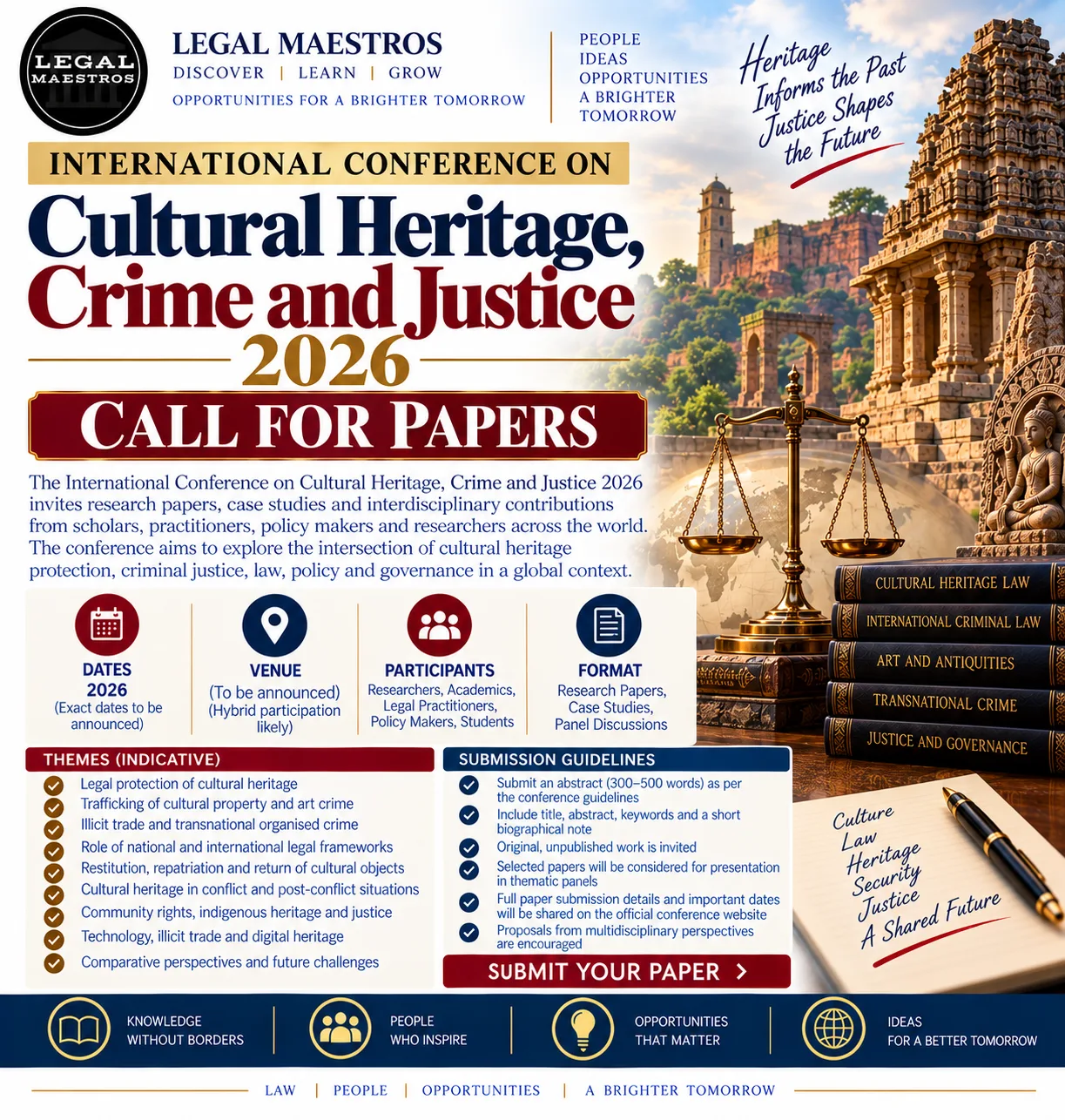
An international conference on “Cultural Heritage, Crime and Justice: Safeguarding Global Commons in International and EU Perspective” has invited paper proposals from academics, legal professionals, early career researchers and PhD candidates.
The conference will examine the role of international and European Union legal frameworks, courts, law enforcement agencies and judicial cooperation in protecting cultural heritage and addressing crimes involving tangible and intangible heritage.
International Conference on Cultural Heritage, Crime and Justice
The conference is being organised by the Department of Legal Sciences, School of Law, University of Salerno, and the Faculty of Law, Transilvania University of Brașov.
The programme will explore cultural heritage as an important global common and examine how contemporary legal frameworks and judicial developments can be used to combat property crime, prevent illicit trafficking and address the destruction of cultural heritage.
The conference will also consider the role of national and supranational courts, administration of justice and judicial cooperation in developing effective approaches to the protection of cultural heritage.
Themes for Paper Submissions
The Call for Papers welcomes contributions examining cultural heritage from the perspectives of tangible heritage, intangible heritage and global commons.
Suggested areas include cultural heritage, armed conflicts and global security, as well as crimes against cultural heritage and liability regimes involving individuals, corporations and states.
The conference will also examine the administration of justice, courts and judicial cooperation, along with criminal justice, intelligence, law enforcement and security.
Other areas include digital frontiers, artificial intelligence and cybercrime, global emergencies, risk management and infrastructure security, and the relationship between cultural heritage and human rights.
Who Can Submit
Proposals are invited from national and international experts, academics, specialised institutions and organisations, early career researchers and PhD candidates working on relevant areas.
The interdisciplinary nature of the conference provides an opportunity for researchers working across international law, European law, criminal law, cultural heritage law, human rights, technology law, cybersecurity and related fields to present their research.
Submission Guidelines
Interested authors must submit an abstract of maximum 350 words. The submission should include the title of the proposed paper, the author’s name, institutional affiliation and email address, along with up to five keywords.
The email submission should also contain a short biography of maximum 100 words. Authors should indicate whether they would prefer to present their paper in person or online.
Abstracts should be submitted as a Word or PDF attachment to:
Email: law-conference@unitbv.ro
Important Dates and Publication Opportunity
The deadline for submission of abstracts is 11 October 2026. Authors will be informed about the acceptance of their proposals by 26 October 2026.
The conference will be conducted in a hybrid format, allowing participation either in person or online. There is no conference participation cost mentioned in the call.
Authors whose papers are accepted may also have an opportunity to publish their work in the Bulletin of the Transilvania University of Brașov, Series VII: Social Sciences and Law, a peer reviewed academic journal.
Conference: Cultural Heritage, Crime and Justice: Safeguarding Global Commons in International and EU Perspective
Format: Hybrid
Abstract Deadline: 11 October 2026
Notification of Acceptance: 26 October 2026
Abstract Length: Maximum 350 words
Keywords: Up to 5
Cost: Free
Submission Email: law-conference@unitbv.ro
Eligibility: Academics, experts, specialised institutions, early career researchers and PhD candidates
For complete Call for Papers details, authors should refer to the official conference information before submitting their abstracts.
Here is a polished Legal Maestros style Call for Papers article:
Here is a polished Legal Maestros style Call for Papers article:
International Conference on Cultural Heritage, Crime and Justice 2026: Call for Papers
An international conference on “Cultural Heritage, Crime and Justice: Safeguarding Global Commons in International and EU Perspective” has invited paper proposals from academics, legal professionals, early career researchers and PhD candidates.
The conference will examine the role of international and European Union legal frameworks, courts, law enforcement agencies and judicial cooperation in protecting cultural heritage and addressing crimes involving tangible and intangible heritage.
International Conference on Cultural Heritage, Crime and Justice
The conference is being organised by the Department of Legal Sciences, School of Law, University of Salerno, and the Faculty of Law, Transilvania University of Brașov.
The programme will explore cultural heritage as an important global common and examine how contemporary legal frameworks and judicial developments can be used to combat property crime, prevent illicit trafficking and address the destruction of cultural heritage.
The conference will also consider the role of national and supranational courts, administration of justice and judicial cooperation in developing effective approaches to the protection of cultural heritage.
Themes for Paper Submissions
The Call for Papers welcomes contributions examining cultural heritage from the perspectives of tangible heritage, intangible heritage and global commons.
Suggested areas include cultural heritage, armed conflicts and global security, as well as crimes against cultural heritage and liability regimes involving individuals, corporations and states.
The conference will also examine the administration of justice, courts and judicial cooperation, along with criminal justice, intelligence, law enforcement and security.
Other areas include digital frontiers, artificial intelligence and cybercrime, global emergencies, risk management and infrastructure security, and the relationship between cultural heritage and human rights.
Who Can Submit
Proposals are invited from national and international experts, academics, specialised institutions and organisations, early career researchers and PhD candidates working on relevant areas.
The interdisciplinary nature of the conference provides an opportunity for researchers working across international law, European law, criminal law, cultural heritage law, human rights, technology law, cybersecurity and related fields to present their research.
Submission Guidelines
Interested authors must submit an abstract of maximum 350 words. The submission should include the title of the proposed paper, the author’s name, institutional affiliation and email address, along with up to five keywords.
The email submission should also contain a short biography of maximum 100 words. Authors should indicate whether they would prefer to present their paper in person or online.
Abstracts should be submitted as a Word or PDF attachment to:
Email: law-conference@unitbv.ro
Important Dates and Publication Opportunity
The deadline for submission of abstracts is 11 October 2026. Authors will be informed about the acceptance of their proposals by 26 October 2026.
The conference will be conducted in a hybrid format, allowing participation either in person or online. There is no conference participation cost mentioned in the call.
Authors whose papers are accepted may also have an opportunity to publish their work in the Bulletin of the Transilvania University of Brașov, Series VII: Social Sciences and Law, a peer reviewed academic journal.
Conference: Cultural Heritage, Crime and Justice: Safeguarding Global Commons in International and EU Perspective
Format: Hybrid
Abstract Deadline: 11 October 2026
Notification of Acceptance: 26 October 2026
Abstract Length: Maximum 350 words
Keywords: Up to 5
Cost: Free
Submission Email: law-conference@unitbv.ro
Eligibility: Academics, experts, specialised institutions, early career researchers and PhD candidates
For complete Call for Papers details, authors should refer to the official conference information before submitting their abstracts.
An international conference on “Cultural Heritage, Crime and Justice: Safeguarding Global Commons in International and EU Perspective” has invited paper proposals from academics, legal professionals, early career researchers and PhD candidates.
The conference will examine the role of international and European Union legal frameworks, courts, law enforcement agencies and judicial cooperation in protecting cultural heritage and addressing crimes involving tangible and intangible heritage.
International Conference on Cultural Heritage, Crime and Justice
The conference is being organised by the Department of Legal Sciences, School of Law, University of Salerno, and the Faculty of Law, Transilvania University of Brașov.
The programme will explore cultural heritage as an important global common and examine how contemporary legal frameworks and judicial developments can be used to combat property crime, prevent illicit trafficking and address the destruction of cultural heritage.
The conference will also consider the role of national and supranational courts, administration of justice and judicial cooperation in developing effective approaches to the protection of cultural heritage.
Themes for Paper Submissions
The Call for Papers welcomes contributions examining cultural heritage from the perspectives of tangible heritage, intangible heritage and global commons.
Suggested areas include cultural heritage, armed conflicts and global security, as well as crimes against cultural heritage and liability regimes involving individuals, corporations and states.
The conference will also examine the administration of justice, courts and judicial cooperation, along with criminal justice, intelligence, law enforcement and security.
Other areas include digital frontiers, artificial intelligence and cybercrime, global emergencies, risk management and infrastructure security, and the relationship between cultural heritage and human rights.
Who Can Submit
Proposals are invited from national and international experts, academics, specialised institutions and organisations, early career researchers and PhD candidates working on relevant areas.
The interdisciplinary nature of the conference provides an opportunity for researchers working across international law, European law, criminal law, cultural heritage law, human rights, technology law, cybersecurity and related fields to present their research.
Submission Guidelines
Interested authors must submit an abstract of maximum 350 words. The submission should include the title of the proposed paper, the author’s name, institutional affiliation and email address, along with up to five keywords.
The email submission should also contain a short biography of maximum 100 words. Authors should indicate whether they would prefer to present their paper in person or online.
Abstracts should be submitted as a Word or PDF attachment to:
Email: law-conference@unitbv.ro
Important Dates and Publication Opportunity
The deadline for submission of abstracts is 11 October 2026. Authors will be informed about the acceptance of their proposals by 26 October 2026.
The conference will be conducted in a hybrid format, allowing participation either in person or online. There is no conference participation cost mentioned in the call.
Authors whose papers are accepted may also have an opportunity to publish their work in the Bulletin of the Transilvania University of Brașov, Series VII: Social Sciences and Law, a peer reviewed academic journal.
Conference: Cultural Heritage, Crime and Justice: Safeguarding Global Commons in International and EU Perspective
Format: Hybrid
Abstract Deadline: 11 October 2026
Notification of Acceptance: 26 October 2026
Abstract Length: Maximum 350 words
Keywords: Up to 5
Cost: Free
Submission Email: law-conference@unitbv.ro
Eligibility: Academics, experts, specialised institutions, early career researchers and PhD candidates
For complete Call for Papers details, authors should refer to the official conference information before submitting their abstracts.