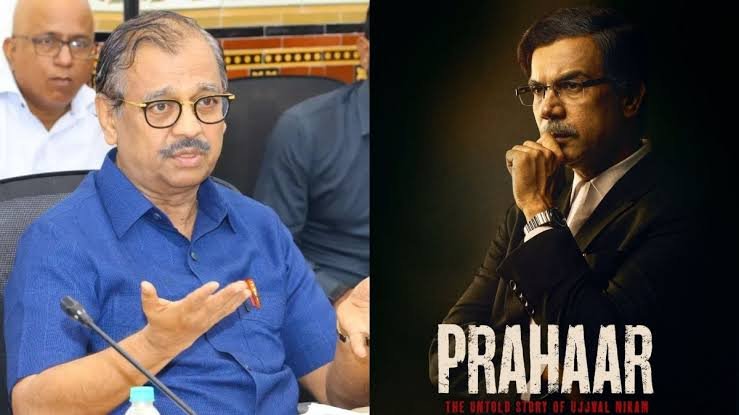
The Ujjwal Nikam Story, starring Rajkummar Rao, will see the actor essay the role of a lawyer in the court battle after the 26/11 Mumbai terror attacks. He will be seen as Ujjwal Nikam, who was the public prosecutor for the State in the Ajmal Kasab trial, the only one among the terrorists who was caught alive in the 2008 attack. The film will arrive on October 16, 2026.
Prahaar, which unlike the films that trace the attack or cover the aftermath, is said to be a story about the trial and courtroom proceedings. The trailer shows the legal discussion about Kasab’s lie and his age. Reportedly, the filmmaker did a lot of homework and the advocate believes that the film is to be made in the same light as the trial and without any sensationalism of the trial. But how well court room dramas reflect the justice system is matter of perspective in real life. NDTV Hindustan Times
The Role of a Public Prosecutor in a Terrorism Trial
A public prosecutor prosecutes the State and puts its case before the court. In a case involving terrorism, the prosecution may have to prove the identity of the accused, that he participated in the attack, his intention, links between him and other individuals and the commission of particular crimes. The case may hinge on testimony, forensics, medical evidence, electronic records, interception of telecommunication and evidence obtained in a prosecution.
The evidence may justify conviction but the purpose of the Prosecution is not in itself to win a conviction. The Prosecution is required to make evidence that is admissible and lawful in its nature while, at the same time, guaranteeing the ‘accused the right to a fair and public trial by an impartial court’. It is for the judiciary and not the Prosecution or Investigating agency to decide if the evidence proves guilt beyond reasonable doubt. A credible depiction of a terrorism trial would thus have to illustrate this interplay of investigative efforts, rules of evidence, reasoning of law, and the decision by the court.
Why Terrorism Cases Present Difficult Legal Challenges
Terrorism cases can also have: many accused; difficult to investigate; and evidence located across locations. The investigators and prosecutors have to prove not only the attack but also how it was planned, how the accused was involved and that the evidence is actually related to the crime. The scope of the investigations, and the number of witnesses in an attack like 26/11 can make the case complex.
The National Investigation Agency Act, 2008 empowers the NIA and creation of Special Courts for specified offences. For certain cases of terrorism prosecution Unlawful Activities (Prevention) Act, 1967, may also be utilised. The exact offence(s) alleged and the law applicable at the time of the offence will determine the precise section of law under which the case is brought against the accused. What is NIA’s stance in its investigation of offences related to terrorism?
Need Help With Your PhD or LLM Thesis?
Explore our thesis and dissertation writing support services for PhD and LLM students. Get subject-specific academic assistance for your research project.
Explore Our Services →Evidence, Witnesses and the Right to a Fair Trial
An essential consideration in the case is the evidence that can be brought forward for the court to believe. A statement that has been given by a witness during an investigation does not necessarily mean guilt. Other questions such as a witness’s capacity to distinguish the accused and to recall details of an incident in a consistent fashion will be asked. Forensic and electronic evidence should satisfy the law before the court is satisfied.
Another area of concern is witness security. Those who give evidence in prominent terrorism trials could be subject to threats or coercion. India’s Witness Protection Scheme, 2018 covers measures such as protection of identity and relocation, where the individual giving evidence faces a threat, according to an evaluation of the risk posed to them. These protections need to be balanced against the accused’s right to cross-examine evidence and have a fair trial. The Home Ministry provided the details of the scheme in a Press Information Bureau release.
The Kasab Trial and the Importance of Due Process
Ajmal Kasab’s case became one of the most followed criminal cases in recent Indian history. The attacks resulted in the death of hundreds but had to be proved before the court of law and evidence. Kasab was then prosecuted in the court, found guilty and sentenced to death; his conviction and sentence was accepted by the Supreme Court and he was executed in November 2012.
How right the case was in showing why the most heinous charge should have to clear the gauntlet of the courts. A prosecution cannot stand in for evidence with rage, nor can the magnitude of an offence stand in for evidence in the court. The law is also concerned about the accused’s right to a lawyer and the right to test the case. This does not mean that a terrorism prosecution is any weaker; it means it is a pure judicial matter.
Can Prahaar Reflect the Reality of Terrorism Prosecutions?
A film can educate viewers about the role prosecutors play by providing the trial prep, witness examination, and cross examination, the argument over evidence, and the build-up to a case that has high publicity. It can shed light on why courtroom procedure is important, even if the case involves a heartbreaking terrorist attack. The difficulty for moviemakers is to make this process understandable without turning a courtroom battle into a caricature of good versus evil.
As a dramatised production, there may be instances where events are condensed, reconstructed or dramatised for narrative purposes. In this context, its verisimilitude can be judged better by juxtaposing it with the available court record and trustworthy attestation on the proceedings, instead of the trailer. According to Nikam, the film is based on the detailed research conducted by him and the team, and will be non-exploitative of information. The film could be an initial peep into the Kasab trial legal history, but not a predictor of the real functioning of laws on terrorism.