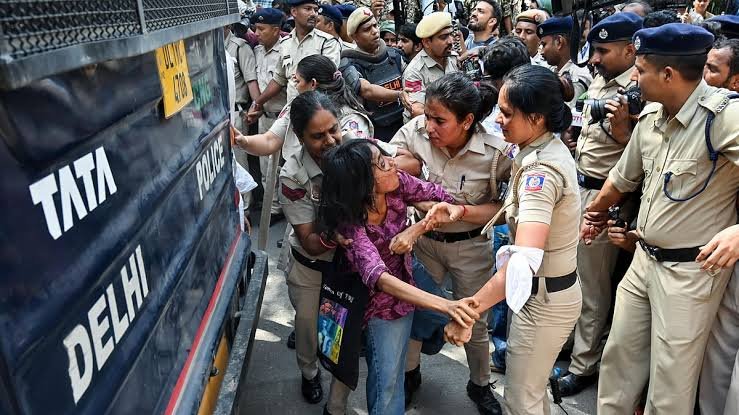
Delhi Police Deploy Body Cameras During Recent Protests
The Delhi Police has launched body worn cameras for its staff deployed to deal with protests and mobs in Delhi. The step was taken against the backdrop of allegations of manhandling and use of excessive force during recent protests, police officials said the cameras will be able to make a real time record of the encounter.
Approximately 80 body worn cameras were allegedly handed out to some ground crew members during the most recent protests, as officers were told to record their encounters while dealing with crowds. The controversy has also once again pushed the focus on whether body cameras should be solely contingent on when the police choose to wear them.
Centre To Make SOP Following HC Directive
The matter has now come before the Delhi High Court. Public Interest Litigation was filed seeking a SOP making it mandatory for police and Rapid Action Force personnel to be equipped with body worn cameras during protests and crowd control situations.
7 October 2026 – Centre directed by Delhi High Court to treat PIL as representation and communicate decision within six months The court added that body worn cameras are already being used by police, but the SOP for their usage was believed to not exist.
The petition asks: “Instead of simply giving cameras to police officers, what policies should be in place for their use, storage, retention, and access, as well as what measures should be used to verify authenticity?”
Why Body Cameras Could Strengthen Accountability
Commonly, different accounts of the same event arise at demonstrations. Police will say demonstrators broke through barricades, assaulted officers or vandalized property; demonstrators will say they suffered excesses or were illegally detained.
Body worn cameras would record what was happening before and during such incidents. This could, potentially, protect civilians from false accusations and police officers from unfounded allegations.
The petition filed before the Delhi High Court had argued that responsibility should not be determined mainly based on videos recorded by bystanders on their mobile phones. It had suggested some security features like safe storage, an auditable chain of custody and a precluding cameras and the officers wearing those cameras from manipulating the footage.
Is It Possible to Make Body Cameras Mandatory by Law?
The implementation of body cameras on a wider scale is not governed by any general central law which makes body cameras mandatory for all police officers at the scene of every protest or crowd control operation. Police is a State subject under the Constitution and body cameras have been used by individual police departments and government modernisation programmes. The Union government had previously confirmed the use of body worn cameras by several State police forces.
This does not stop governments from imposing compulsory regulations upon their police forces. Statutory regulations, police regulations or well-drafted SOPs could stipulate when police must turn on the cameras, what police officers’ responsibilities are, what happens in cases where turning them on would be a risk, and how to safeguard the recordings.
The more challenging question is what should happen when an officer intentionally chooses not to document an incident or deliberately turns off the camera. A serious legal obligation would have to entail some sort of repercussion for not following it, rather than just the requirement of having to provide cameras.
Privacy Is Also a Constitutional Concern
Mandatory body cameras could enhance accountability but an unrelenting record also raises issues of privacy. Protesters may be journalists, lawyers, students, political workers or other citizens exercising their constitutional rights. The ongoing recording of their behaviour and interactions with police must be subject to regulation and limits.
Article 21 guarantees of personal liberty include significant privacy protections, according to the Supreme Court. These rights are balanced against Articles 19(1)(a) and 19(1)(b) which guarantee freedom of speech and the right to assemble peacefully and without arms, subject to regulation.
A body camera policy should set out when a camera can be used during an enforcement operation. Clear guidelines should also be in place about when footage and personal information that is captured is necessary or should be deleted.
Lessons From the Supreme Court’s CCTV Orders
In the Supreme Court’s view, video recording has been considered an essential accountability tool in relation to police stations. In the case of Paramvir Singh Saini v. Baljit Singh, the Court gave directions in relation to CCTV cameras in police stations and investigative agencies and enumerated those safeguards as being connected to the fundamental right to life under Article 21. CCTV footage has been directed to be preserved for a period of at least 3 months.
Although body worn cameras differ from fixed CCTV systems, the fundamental issue of accountability remains the same. Where technology is used to capture a police- citizen encounter, rules about the integrity and accessibility of the recording need to exist.
Without these safeguards, an officer having a camera on his or her uniform may not prevent argument about what occurred. The effectiveness of the system depends on whether the recording is continuous when needed, whether it can be edited or deleted, and whether there is some external way to check the record.
Compulsory Body Cameras?
The Delhi incidents are why we are no longer debating whether body cameras belong on police; we are debating whether their use should be under a consistent and enforceable legal regime.
A compulsory system could help make officers more accountable if they use force during a protest, where there are claims of police brutality or other illegal behavior. However, any such system would need to ensure officers were protected as well as protesters, and should include strict rules on when it was used, security and retention of data, access and release of information, chain of custody, and penalties for intentional failure to comply.
However, the Delhi HC has not held that body cameras are now to be mandated. It has merely directed the Centre to think over the SOP question for six months. How the government responds, and whether India ends up having a crisp legal regime on body worn cameras for public order operations, is what comes next.