In a legal article I would put this as “what is established, what is alleged and what is left to be decided” rather than taking sides by declaring this judge right or that. The CJI himself mentioned that these allegations couldn’t be decided in a “battle of the sound bytes in the media” and have to go through the institutional apparatus. ([India Today][1])
Justice Sandeep Mehta vs Justice Sanjeev Prakash Sharma: What Is the Rajasthan HC Controversy All About?
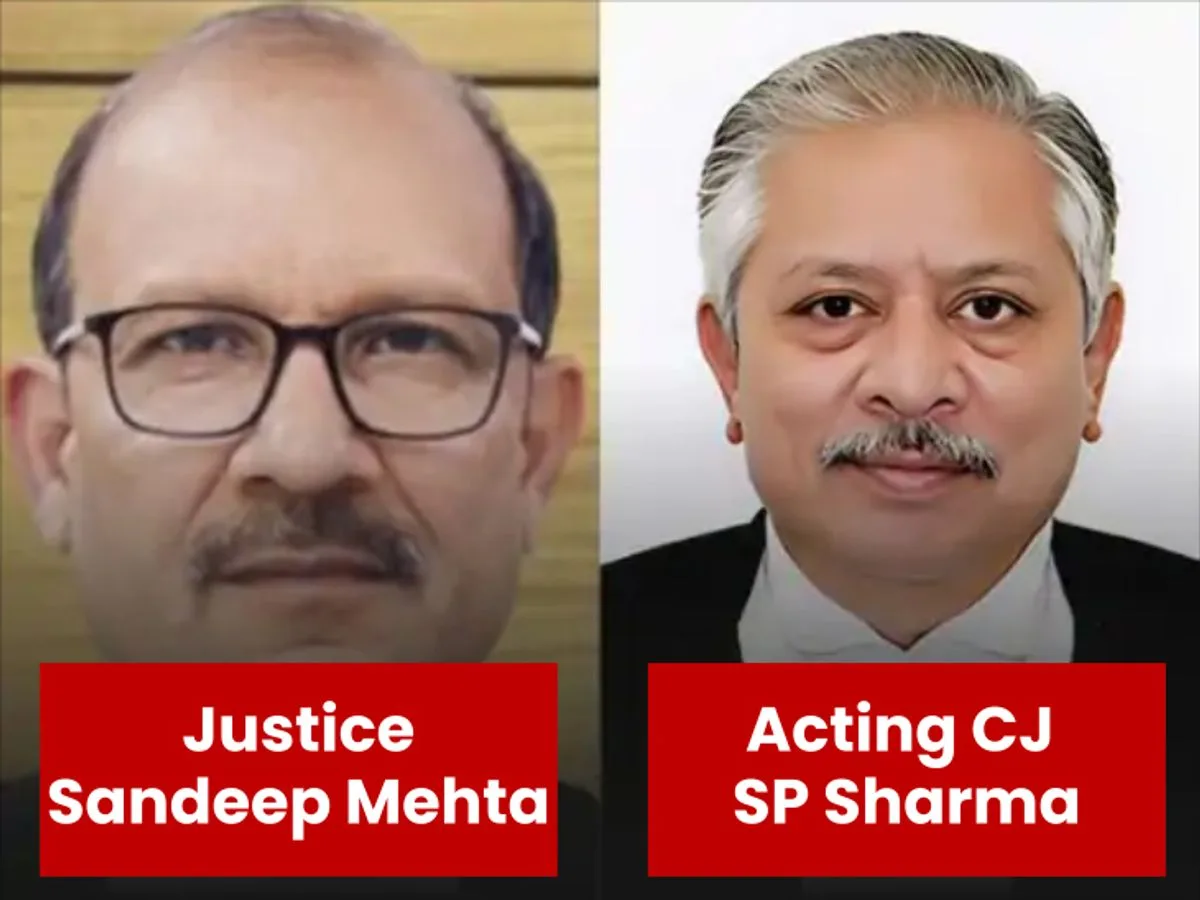
This issue on Supreme Court justice Sandeep Mehta and former Rajasthan High Court acting Chief Justice Sanjeev Prakash Sharma has touched the very root of the administration of justice in the country, the powers of a CJ, the working of the collegium and the procedures relating to complaints against the judges.
Justice Mehta, a former Rajasthan High Court judge before he was sworn in as a judge of the Supreme Court, sent a series of letters to then CJI Surya Kant in August 2026 making allegations against Justice Sharma.
Justice Sharma dismissed the charges as false and motivated by spite. Released from the Rajasthan High Court on September 26, he has now vented himself on the controversy and said that Justice Mehta could not have dictated terms to a High Court.
Hence, the key legal issue is not merely “Who has the right and who has the wrong?” What would be more meaningful is: What precisely has been accused, what has been challenged, how has the system of institutions, order or law acted, and what has yet to be proved?
How The Controversy Began
On 8 September 2025, then Chief Justice K.R. Shriram retired and Justice Sanjeev Prakash Sharma was sworn in as Acting Chief Justice of Rajasthan High Court.
In that capacity, he stayed there for nearly a year. In August of 2026, Justice Sandeep Mehta wrote three letters to CJI Surya Kant asking him to replace Justice Sharma and to appoint a Chief Justice of another High Court to Rajasthan.
The letters voiced complaint about abuse of administrative authority, listing of cases, favoritism, nepotism and general maladministration.
Justice Mehta also mentioned the complaints reportedly lodged by the judges and others on the functioning of the Rajasthan High Court.
An essential part of this Complaint was that such allegations were levelled by a sitting Supreme Court judge against a sitting Acting Chief Justice of a High Court.
What Did Justice Sandeep Mehta Allege?
One of the biggest accusations was against the master of the roster.
An administrative power exists in a Chief Justice of a High Court to form benches and assign cases. Justice Mehta claimed that some cases which were on the list before other benches were rescheduled for a bench led by Justice Sharma for no apparent reason.
In the same letters, Justice Mehta revealed that some of the decisions involved expensive property and high-profile litigants. He also suggested that the way a few cases were transferred, left him wondering how the decision was made.
Justice Mehta further mentioned a property dispute that emerged between land worth crores in Udaipur. He said that the court transferred cases related to the property to Justice Sharma’s bench in Jaipur, even though the Jaipur-Jodhpur territorial jurisdiction had already been decided.
This was the averment in the communications of Justice Mehta. That does not mean because it was in those letters, that it was a judgment of misconduct.
That is especially relevant in the context of accusations leveled at judges.
Allegations About Nepotism And Favouritism
In his letters, Justice Mehta also alleged nepotism and favours.
Another complaint was about a suggestion or recommendation of names for appointment in bodies like Permanent Lok Adalats. Yet another complaint was about names suggested for elevation to the High Court.
Justice Mehta also mentioned a grievance against the elevation of a lawyer related to a senior advocate.
Again, the matters complained of were issues in correspondence and complaints. The public material did not amount to a proof of each of them.
This is the reason why the statement of the Chief Justice of India became relevant.
What Did CJI Surya Kant Say?
CJI Surya Kant did not say on record any of the two judges, Dr. Mehta or Dr. Sharma, were correct.
Alternatively, he noted that the matter concerning a sitting judge had to be handled through the mechanism created for this purpose.
He emphasised particularly that the Supreme Court would not sanction judicial complaints being heard by competing claims in the media.
The CJI referred to the submission made by Justice Mehta and response of Justice Sharma in the proper manner.
This is an important constitutional principle.
Having a complaint about a judge is not the same as a finding about the judge, but knowing that a complaint has not been decided does not imply that the complaint is untrue.
The institutional process is in place specifically to check those competing claims.
Justice Sharma’s Response
Justice Sanjeev Prakash Sharma vehemently denied the charges.
He stated in September that the claims were without merit and that he had responded to the Supreme Court.
He urged the media, legal practitioners and others to allow the institutional process to take it’s course, instead of jumping to conclusions after reading about it in the press.
Justice Sharma, on the other hand, elaborated after his withdrawal.
In an interview published on Sunday, he had said Justice Mehta’s charges could have been “out of professional jealousy” and pointed out that a judge of the top court had no locus standi in the affairs of a High Court administration.
He defended his time in office and said he took his decisions in accordance with the law and institutional requirements.
The statement that he was motivated by professional jealousy is an allegation about motive.
The Fourth Letter
But the debate didn’t stop there.
The justice, who has now sent a fourth letter, also addressed the CJI on August 30.
This letter was said to have further allegations against Justice Sharma of interfering in internal judicial enquiry, breach of confidentiality of proceedings and administrative work.
Justice Mehta further claimed that there was disturbance in an enquiry of a judicial officer.
As per the letter which was published by The Indian Express, a committee on the issue had also noted that the intervention in the enquiry and the proceedings was not made public.
Justice Sharma once again denied these accusations.
The Jodhpur Court Building – What Is Contested?
Justice Mehta also expressed concern over the newly constructed Jodhpur District Court building.
Mehta accused Sharma of postponing the opening of the building and mandating alterations to the building and infrastructure after the structure had been built.
Mehta further claims that this result of the delay was that courts operated from rented accommodation.
The controversy eventually came to the CJI who formally opened the building after the matter was brought to him, as reported on Justice Mehta’s letters.
This is an illustration of the distinction between an administrative dispute and a proved case of misconduct.
Dispute over an administrative decision cannot be the sole ground to show corruption or dishonesty, but an appropriate institutional authority would have to look at the facts, data and rationale of the decision.
### The “Master Of The Roster” Issue Why Is It So Important?
This controversy has also highlighted the significance of the principal administrative power of a HC Chief Justice.