What Is Special Intensive Revision of Electoral Rolls?
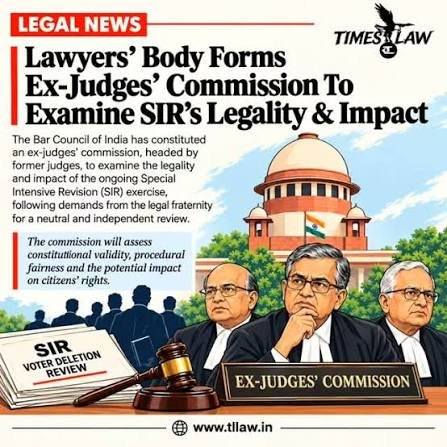
The Special Intensive Revision, commonly known as SIR, is an electoral roll revision exercise undertaken by the Election Commission of India to verify existing voter records and ensure that eligible citizens are included while ineligible or duplicate entries are removed.
The exercise has been carried out in phases across different States and Union Territories. The Election Commission has stated that the objective is to ensure that no eligible citizen is left out while no ineligible person remains on the electoral roll. The current SIR exercise draws its legal authority from Article 324 of the Constitution, Section 21 of the Representation of the People Act, 1950 and the Registration of Electors Rules, 1960.
The exercise has nevertheless generated substantial constitutional and legal debate because an electoral roll determines who can participate in elections. Questions have therefore arisen about the Commission’s power to demand documents, examine eligibility, delete names and prescribe procedures during an intensive revision.
The Supreme Court addressed many of these questions in its judgment of May 27, 2026 in Association for Democratic Reforms v. Election Commission of India, which concerned the Bihar SIR. The Court upheld the validity of the exercise while also laying down important limits concerning citizenship verification and the protection of eligible voters.
What Is the ECI’s Constitutional Power Under Article 324?
Article 324 of the Constitution vests the superintendence, direction and control of the preparation of electoral rolls and the conduct of elections in the Election Commission. This is the basic constitutional foundation of the Commission’s authority over electoral rolls.
The Supreme Court has described Article 324 as conferring broad constitutional power on the Commission. However, that power is not independent of the Constitution or statutory law. The Commission cannot exercise its powers in a manner contrary to an express statutory prohibition.
Parliament has also enacted laws governing elections. Article 327 empowers Parliament to make provisions concerning elections, including preparation of electoral rolls. The Representation of the People Act, 1950 consequently provides the statutory framework for electoral registration and revision.
The Supreme Court’s 2026 judgment explained that Articles 324 and 327 operate together rather than as competing sources of authority. The Commission has constitutional powers, while Parliament establishes the statutory framework within which those powers are exercised.
What Does Section 21 of the Representation of the People Act Say?
Section 21 of the Representation of the People Act, 1950 deals with preparation and revision of electoral rolls. Ordinary revision takes place according to the statutory framework, while Section 21(3) provides for a special revision.
The Supreme Court examined the significance of Section 21(3) in the Bihar SIR case. The provision allows the Election Commission to direct a special revision of electoral rolls in such manner as it thinks fit. The Court held that this gives the Commission wide authority to prescribe the manner in which an SIR is conducted.
The Court therefore rejected the argument that the Election Commission had no statutory authority to conduct the Bihar SIR. It held that the exercise was traceable to Section 21(3), read with Article 324 and the relevant electoral laws.
This is an important point because the legal validity of SIR does not depend only on Article 324. The Commission’s authority is supported by a specific statutory provision dealing with special revision of electoral rolls.
Can the ECI Ask Voters for Additional Documents?
One of the most significant issues in the SIR litigation concerns documentation.
During the Bihar exercise, the Election Commission required electors who were not included in the earlier 2003 electoral roll to provide specified government documents. The original framework identified eleven documents. During the litigation, the Supreme Court also directed that Aadhaar be accepted as an additional document for identity purposes.
The Supreme Court recognised that the Commission has authority to prescribe documentation requirements in an intensive revision. However, this does not mean that every document requirement imposed by the Commission is automatically immune from judicial scrutiny.
The distinction is particularly important because an electoral roll exercise can affect a person’s ability to vote. Any documentation requirement must operate within the constitutional and statutory framework governing electoral registration and cannot be used in a manner that unlawfully excludes eligible citizens.
The recent controversy over additional declarations attached to Form 6 illustrates this distinction. The Supreme Court has clarified that its May 2026 judgment did not amount to approval of every subsequent modification made to Form 6.
Can the ECI Determine Who Is an Indian Citizen?
This is one of the most sensitive legal questions surrounding SIR.
The Supreme Court held that citizenship is a condition for registration as an elector under Article 326 and the Representation of the People Act. Consequently, the Election Commission cannot maintain a valid electoral roll without considering whether a person satisfies the statutory conditions for enrolment.
At the same time, the Court made an important distinction between an electoral eligibility inquiry and a formal determination of citizenship.
The Commission can conduct a limited inquiry for the purpose of deciding whether a person is eligible to be included in the electoral roll. It does not thereby acquire the exclusive statutory power to finally determine citizenship under the Citizenship Act, 1955.
The Court directed that where the Commission is not satisfied that a person meets the citizenship requirement, the matter must be referred to the competent authority under the Citizenship Act for adjudication. The affected person must receive notice and an opportunity of hearing, and a person ultimately found to be an Indian citizen must be included in the electoral roll.
What Are the Constitutional Limits on SIR?
The existence of a wide constitutional power does not mean that the Election Commission can act without procedural safeguards.
Articles 325 and 326 are particularly relevant. Article 325 establishes the principle of one general electoral roll and prohibits exclusion from an electoral roll on grounds only of religion, race, caste or sex. Article 326 provides for elections based on adult suffrage, subject to constitutional and statutory qualifications.
The Supreme Court’s approach in the Bihar SIR case therefore attempted to balance two constitutional objectives. The electoral roll must not contain persons who are legally ineligible, but eligible citizens must also not be wrongly excluded. The Court upheld the SIR after examining its statutory basis, purpose, proportionality and procedural safeguards.
Natural justice is also important where an individual’s eligibility is questioned. The Bihar framework contemplated notice, an opportunity to respond and a reasoned order where an Electoral Registration Officer found an elector’s eligibility doubtful. Appeals were also available against such decisions.
These safeguards matter because deletion of a name from the electoral roll has consequences for a person’s participation in an election.
Can an Electoral Officer Delete a Voter’s Name Without Notice?
The answer depends on the stage and circumstances of the electoral roll process.
The SIR framework envisages publication of a draft roll followed by a period for claims and objections. Where an elector’s eligibility is specifically questioned, the Bihar SIR guidelines contemplated issuance of a show cause notice, an opportunity to respond and a speaking order before exclusion. Appeals were provided against the decision of the Electoral Registration Officer.
The Election Commission has also stated that safeguards include house-to-house verification, publication of draft rolls, claims and objections and appellate remedies.
Recent proceedings in High Courts show why these safeguards remain legally significant. The Telangana High Court has questioned the ECI regarding the exclusion of a petitioner from the electoral roll without notice in a challenge concerning the use of AI-assisted processes during SIR. The Bombay High Court has also raised questions concerning automated rejection of voter applications in the context of the revision process.
Such proceedings do not establish that the entire SIR exercise is unlawful. They demonstrate that individual decisions taken during the exercise remain open to judicial scrutiny.
Does the Supreme Court Judgment Give the ECI Unlimited Power?
No.
The May 2026 judgment is significant because the Supreme Court upheld the legal foundation of the Bihar SIR. It recognised the Commission’s authority under Article 324 read with Section 21(3) of the Representation of the People Act to undertake a special revision and prescribe its methodology.
But the judgment does not mean that every action taken during an SIR is automatically valid. The Commission remains subject to the Constitution, the Representation of the People Act, the Registration of Electors Rules and principles of natural justice.
This distinction has become especially relevant in October 2026. The Supreme Court is presently examining allegations concerning whether important SIR decisions were taken unilaterally by the Chief Election Commissioner rather than through the constitutionally constituted Election Commission. The Court has indicated that decisions not taken in accordance with the required collective decision-making process could face judicial consequences. These are ongoing proceedings and no final determination on those allegations has yet been made.
The issue demonstrates that the legal authority of the ECI belongs to the Election Commission as a constitutional body. The question of how that authority must be exercised can remain subject to constitutional and statutory requirements.
What Is the Legal Balance Between Electoral Integrity and the Right to Vote?
SIR presents two related constitutional concerns. The first is maintaining accurate electoral rolls so that elections are conducted on the basis of eligible voters. The second is ensuring that an eligible citizen is not wrongly removed from the electoral process.
The Supreme Court’s May 2026 judgment recognised both concerns. It upheld the Commission’s power to conduct the Bihar SIR while requiring safeguards where questions regarding eligibility and citizenship arise.
The ECI therefore has substantial legal authority to revise electoral rolls, verify eligibility and remove entries that do not satisfy statutory requirements. But the exercise must remain within the constitutional structure, statutory provisions and procedural safeguards governing elections.
The continuing litigation over SIR shows that the important legal question is no longer simply whether the Election Commission has the power to conduct a Special Intensive Revision. The Supreme Court has already recognised that power. The continuing questions concern how that power is exercised, what evidence can be demanded, whether eligible voters receive adequate opportunity to establish their entitlement, and whether decisions are taken through the legally required institutional process.