Bit Chat Removed From India App Store After Government Instructions
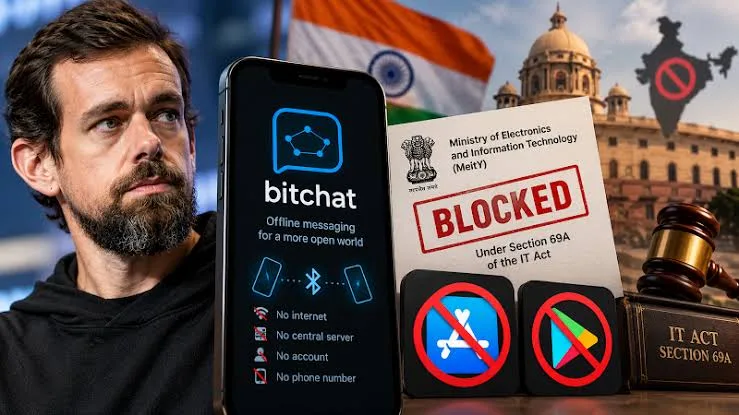
Apple India pulls down Twitter co-founder Jack Dorsey’s decentralised app, Bit Chat The Apple App Store in India has pulled down Jack Dorsey’s blockchain-based decentralised Twitter alternative Bit Chat after receiving government orders to do so. The latest move by Apple comes after the Ministry of Electronics and Information Technology (MeitY) issued a takedown order citing Section 69A of the Information Technology Act, 2000.
Apple said that the app was being taken down due to it having content illegal in India. The notice did not publicly identify the content or specify which of the grounds Section 69A of the IT Act was claimed to support the removal. Bit Chat also is reportedly not available on Google Play in India.
Bit Chat is unique to other messaging services because it operates without the use of mobile data, Wi-Fi, a phone number or server. Unlike typical messaging apps, Bluetooth Low Energy (BLE) mesh technology connects nearby devices together which then pass messages between each user.
The application had previously garnered government concerns that spring of that year (2026). In July the government directed GitHub to shut down the Bit Chat repositories citing fears that the technology could fall into the wrong hands of malefactors.
What Can Section 69A of the IT Act Do?
Section 69A of the IT Act grants the Central Government or an officer authorised by it the power to issue directions to any agency or intermediary for blocking any information through any computer resource.
The Power is not unfathomed When is it limited? Blocking is authorized under the Statute in case the Government is of the opinion that such road blockage is necessary or expedient, in the interests of the sovereignty and integrity of India, the security of India, and friendly relations of India with foreign States, public order or to prevent incitement to commission of any cognizable offence. The reasons are recorded in writing.
The Supreme Court dealt with the question of the constitutionality of Section 69A in Shreya Singhal v. Union of India. The Court upheld both the Section 69A and the 2009 Blocking Rules. The Court found that there was a set of procedural safeguards in the statutory scheme (particularly, the “reasoned blocking order” and “opportunity of hearing” in the ordinary procedure).
So too, there may have been, or were, valid and lawful grounds and safeguards when the Section 69A order was issued. If so, the removal of Bit Chat can still be declared unconstitutional.
How the Right to Privacy Is Being Invoked in the Debate
The constitutional privacy issue is rooted in the Supreme Court’s authoritative verdict in the case of Justice K.S. Puttaswamy (Retd.) v. Union of India The Supreme Court of India struck down privacy as a fundamental right encompassed under Article 21, and associated with the freedoms guaranteed by Part III of the Indian Constitution.
Privacy in the digital environment is not only about confidentiality of data but also about privacy of the person (autonomy) and the individual’s right to freedom of choice and association, which include channels of communication.
But this right is not absolute. The Supreme Court has said that an invasion of privacy must meet minimum requirements including legality, a just and legitimate aim of the State, and proportionality.
It does not, in other words, follow that the deletion of an application cannot be categorised as a breach of privacy simply because it is an app that facilitates private or decentralised communications. It is capable of applying lawfully authorised restrictions if the Constitution and legislation permit it.
Is Section 69A Enough to Ban the Whole of a Messaging App?
And then it gets very complicated from here.
Section 69A specifically states the authority to block the dissemination of information by means of a computer resource. The Supreme Court in Shreya Singhal upheld the validity of the Section due to the safeguards built into the process of blocking. The Court observed that blocking could be carried out either according to the procedure defined by the 2009 Rules or under the orders of a Court.
The distinction was also made in the context of Anuradha Bhasin v. Union of India, where the Court made an important difference between Section 69A and the power to shut down the internet. The Court held that Section 69A is used for obstructing access to a specific site or data, it was not a general power to shut down the internet.
On the question of law that the Bit Chat problem thus gives, it is clear that blocking specific illegal content and blocking an entire communications application are not directly interchangeable usages of the authority. It would have depended on what indeed was the actual order, the rationale of the order recorded and the legal process followed.
What About the Freedom of Speech and Communication?
The controversy is also linked to the scope of Article 19(1)(a), which guarantees freedom of speech and expression. Expression can include digital communication that can be considered part of the freedom of speech and expression, although it may be justifiably restricted under Article 19(2).
The significance of the case of Shreya Singhal is that the Supreme Court upheld the validity of s. 69A and at the same time, considered procedural safeguards to be significant. The Court held that the s. 69A as constitutionally valid because it limited the blocking to grounds and a procedural process.
The Internet Freedom Foundation has alleged that the Bit Chat removal was an unconstitutional act. The organisation has raised questions on why there was no blocking order, why was the alleged illegal content not provided to the user and whether the developers were given any opportunity to be heard. These are currently submissions raised by the organisation and not a finding by the Court that the government order is unconstitutional.
The Central Constitutional Question
A legal issue is not whether Bit Chat is an appropriate medium to ensure privacy, or whether the government has the power to regulate messaging apps in general. Rather, the question is whether blocking by the State is a justified means of achieving a legal end, with due process, statutory authority and proportionality.
In this context, where the government has a valid Sec 69A order on a statutory basis and has up us the necessary safeguards, there can be no privacy interest to justify a restriction. On the other hand, where the order is not on a statutory basis, or not made in accordance with its procedures, or is otherwise unreasonable, then such a restriction can be challenged on constitutional and judicial grounds.
So the real Section 69A order is material in any ultimate assessment. While Apple’s public notice cites MeitY and Section 69A, it doesn’t directly reveal the substantive reasons for the government’s direction.