Abhijeet Dipke Released While Two CJP Leaders Remain in Custody
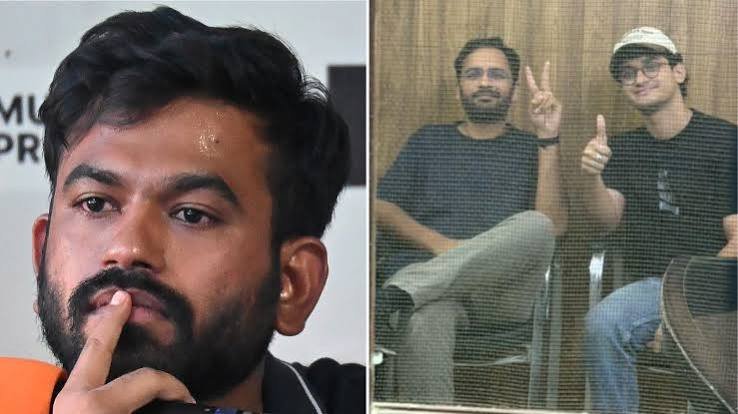
Why was Abhijeet Dipke, CJP founder, released while two other political activists, Saurav Das and Ashutosh Ranka, continue to languish in jail? Such questions are bound to arise when persons associated with the same political agitation are treated differently.
On October 17, 2026, a Special Executive Magistrate at Delhi directed Dipke’s release on his executing a bond of ₹50,000 with one surety of the like amount and on his furnishing a personal bond undertaking to keep the peace during the proceedings of the proposed demonstration at the Connaught Place.
Meanwhile, Das and Ranka were sent to five days judicial custody after they were booked on charges of trespassing into prohibited Jantar Mantar protest area despite police objections. They were produced in court on October 19 for further inquiry.
In another NDTV report, police sources said that they had been able to differenciate between Dipke and the two others because Dipke had not entered the protest, while Das and Ranka allegedly entered the prohibited zone. Their lawyers have challenged the police’s version of events and the legality of their detention.
Does Article 14 Require Equal Treatment of All Co-Accused?
India, the equality of laws and the equal protection of the laws are ensured. But this does not require that all persons involved in the same facts shall be ordered to be released or detained in the same manner.
Courts are allowed to differentiate between persons so long as the differentiation is based on relevant facts and bears a reasonable relation to the matter to be decided.
Need Help With Your PhD or LLM Thesis?
Explore our thesis and dissertation writing support services for PhD and LLM students. Get subject-specific academic assistance for your research project.
Explore Our Services →If the proceedings relate to bail or preventive proceedings, the circumstances include the person’s alleged behaviour, the evidence against them, any past behaviour which complies with directions, and the possibility of future unlawful behaviour and the statutory conditions for detention.
Thus, the release of one person does not give rise to the release of all others in relation to the same cause of action. On the other hand, this does not mean that a court may discriminate on the basis of subjective considerations, unfounded assumptions or extraneous considerations.
The key constitutional question is whether there is a legitimate and non-discriminatory reason for the differential treatment.
Why Did They Send Allandale Das and Ranka to Judicial Custody?
CJP leaders have been charged under preventive provisions of the Bharatiya Nagarik Suraksha Sanhita, 2023 Proceedings of the CJP leaders are based on the preventive provisions of the Bharatiya Nagarik Suraksha Sanhita, 2023. Sections 126 of this act empowers an Executive Magistrate to start proceedings when information is received that an individual is likely to commit any breach of peace or disturb the public tranquility.
Certain situations in which a person can be arrested to prevent commission of cognisable offences. Situation if in knowledge of commission of a design to commit an offence cognisable is to be arrested.
As per the magistrate order cited by India Today, Das and Ranka were booked for repeatedly inciting others to gather at Jantar Mantar despite the restrictions. The order, in fact, mentioned apprehensions of further breach and non-availability of acceptable sureties at that stage.
The magistrate directed notices to be issued under section 130 of the BNSS and remanded the two leaders to five days judicial custody till the next hearing. .
Their counsel has questioned the foundations of the case. They have argued that the FIR regarding entry into Jantar Mantar cannot be assumed to be the new breach of earlier peace bonds. They have also questioned whether the custody was necessary at all.
Both these aspects of the legal considerations involve an analysis of the orders and the law and circumstances in which they were required, as well as the evidence which is led before the magistrate.
What Is the Principle of Parity in Bail Matters?
The principle of parity is applied by Indian courts when an accused in the same case applies for bail. The principle stipulates that the courts should examine if equally situated persons are being treated similarly.
But parity is not mechanical The Supreme Court has held, in a string of decisions, that the role assigned to each accused, the nature of the offence and other circumstances must be considered before bail is granted on the ground that some other accused has been released.
In Ramesh Bhavan Rathod v. Vishanbhai Hirabhai Makwana (2021), the court said, “Parity should necessarily be a comparision of facts of the accused and not a mechanical extension of the benefit of bail.”
This distinction becomes especially relevant in the CJP case because Dipke and the other two leaders have been detained in relation to separate alleged acts at different times. While Dipke’s release from preventive detention came on October 17, following his arrest before a planned protest, Das and Ranka face proceedings based on their alleged acts at Jantar Mantar.
As to whether the situations were so similarly situated to permit a parity argument would depend on the legal ground and factual record of their course of proceedings.
Can Preventive Detention Be Challenged Under Articles 14 and 21?
Article 21 section on (a) personal liberty, and (b) rights to life, and has special importance, and is relied upon in many cases, because it states: “No person shall be deprived of his life or personal liberty except according to procedure established by law”–(a) as to personal liberty.
The purpose of preventive proceedings under the BNSS is to prevent a breach of peace before it happens; it is not to punish a person for an offence he has already committed and proved. The proceedings must be in accordance with the safeguards laid down by statute.
The Supreme Court in Madhu Limaye v. Sub-Divisional Magistrate (1970) held that, based on preventive proceedings under the old Code of Criminal Procedure, it was necessary to prevent abuse of the powers.
He may assert that the conditions in the statute were not met, that the magistrate did not take relevant facts into account, or that the detention is out of proportion to the preventive purpose.
Article 14 applicable where the authorities have not treated people in a similar situation less favorably without any reasonable grounds. However, it is not enough to argue that two people linked to the same demonstration received different orders and, therefore, a violation of the constitution.
What Remedies are Saurav Das and Ashutosh Ranka entitled to?
Das and Ranka might explore the remedies provided under the BNSS and constitutional law to challenge their continued detention. They might file the application before the proper superior court or approach the High Court, as per the relevant provisions and procedural aspects.
Their lawyers can challenge the adequacy of the allegations, the necessity of preventive detention, the adherence to the statutory investigation process and the grounds for or the requirement of specific sureties.
A court hearing such a challenge would then have to evaluate the bases of detention and whether the requirement that the legal grounds to keep custody be satisfied remains met. It would have also to decide whether the authorities have disparate treatment of the individuals with no legally relevant justification.
Thus, the decision to release Abhijeet Dipke and to keep Das and Ranka in detention alone does not invoke a violation of Article 14. The constitutionality of the classification turns on whether the facts and lawful reasons justify the distinction.
On 18 October 2026 proceedings against Das and Ranka listed as pending. Adjourned for 19 October. Their detention and continued detention and the grounds thereof are currently under examination by a judge.