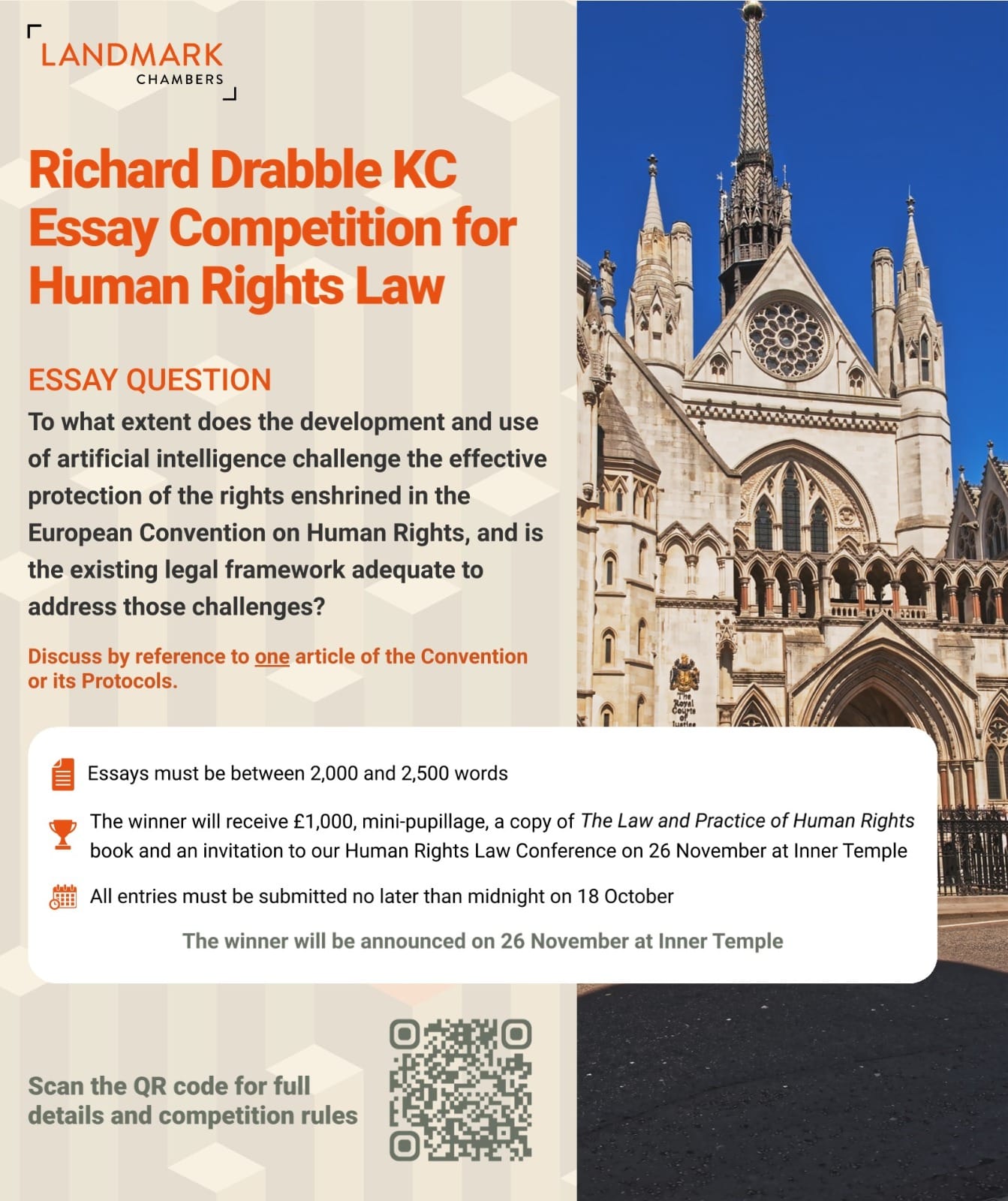
Landmark Chambers has announced the Richard Drabble KC Essay Competition for Human Rights Law, inviting aspiring lawyers, students and researchers to explore the impact of artificial intelligence on human rights protections under the European Convention on Human Rights.
The competition provides participants with an opportunity to engage with one of the most significant legal questions emerging from the rapid development and use of artificial intelligence. The organisers are particularly interested in examining whether the existing human rights framework is capable of responding effectively to the challenges created by AI.
Essay Question
Participants have been asked to address the following question:
“To what extent does the development and use of artificial intelligence challenge the effective protection of the rights enshrined in the European Convention on Human Rights, and is the existing legal framework adequate to address those challenges?”
The essay must discuss the issue by reference to one article of the European Convention on Human Rights or one of its Protocols.
The question gives participants considerable scope to examine the relationship between emerging technologies and established human rights principles. Depending on the Convention right selected, candidates may consider issues such as privacy, freedom of expression, discrimination, due process, surveillance, automated decision making and the use of AI by public authorities.
Word Limit and Submission Deadline
Essays submitted for the competition must be between 2,000 and 2,500 words. Participants will therefore need to develop a focused argument rather than attempt to address every possible human rights implication of artificial intelligence.
According to the competition announcement, all entries must be submitted no later than midnight on 18 October. Participants should consult the official competition rules for the precise submission requirements and eligibility conditions before submitting their essays.
Prize for the Winner
The competition offers a substantial package of opportunities and rewards to the successful participant.
The winner will receive £1,000, a mini-pupillage, and a copy of The Law and Practice of Human Rights. The winner will also receive an invitation to attend the Human Rights Law Conference on 26 November at Inner Temple.
The winner is scheduled to be announced on 26 November at Inner Temple.
Beyond the financial prize, the mini-pupillage and opportunity to attend a specialist human rights law conference could provide valuable exposure to practitioners working in the field.
Why the Topic Matters
Artificial intelligence is increasingly being used in areas that directly affect individuals and their rights. Governments, public authorities, employers and private organisations are adopting AI systems for decision making, monitoring, profiling and the processing of large quantities of personal information.
These developments raise difficult questions about accountability and legal protection. When an automated system contributes to a decision affecting an individual’s rights, it may not always be clear who is responsible for the outcome. Questions may also arise concerning transparency, bias, access to remedies and the ability of an affected person to challenge an automated decision.
The European Convention on Human Rights was developed long before the emergence of modern artificial intelligence. Nevertheless, Convention rights are interpreted in light of contemporary social and technological developments. This creates an important area of legal debate concerning whether existing rights and judicial approaches can adequately address the risks created by AI or whether additional safeguards are necessary.
For participants, the competition therefore offers an opportunity to examine how established human rights principles can be applied to rapidly changing technology.
A Strong Opportunity for Law Students and Researchers
The Richard Drabble KC Essay Competition may be particularly valuable for students and early-career researchers interested in human rights law, constitutional law, technology law and public law.
A successful essay will likely require participants to do more than describe the potential risks associated with artificial intelligence. The competition question calls for a critical assessment of the adequacy of the existing legal framework. Participants should therefore develop a clear legal argument supported by relevant Convention provisions, case law and academic commentary.
Choosing a single Convention article can also help candidates develop a focused and detailed analysis. Rather than attempting to discuss artificial intelligence and human rights generally, participants can examine a specific right and use AI-related developments to test the strengths and limitations of the existing legal framework.
How to Approach the Essay
Candidates should begin by selecting the Convention right that provides the strongest foundation for their argument. They should then identify the principal ways in which artificial intelligence may affect that right and consider how the European Court of Human Rights has approached comparable issues.
The essay should maintain a clear central argument throughout. It should consider both the ability of existing Convention protections to respond to technological developments and the possible gaps or limitations in the current framework.
The strongest submissions are likely to demonstrate an understanding of both technology and human rights law while maintaining a precise focus on the question set by the competition.
An Emerging Area of Legal Debate
The increasing use of artificial intelligence is likely to generate significant litigation and policy debates in the coming years. Issues concerning privacy, discrimination, freedom of expression, surveillance and procedural fairness are already attracting considerable attention from courts, governments and international organisations.
The Richard Drabble KC Essay Competition provides participants with an opportunity to engage with these questions from the perspective of the European Convention on Human Rights. It also offers aspiring lawyers an opportunity to develop their legal research and writing skills while addressing a subject of growing importance to the legal profession.
Interested candidates should carefully review the official competition rules and ensure that their essays comply with the prescribed word limit and submission deadline. Entries must be submitted by midnight on 18 October.
The competition represents an attractive opportunity for law students and emerging legal researchers seeking to develop their expertise in human rights law and explore the challenges posed by artificial intelligence to established legal protections.