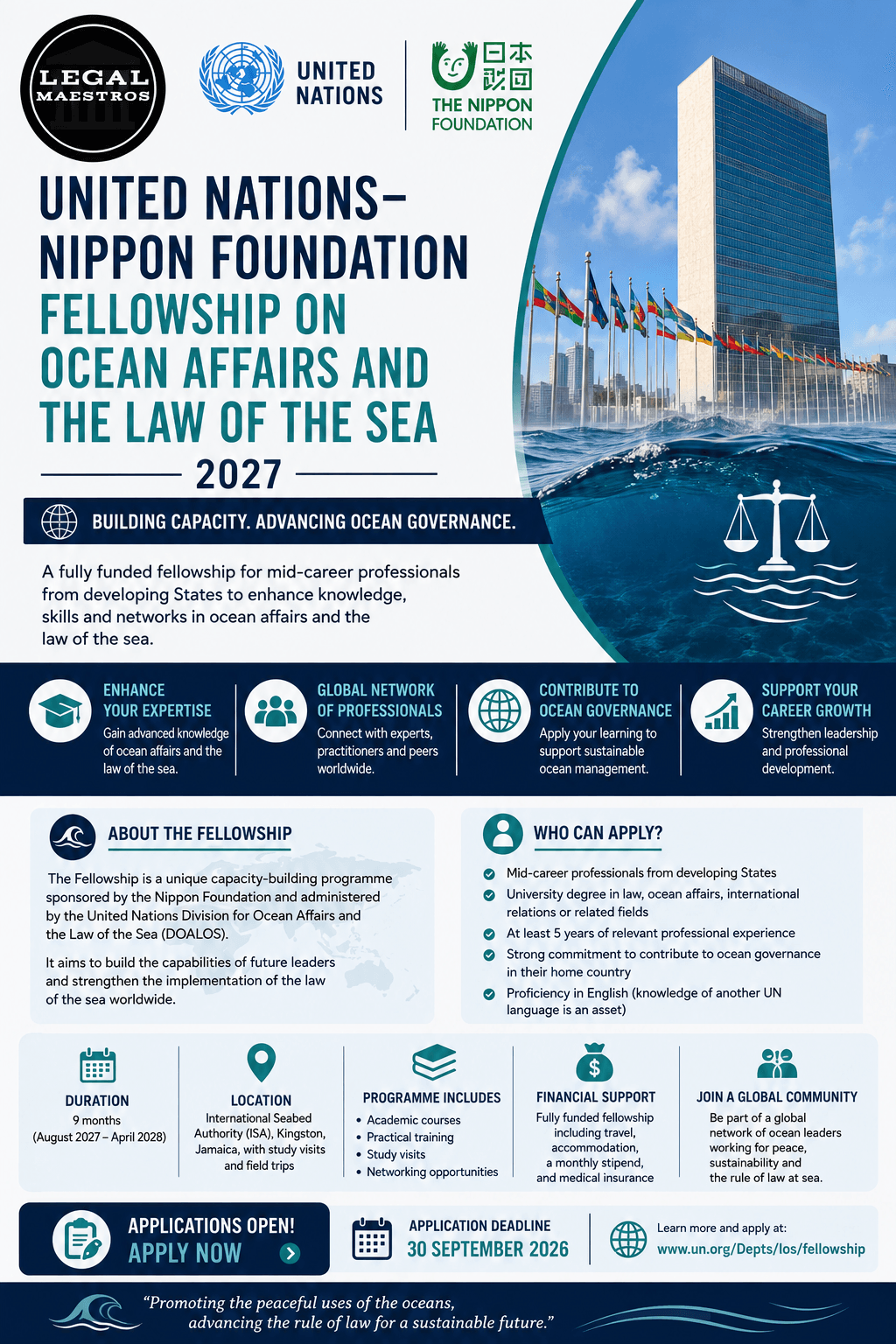
The United Nations Office of Legal Affairs – Division for Ocean Affairs and the Law of the Sea (OLA/DOALOS) has officially opened applications for the 2027 session of the United Nations–Nippon Foundation Fellowship on Ocean Affairs and the Law of the Sea (UNNF
This prestigious fully funded international fellowship is designed for mid-level government officials and professionals from developing countries who are directly involved in ocean affairs, maritime governance, marine science, and the implementation of the UNCLOS
For the 2027 session, 14 fellowships will be awarded to qualified candidates, offering an exceptional opportunity to receive advanced training at United Nations Headquarters in New York followed by a six-month research placement at a leading academic institution specializing in ocean affairs and the law of the sea.
Since its launch in 2004, the United Nations–Nippon Foundation Capacity-Building Programmes have trained more than 350 professionals from around the world, helping strengthen national and regional capacities for sustainable ocean governance.
Applications close on 13 September 2026, and interested candidates are encouraged to begin preparing their applications early.
The United Nations–Nippon Foundation Fellowship on Ocean Affairs and the Law of the Sea is a flagship capacity-building initiative that equips professionals with the knowledge and practical skills needed to strengthen ocean governance and support sustainable development.
The fellowship focuses on helping participants better understand and implement international legal frameworks governing the oceans, particularly the UNCLOS
By combining classroom-based learning with advanced academic research, the programme prepares fellows to make meaningful contributions to ocean policy, marine resource management, maritime governance, and environmental protection in their home countries.
Fellowship Objectives
The programme aims to strengthen national capacities by providing participants with advanced training and research opportunities.
Key objectives include:
- Enhance knowledge of ocean affairs and the law of the sea.
- Support implementation of UNCLOS and related legal instruments.
- Strengthen national and regional ocean governance.
- Promote sustainable management of marine resources.
- Build expertise in marine science and ocean policy.
- Contribute to the implementation of the 2030 Agenda for Sustainable Development, particularly Sustainable Development Goal 14 (Life Below Water).
- Develop future leaders in maritime governance and ocean management.
Fellowship Structure
The fellowship runs for nine months and is divided into two distinct phases.
Phase One: United Nations Headquarters Training
The first phase takes place at United Nations Headquarters in New York.
Duration:
- 24 March – 30 June 2027
During this period, fellows receive intensive training from experts in:
- Ocean affairs
- International maritime law
- UNCLOS implementation
- Marine governance
- Ocean policy
- Sustainable ocean management
- International legal frameworks
Participants also gain valuable exposure to the work of the United Nations and interact with professionals from around the world.
Phase Two: Academic Research
The second phase consists of a six-month research placement at one of the participating academic host institutions.
Duration:
- 1 July – 17 December 2027
Each fellow is matched with a host institution based on the relevance of its expertise to the fellow’s proposed research topic.
The research phase allows participants to deepen their knowledge while producing work that can benefit their home institutions and countries.
Who Can Apply?
The fellowship targets experienced professionals already working in ocean-related fields.
Applicants must meet all of the following eligibility requirements:
- Be 25 to 45 years of age.
- Hold at least a first university degree or equivalent.
- Demonstrate the ability to undertake advanced academic research.
- Be a national of a developing State.
- Be a mid-level government official or mid-level professional directly involved in ocean affairs or the law of the sea.
- Have a strong command of spoken and written English.
Training is delivered in English. However, French and Spanish training materials may be available upon request, subject to availability. Research may be conducted in English or French if the selected host institution can provide appropriate supervision.