Introduction
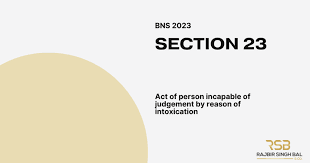
Section 23 of the Bharatiya Nyaya Sanhita (BNS), 2023, deals with cases where a person does something while being involuntarily drunk. It says that if someone is involuntarily drunk or without his knowledge and, due to that, is unable to comprehend the nature of his act or realize that what he is doing is wrong or unlawful, he is not criminally responsible for his act.
Understanding the Provision
This legal stipulation recognizes that intoxication will weaken one’s judgment and perception. Yet for this exemption to hold, two conditions need to be fulfilled:
1. Involuntary Intoxication The intoxicating substance must have been given to the person unknowingly or against his will.
2. **Impaired Understanding**: Because of this involuntary intoxication, the person must not be able to know the nature of his act or that he is doing something wrong or against the law.
For More Updates & Regular Notes Join Our Whats App Group (https://chat.whatsapp.com/DkucckgAEJbCtXwXr2yIt0) and Telegram Group ( https://t.me/legalmaestroeducators )
Illustrative Example
Imagine a situation where a person goes to a social party and drinks a non-alcoholic drink. Without their knowledge, somebody has spiked the drink with a very strong intoxicant. As the effect of the substance is felt, the person becomes extremely intoxicated and, in that state, causes damage to property. By Section 23, since the drunkenness was involuntary and it made the person incapable of knowing what they were doing, the person would not be criminally liable for the damage done.
Need Help With Your PhD or LLM Thesis?
Explore our thesis and dissertation writing support services for PhD and LLM students. Get subject-specific academic assistance for your research project.
Explore Our Services →Distinction from Voluntary Intoxication
It is important to distinguish between involuntary and voluntary intoxication. If a person voluntarily takes an intoxicating substance and then commits an offense, they cannot plead exemption under Section 23. The law makes people responsible for acts done while voluntarily intoxicated, since they are held responsible for putting themselves in such a state.
Burden of Proof
The burden of establishing involuntariness of intoxication rests on the accused. They have to show that the intoxicating drug was given without their knowledge or against their will, resulting in their state of intoxication at the time of the act.