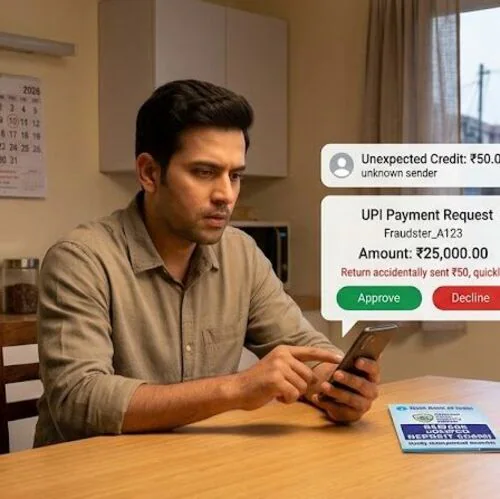
SBI Warns Customers About the Jumped Deposit Scam
The State Bank of India (SBI) issued a warning about the online scam called ‘Jumped Deposit Scam’. In the Jumped Deposit Fraud, the scammer takes advantage of a sudden credit in the bank account.
This scam generally starts when an individual gets a low amount of money credited to their digital payment system. Moments later, the scammer poses as the one who had transferred the amount by mistake, and then asks for a refund right away. The scammer might put a person on a deadline and ask them to initiate a request or direct through a UPI app.
It can get risky when victim thinks they are refunding the original amount and unknowingly authorizes a new payment to the culprit. The amount can be far more than the unexpected deposit. SBI has told customers not to trust suspicious refund requests and to verify transactions before acting on any. (The Economic Times)
Can a Victim Recover Money Under Indian Banking Laws?
The extent to which a victim can be reimbursed for that sum also hinges on the transaction in question. Several guidelines concerning the extent of liability for the customer as regards transactions in unauthorised electronic banking transactions have been laid out by the Reserve Bank of India (RBI). Under these guidelines, certain remedies are available if a customer loses money due to a third-party breach.
Need Help With Your PhD or LLM Thesis?
Explore our thesis and dissertation writing support services for PhD and LLM students. Get subject-specific academic assistance for your research project.
Explore Our Services →Under the RBI guidelines, in case of unauthorised transaction, the customer is not liable where the unauthorised transaction is due to the negligence or deficiency on part of the bank. Zero liability is also there if the unauthorised transaction is caused due to third party breach and neither bank nor customer is negligent. The customer must intimate the bank within three working days of receipt of communication.
In cases where the loss is attributable to the negligence of the customer, e.g. dissemination of any means including the payment credentials, the loss before reporting of an unauthorised transaction would be attributable to the customer. For some of the third party breaches reported within four to seven working days, liability is restricted under the RBI guidelines.
But the difference between an unauthorised transaction and a payment that the customer himself has authorised is important. Under a jumped deposit scam, the victim can be tricked into entering the UPI PIN and authorising a payment. The bank can look into the situation and determine whether the transaction should be covered by the RBI rules. Being tricked doesn’t necessarily mean that you will be reimbursed.
As per the RBI framework, the banks have to implement a facility to report unauthorised electronic transactions and take measure to stop further unauthorised transactions upon notice. Customers should thus report the incident promptly and ask for a formal investigation. (Reserve Bank of India)
What Legal Remedies Are Available to Victims?
The victim can file the case as suspected cyber financial fraud on the National Cyber Crime Reporting Portal and the cybercrime helpline number. The complaint filed by the victim can assist law enforcement agencies in probing the transaction and tracking down the suspected accounts and taking necessary action related to the money that is still traceable.
In addition to the above, in certain cases, the act may fall under criminal offences in connection with cheating, impersonation, or any other offences under the Indian law, to which it might be subjected. The exact offences are determined on how the cheating was executed, and who were involved.
Filing a cybercrime complaint alone does not ensure a refund of the amount. The investigating agencies can identify the trail of the transaction by tracking the money in several bank accounts and take necessary action. It may be harder to recover the amount once withdrawn or moved further.
The victims should keep the bank statements, details of the transaction reference number, UPI payment, screen shots, messages, call recordings, and other communication with the identified fraudster. These records will aid the bank and investigating authorities in understanding the case and concluding whether the transaction is lost and result of deception.
Why Minutes Matter When Reporting
Contact bank if money lost through jumped deposit The person should contact their bank straight away on the registered number for customer service or go into their branch. They should then tell the bank that the deposit is in dispute and ask for a reference number.
Victims are advised to make an immediate report by calling 1930, India’s helpline for cyber financial fraud, and lodge a complaint on the National Cyber Crime Reporting Portal. In most cases, the faster the authorities and involved financial institutions are made aware of the fraudulent transfer, the easier it is to locate and retrieve the amount.
“We introduced the Citizen Financial Cyber Fraud Reporting and Management System with an objective of enabling quick reporting and action for preventing siphoning of money through cyber fraud. It all depends on the circumstances and action taken by respective authorities and financial institutions whether funds could be frozen or retrieved,” the MHA said. (Press Information Bureau)
In the event that the bank refuses to credit the claim for an unauthorised transaction, the customer should specifically seek the reason from the bank in writing and file the complaint with the bank’s grievance redressal machinery. If the dispute is not resolved or the customer’s grievance is not satisfied, the customer can proceed to the Integrated Ombudsman Scheme of the RBI with its eligibility criteria and procedural compliance.
How Customers Can Protect Themselves
The best course of action to take when faced with an unforeseen deposit is never to follow instructions from an unknown caller. Always check the credit in the app or bank statement first, and contact the bank directly if you notice it is one you were not expecting. Never send the money to another caller because you think they could be the sender.
You have to keep in mind that a UPI PIN for registering a beneficiary and performing a transaction is different from an OTP for cashing in a payment on the UPI platform. You do not approve a payment to receive money.
Where a authentic transfer has been made in error, instead of refunding it directly into an unverified account, ask the bank to assist with the official retraction or refund process. This minimizes the risk of accidentally refunding a criminal whilst the initial credit remains unclaimed.
The jumped deposit scam is used as an example of a standard banking activity that the cyber-criminal is using and that is “rushing to return the money”. Indian banking and cyber-criminal mechanisms provide recourse for reporting, investigating and recovering. However, the immediacy of the report, the transaction record and the legal categorisation of the th.