‘Chalo Dilli’ March Results in Supreme Court Complaint
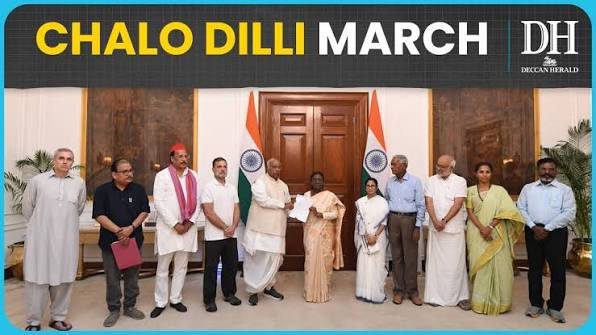
The India bloc led by Congress held a protest march to the Supreme Court on October 12, 2026, called the ‘Chalo Dilli: March for Democracy’, in which opposition leaders including Rahul Gandhi and Mallikarjun Kharge demanded accountability from the Election Commission of India (ECI) over anomalies in electoral rolls and the Special Intensive Revision (SIR) process.
Delhi Police halted the march just before reaching the Supreme Court. A team of opposition leaders was allowed inside the court premises to submit their petition at the filing counter. The petition against the Election Commission, led by Rahul Gandhi and signed by all opposition leaders, alleges certain irregularities in the working of the Election Commission.
This is the development that took place after the CJI refused to meet with the opposition delegation to accept its memorandum. The CJI told the opposition leaders that they will have to seek the Court’s intervention through its prescribed mechanism as the matter was already before the Court. The petition was moved under Art 32 of the Constitution. (The Indian Express)
What Does Article 32 of the Constitution Provide?
Article 32 gives the right to file a writ petition in the Supreme Court for the enforcement of fundamental rights. The Supreme Court can provide the necessary directions, orders or writs for enforcement of the fundamental rights.
Dr B.R. Ambedkar once remarked that Article 32 was “the very soul of our Constitution, the very heart of it”. That’s because a fundamental right is only useful when an individual is able to approach a court in order to defend it. A petition under Article 32 is, therefore, not an appeal against a mere administrative decision.
Citizens can accordingly seek the protection of the Supreme Court if they allege that some act of State has infringed their fundamental rights. But the Court cannot unconditionally entertain every petition directed to the Court under Article 32. They will have to fulfil that there is a legally permissible ground for seeking relief and the Court takes facts, laws and constitutional questions into account.
Need Help With Your PhD or LLM Thesis?
Explore our thesis and dissertation writing support services for PhD and LLM students. Get subject-specific academic assistance for your research project.
Explore Our Services →In this case, the petition states that eligible citizens have been excluded from the voters list without proper guardrails. These exclusion of eligible voters from the election lists have implications for the constitutional setup of the election and the citizen’s right to vote. (India Today)
Can the Election Commission Be Challenged Under Article 32?
The Election Commission of India is a constitutional authority established under Article 324 of the Constitution. Its powers and functions include the superintendence, direction and control of the entire process relating to the preparation of electoral rolls and the conduct of elections to the Parliament, State legislatures and of the offices of the President and Vice- President.
ECI is a constitutionally mandated entity, but its decision is not automatically immune to judicial review. The Supreme Court and High Courts are empowered to question the Commission for any transgression of powers, relevant laws, and fundamental rights.
Article 32 is used when a petitioner contends that the Commission has violated a fundamental right. It’s important to note, however, that not every dispute over an electoral outcome is entitled to the Article 32 remedy. The Court will determine whether the petition alleges a constitutional violation and whether the requested relief is permitted by law.
The distinction is relevant to the present case. The opposition petition asks whether the Commission collectively exercised its authority within the law and whether the SIR process’s execution was consistent with safeguards on registration and deletion. These are allegations made by the petitioners and will have to be tested by the courts rather than assumed to be violations.
What Is the Dispute Over Special Intensive Revision?
The exercise of revision of electoral roll carried out by the Election Commission. The revision of electoral roll meant ensuring the correctness of the electoral rolls by bringing in the eligible electors and deleting the others who ceased to be eligible under the law.
The opposition petition addresses irregularities including questions of the manner in which the deletion process was undertaken, while pointing out the gap in the process and whether or not all qualified voters were duly notified. It also seeks to obtain information on records pertaining to the Commission’s orders and the manner in which it used its powers.
The petition admits that the Supreme Court had, on 27.05.2026, upheld the validity of the SIR in ‘Association for Democratic Reforms v. Election Commission of India’. As per the petition, the present challenge is limited to the implementation of the exercise, compliance of safeguards and legality of certain administrative steps taken by authorities and not re-opening the wider issue of the validity of the SIR.
The Election Commission has stood by its decision and process in the larger debate. The issue before the Court is whether the actions in question met the constitutional and statutory standards, which include protection for registration and deletion for electoral purposes. (The Indian Express)
Does the Right to Vote Fall Under Article 32?
Voting has a unique constitutional status in India. While the Supreme Court has tended to view the right to vote as a statutory right relying on election rules, the Court has also recognised that different elements of electoral participation and information may implicate constitutional protection.
Sabha and to the Legislative Assemblies of States And Article 230(r) Elections on the basis of adult suffrage to the State legislatures and regulations thereon. Representation of the People Act, 1950 and rules made thereunder (for electoral registration) Representation of the People Act, 1951 and rules made thereunder (for election related essentials)
This difference between the statutory right to vote and the fundamental rights potentially involved in elections is relevant for Article 32. Petition is not sustainable on the ground that every election dispute involves violation of a fundamental right. The Court has to find whether the conduct complained of violates an enforceable right or otherwise falls within its relief jurisdiction.
When entitled citizens are purportedly omitted from electoral rolls in contravention of prescribed procedures, the matter may give rise to issues of equal treatment, lawful governance and the constitutional obligation to a representative democracy. It is to be seen whether those issues will qualify as standing for action under Article 32.
What’s Next in the Supreme Court?
This is a request that the courts directly examine the Election Commission’s decision making and its implementation of the SIR. Key reliefs include directions for the production of relevant records, greater transparency as to deletion from the electoral-roll, examination of the functioning of electoral databases, and protection of right to vote of eligible voters from illegal deletion.
The filing of a petition does not ipso facto imply that the allegations have been accepted or the reliefs sought granted by the Supreme Court. The Court will have to decide the issue in accordance with law including other proceedings related thereto, and the judgments in force in respect of the SIR.
This also highlights the distinction between the exercise of political protests and the exercise of remedial mechanisms under the constitution. Citizens and members of parliament have the right to express their political views by peaceful demonstration, which can be limited in the public interest. Citizens who want binding judicial relief must utilize the right procedure.
Following article 32 is also an effective way to control fundamental rights.