Makhi Janta Party Rises Following Chief Justice’s Remark
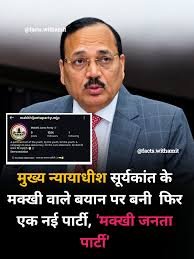
It is in this context that the newly-formed MJP (Makhi Janta Party) has garnered attention on social media and elsewhere by questioning how the fundamental right to freedom of expression, political satire and the judiciary in India operates. The satirical set-up found inspiration in Chief Justice of India Surya Kant’s warning to authorities not to use a “hammer to kill a fly” when considering restrictions ahead of a planned demonstration in Delhi.
Bench, comprising CJI Surya Kant, examined general restrictions on the public transport system, the closure of the stations of the Delhi Metro and restrictions on trains, before the fight of the Mayor Cockroach Party (CJP) and other organizations. The bench noted that the arrangements related to the safety of the public could be implemented even without shutting down the public transport system completely. The comparison later became the online identity of the Makhi Janta Party. (The Indian Express)
The MJP gained widespread attention on social media, after it came up with a fly reference in its name and posts. Tweets reported on October 13 said the organisation said it received over 40 lakh views and over 3.3 lakh Instagram followers in 72 hours. It has also said it supported the Cockroach Janta Party which was formed as a satirical take on the earlier controversy around the comments made by the CJI regarding a section of the youth. (Hindustan Times)
Article 19 Protects Satire and Freedom of Expression
Article 19(1)(a) of the Constitution of India provides to every citizen the right of freedom of speech and expression. Its scope is not restricted to political speeches or newspaper articles. It can also include cartoons, parody, satire, memes and criticism of public institutions, such as the judiciary.
Satire often employs hyperbole, humour and irony to ridicule those in power. A satirical organisation that references the comment of a judge in its name or online activity will not necessarily be in breach of the law simply because its material relates to a judge or court.
But freedom of expression under Article 19 is not unlimited. Article 19(2) allows for certain “reasonable restrictions” on freedom of speech and expression that are imposed “by law” on grounds that include order, defamation and contempt of court. If you criticise the judiciary, whether your post is protected under the constitution will depend on the nature, content and consequences of your post. (Constitution of India, Art 19)
Need Help With Your PhD or LLM Thesis?
Explore our thesis and dissertation writing support services for PhD and LLM students. Get subject-specific academic assistance for your research project.
Explore Our Services →When Can Satire Become Contempt of Court?
Section 2(c) of the Contempt of Courts Act, 1971 states that “a publication, a speech or a writing which scandalizes or tends to scandalize or lowers or tends to lower or prejudices or interferes or tends to interfere with the course of judicial proceedings in a court or interferes or tends to interfere with the due course of a judicial proceeding in a court”.
However, criticising a judgment, dissenting from a court observation or employing humour about a court does not per se amount to contempt. The form of expression and the possible effect on the course of justice should be taken into account. A line must be drawn between questioning public decisions in criticism and falling into contempt of court.
Safeguards are also provided in law. A fair comment on the merits of a case which has been heard and finally decided shall not amount to contempt (section 5). The punishment for contempt shall not be imposed if contempt interferes, or tends to interfere, substantially with the course of justice (section 13). Truth may also be pleaded as a defence if the court is satisfied that the plea is made in the public interest. (Contempt of Courts Act, 1971).
Judicial Authority and the Right to Question Institutions
The satire-judiciary debate points to a larger constitutional dilemma: How can courts uphold their legitimacy, while giving the public a right to hold the judiciary accountable? Judges play a vital constitutional role, but that public role does not exempt every judicial utterance from criticism.
In a constitutional democracy, the public’s trust in the institutions of the state can be reinforced through dispassionate judgment, openness and the opportunity for people to discuss issues of collective concern. Satire can be part of that discussion, especially when it comments on statements in court or decisions affecting public life.
Similarly, criticism is to be differentiated from lies, defamation, personal threats or behaviour that hinders the administration of justice. The right to free expression under the constitution does not provide an unfettered guarantee for what is posted online. Nor does mere embarrassment of an institution – by whatever a statement may be, constitute as a matter of itself, that something is not subject to the restrictions in Article 19(1)(a).
What Does the Makhi Janta Party Episode Mean for Article 19?
The Makhi Janta Party, a judicial metaphor has left the courtroom and entered popular commentary. Its name transforms the Chief Justice’s fly into a satiric retort, and its social media presence ties this episode into larger debates over protest, accountability and the response to dissent.
If any specific posting by the group would be protected speech then, without looking at the content and context, it is impossible to know. The name, the notoriety, the use of humour are not the test. The limit would also have to be measured by the law and constitution.
The larger point is that the principle is that Article 19 provides room for citizens to ask questions, criticise and satirise public institutions. It is available in conjunction with the contempt law, not in opposition to it. The goal is to maintain the integrity and independence of the courts without overly constraining the democratic critical space.