.
Introduction
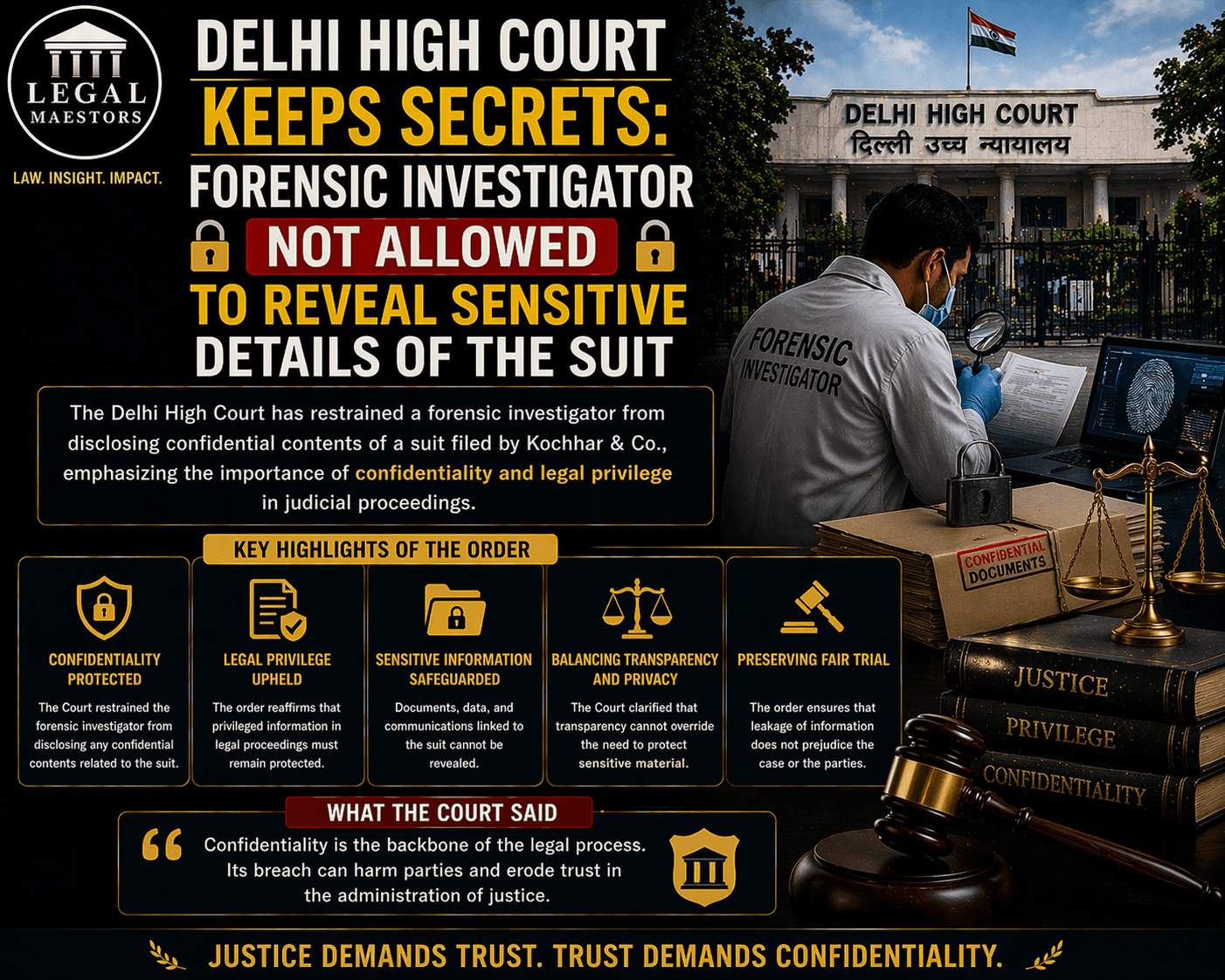
In a landmark ruling, the Delhi High Court has given an important order on preserving confidentiality in lawsuits by prohibiting a forensic investigator to reveal sensitive materials of a suit filed by Kochhar and Co.
The case shows the significance of privacy, professional ethics, and confidentiality of legal information in the judicial process.
Background of the Case
The case was brought about in relation to a lawsuit brought by Kochhar and Co., which is among leading law firms in India.
Throughout the proceedings, a forensic investigator was engaged, probably to analyze documents, digital evidence, or internal communications pertinent to the case.
It was however questioned that the investigator would disclose or may disclose confidential information regarding the suit.
Need Help With Your PhD or LLM Thesis?
Explore our thesis and dissertation writing support services for PhD and LLM students. Get subject-specific academic assistance for your research project.
Explore Our Services →This led the law firm to the Court to seek urgent relief.
Issue Before the Court.
The primary matter to be considered by the Court was whether a forensic investigator can reveal or distribute confidential material acquired in the process of investigation in an ongoing legal case.
The Court was forced to weigh openness and the necessity to keep privileged and sensitive information secret.
Court’s Observations
The Delhi High Court was very firm on the aspect of confidentiality.
It observed that:
Criminal cases are usually related to confidential and sensitive data.
Any unauthorized release may damage the involved parties and jeopardize the fairness of the trial.
Individuals working in these affairs are subjected to confidentiality and ethical standards.
The Court stressed that in order to preserve trust in the legal system, the confidential information should be strictly protected.
In lawsuits, Confidentiality is important.
The Court pointed out that confidentiality is one of the pillars of legal profession.
It ensures that:
The clients do not have to fear sharing information with their lawyers.
Legal measures and practices are safe.
The integrity of judicial proceedings is maintained.
Any breach of confidentiality can have serious legal and professional consequences.
Restraint Order by the Court
Given the gravity of the issue, the Court issued an order barring the forensic investigator to reveal any confidential content in regard to the suit.
This included:
Paperwork reviewed in the investigation.
Data acquired in the process of forensic analysis.
Any communication or any material that is associated with the case.
The objective of the order was to avoid misuse or leaking of sensitive information.
Finding the balance between Transparency and Privacy.
The Court agreed that transparency is a significant issue, but it cannot be at the expense of confidentiality.
It clarified that:
Not everything heard in court is to be disclosed publicly.
There are some materials that should be preserved so that there is fairness and justice.
The Court has the role of balancing between privacy and openness.
Importance of the Judgment.
This is an important order in the sense that it:
Strengthens the obligation of privacy among those professionals in legal affairs.
Insures litigants against possible damages due to information leaks.
Enhances confidence in the courts of law.
Provides a precedent of dealing with sensitive information in contemporary issues of digital and forensic evidence.
The ruling of the Delhi High court is a lesson that confidentiality is not only a professional practice but it is also a necessity to the justice system.
The Court crippled the forensic investigator by doing this, in order to make sure that confidential legal information is safeguarded, and that the proceedings are conducted within a system of integrity.
This ruling is a step in the right direction towards dealing with issues concerning privacy and data security in the dynamic legal environment.
Keywords
confidentiality, forensic investigator, data protection, sensitive information, legal ethics, Indian judiciary, Kochhar & Co, Delhi High Court.