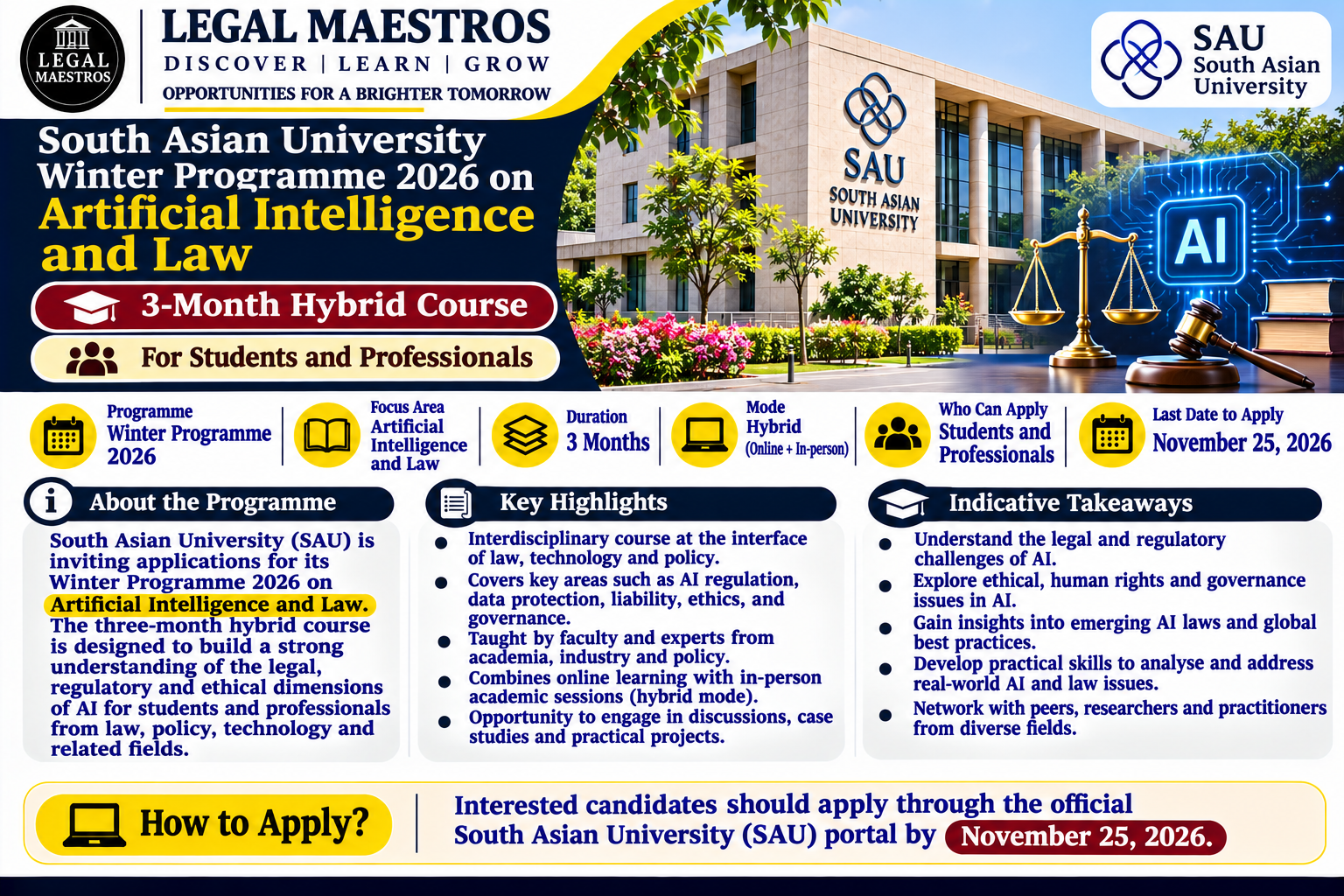
The Faculty of Legal Studies at South Asian University, New Delhi, is organising a three-month Winter Programme on Artificial Intelligence and Law, beginning on 12 December 2026. The programme will examine the legal and policy issues arising from the increasing use of artificial intelligence across different sectors.
The course will be conducted in a hybrid format, with sessions taking place online and at the university campus in New Delhi. Classes will be held on weekends over 12 weeks.
Applications are open to law students, research scholars, advocates, judicial officers, government officials, corporate professionals, academicians and individuals interested in artificial intelligence and its regulation.
The last date to apply is 25 November 2026.
About South Asian University
South Asian University is an international university based in New Delhi. It was established through an agreement among member countries of the South Asian Association for Regional Cooperation (SAARC).
The university offers postgraduate and research programmes in several academic disciplines, including legal studies.
Need Help With Your PhD or LLM Thesis?
Explore our thesis and dissertation writing support services for PhD and LLM students. Get subject-specific academic assistance for your research project.
Explore Our Services →Its Faculty of Legal Studies undertakes teaching and research concerning law, governance, international legal developments and contemporary regulatory issues.
The Winter Programme on Artificial Intelligence and Law is being organised by the Faculty of Legal Studies.
About the Winter Programme on Artificial Intelligence and Law
Artificial intelligence is increasingly being used in business operations, public administration, financial services, healthcare and other areas.
Its growing use has raised questions concerning privacy, intellectual property, competition, consumer protection and legal accountability.
The Winter Programme aims to examine these issues through discussions of existing legal frameworks, policy developments and practical examples.
The programme will combine academic learning with case studies, research exercises, compliance-related activities and interactions with experts.
It is designed for participants from legal as well as non-legal backgrounds who want to understand the relationship between artificial intelligence, law and public policy.
Programme Duration and Format
The programme will run for three months, covering approximately 12 weeks.
Starting Date: 12 December 2026
Duration: 3 months (12 weeks)
Mode: Hybrid
Schedule: Weekend sessions
Venue: South Asian University, New Delhi, and online
Participants will be able to attend sessions through the hybrid format according to the arrangements specified by the organisers.
The exact session timetable and attendance requirements should be checked in the detailed programme brochure.
Topics Covered During the Programme
Artificial Intelligence and Legal Implications
The programme will examine legal questions arising from the development and use of artificial intelligence.
Participants will discuss how AI technologies interact with existing legal principles and regulatory systems.
AI and Data Privacy
Sessions will explore the relationship between artificial intelligence and personal data protection.
The discussions will consider privacy-related legal questions arising from the collection, processing and use of data in AI systems.
AI and Competition Law
The programme will address competition law issues connected with artificial intelligence.
This area will examine the relationship between emerging technologies, business practices and competition regulation.
AI, Consumer Law and Policy
Participants will study legal and policy questions involving AI-based products and services from the perspective of consumer protection.
AI and Intellectual Property Rights
The programme will discuss intellectual property issues arising from artificial intelligence, including questions involving the creation and use of AI-generated material.
AI and International Law
Sessions will also consider artificial intelligence in the context of international law and cross-border regulatory developments.
Sector-Specific Regulation
The programme will examine regulatory questions concerning the use of AI in healthcare, telecommunications, banking and finance.
These sessions will connect broader legal principles with sector-specific applications.
Learning Activities and Expert Interactions
The programme will use several learning methods rather than relying only on lectures.
Participants will engage in case studies, group discussions, research and policy exercises, and compliance-related activities.
The organisers have also planned expert sessions and industry interactions.
Networking opportunities will include an introductory lunch, tea and interaction sessions, and a valedictory networking lunch.
These activities are intended to provide opportunities for participants to interact with speakers, faculty members and fellow participants.
Who Can Apply?
The programme is open to candidates from different academic and professional backgrounds.
Law students and research scholars interested in technology law and policy may apply.
Advocates and other legal practitioners are also eligible to participate.
The programme is open to judicial officers, government officials, in-house counsel and compliance professionals.
Corporate and technology professionals may apply, along with academicians and researchers.
Individuals from other disciplines who have an interest in artificial intelligence, law and policy are also welcome.
The announcement does not prescribe a minimum academic percentage or a specific number of years of professional experience.
Registration Fees and Assessment
The organisers have indicated that the detailed programme brochure contains information about the course fees, assessment requirements, programme structure and modules.
However, the fee amount and assessment conditions are not included in the announcement provided here.
Applicants should review the official brochure or contact the organisers before completing their registration.
How to Apply
Interested candidates must complete the online registration form for the Winter Programme on Artificial Intelligence and Law.
Registration Link: https://docs.google.com/forms/d/e/1FAIpQLSc0HdPu0bW-qMc1PaJ7UNznTjAGtFp4N8ulaXdGcRJRoG4Ihg/viewform
Applicants should follow the instructions provided in the registration form and check the detailed brochure for information about the programme fees and other requirements.
Important Dates
Last Date for Applications: 25 November 2026
Programme Commencement: 12 December 2026
Programme Duration: 12 weeks
Contact Details
For queries relating to registration, eligibility, fees or the programme schedule, applicants may contact the organisers.
Organising Institution: Faculty of Legal Studies, South Asian University, New Delhi
Email: AI-Law@sau.int
Phone: +91 9610608888
Official University Website: https://sau.int/
Registration: https://docs.google.com/forms/d/e/1FAIpQLSc0HdPu0bW-qMc1PaJ7UNznTjAGtFp4N8ulaXdGcRJRoG4Ihg/viewform
Note: The information above is based on the programme announcement supplied. The detailed brochure was not available for review, so the registration fees, assessment conditions and complete module structure have not been independently confirmed.
Keywords: South Asian University Winter Programme 2026, Artificial Intelligence and Law Course, SAU AI and Law Programme, AI Law Certificate Course 2026, Technology Law Courses India, AI and Data Privacy Course, AI and Competition Law, Legal Education Programmes 2026, Hybrid Law Courses New Delhi, Artificial Intelligence Law Training, SAU Faculty of Legal Studies