Rajpal Yadav’s 2 Crore Payment Dispute Reaches the Supreme Court
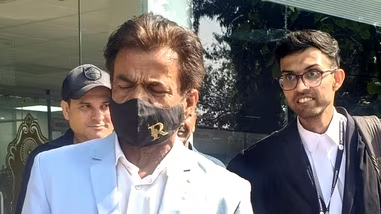
Actor Rajpal Yadav has appeared before Supreme Court once again regarding the long pending cheque bounce case for his 2012 film Ata Pata Laapata. Supreme Court has told the actor to deposit Rs 2 crore and ordered him to raise rest of the amount by selling the ancestral property.
The differences had started after Murali Projects Pvt Ltd had extended financial aid of about 5 crore for the film. The complainant alleged that subsequently an agreement had been entered into where Yadav, his wife Radha Rajpal Yadav and their company had agreed to repay the amount along with interest. However seven cheques issued for the repayment had bounced.
This culminated in the initiation of criminal proceedings under the law on dishonour of cheques. Yadav was convicted by a magistrate in 2018 and was awarded imprisonment. The conviction was confirmed by the Sessions Court and the Delhi High Court, with the latter reduced to three months of imprisonment.
May the Supreme Court Award Money?
The Court does not want the impression that the Court is functioning as a civil recovery agency. It is from offences under the offence of dishonoured cheque, the proceedings before the Court are instituted.
Section 138 of the Negotiable Instruments Act stipulates that if a cheque is dishonoured due to insufficiency of funds, it can be deemed to be a criminal offence if the conditions specified under the section are fulfilled. The provision also enables the criminal court to sentence the defendant with a fine and imprisonment. Even in criminal law, there is a financial repercussion on the person found guilty.
An additional factor in Rajpal Yadav’s situation is that the court has also considered the effects of the sentence and the application for relief from that sentence that he has made. So, the court has been examining whether he can make payments at this stage when his challenge remains at the Court. The direction to deposit money is related to proceedings.
Why Required to Deposit 2 Crore?
Yadav was granted another chance by the apex court to prove his good faith by depositing a large sum towards the arrears. The Supreme Court on 15 September granted Yadav a last chance to deposit 2 crore and submit a clear plan towards repaying the arrears.
When the matter came up once again on October 7, Yadav tendered demand drafts aggregating 1.15 crore. The Court was told that another 85 lakh would be paid to him by a prospective buyer of his property. The Supreme Court agreed to the arrangement and recorded the payment of 2 crore as made.
The Court has also looked into Yadav’s suggestion to sell ancestral property to meet the demand. This does not imply that the Supreme Court has clarified that all parties in a private financial dispute should sell their property to meet a claim. The direction has come because of the specific criminal proceedings, the prior Court orders and the relief being demanded by Yadav before the Supreme Court.
Is It a Civil Dispute or a Criminal Case?
Initially, it may seem like the issue is of money not paid. But a cheque bounce case under Section 138 of the Negotiable Instruments Act has a specific statutory criminal element.
The transaction with which the cheque is concerned may be a loan or financial arrangement with private parties. This can normally be claimed in civil proceedings for money damages, whereas in the case of a cheque, in the event the statutory requirements of S138 are satisfied, the dishonour also provides a criminal offence.
Therefore it is not possible to term this case as what normally happens, which is a civil suit before the Supreme Court ordering an actor to pay a private party. The case of Rajpal Yadav as before the Court is dealing with conviction in cases for dishonour of cheques, and appeals and application for relief in conviction.
The Delhi High Court noted continued breach of undertakings to pay and declined to interfere with the conviction. Further, in each of the seven cases, the Court directed that Rs. 1 crore be paid to the complainant, and Rs. 2 crore paid by Yadav be adjusted.
Can the Supreme Court Place Conditions When Granting Relief?
The Supreme Court has expansive appellate and constitutional jurisdiction and can attach conditions related to the relief if it is hearing an appeal against conviction or an application for interim relief.
In the instant case, Court was already of the opinion that Yadav could be protected against surrender on the deposit of 5 crore. Later, Court allowed him to make a deposit of 2 crore and indicated the need of framing a real proposal.
A direction is not a final civil order that finds one private person owes the money to another The Supreme Court has a not yet final criminal matter of conviction, penalty, and appeal.
The Court’s attitude also illuminates why there might be significance in observing the undertaken behaviour. After a party has undertaken in the court and subsequently fails to comport itself as promised several times, the court may weigh that behaviour when a party asks for relief.
What Does Rajpal Yadav’s Case Mean Under Indian Law?
This example demonstrates the complex position that can be created by a private financial transaction that has given rise to a dishonoured cheque. While the conflict may be with another business or individual, a financial relationship, the provisions of Section 138 of the Negotiable Instruments Act could lead to criminal sanctions.
There is no exemption from payment of money for actors or public figures by virtue of being famous as per the Supreme Court’s latest order. Rajpal Yadav has been subjected to the same procedure and statutory scheme that applies to any accused in a cheque dishonour case.
Presently, the Court has recorded the 2 crore payment commitment, i.e. 1.15 crore in demand drafts and the 85 lakh payment from the property buyer. The Court is examining how the other dues are to be satisfied.
The real question then is not whether the Supreme Court can order a conversion of a private debt into a court ordered one but whether it can do so while weighing other aspect of the case- interim protection from its impending fine and jail term by a Court (in this case) pending a cheque bounce case and appeal. The case of Rajpal Yadav provides a live case on this.