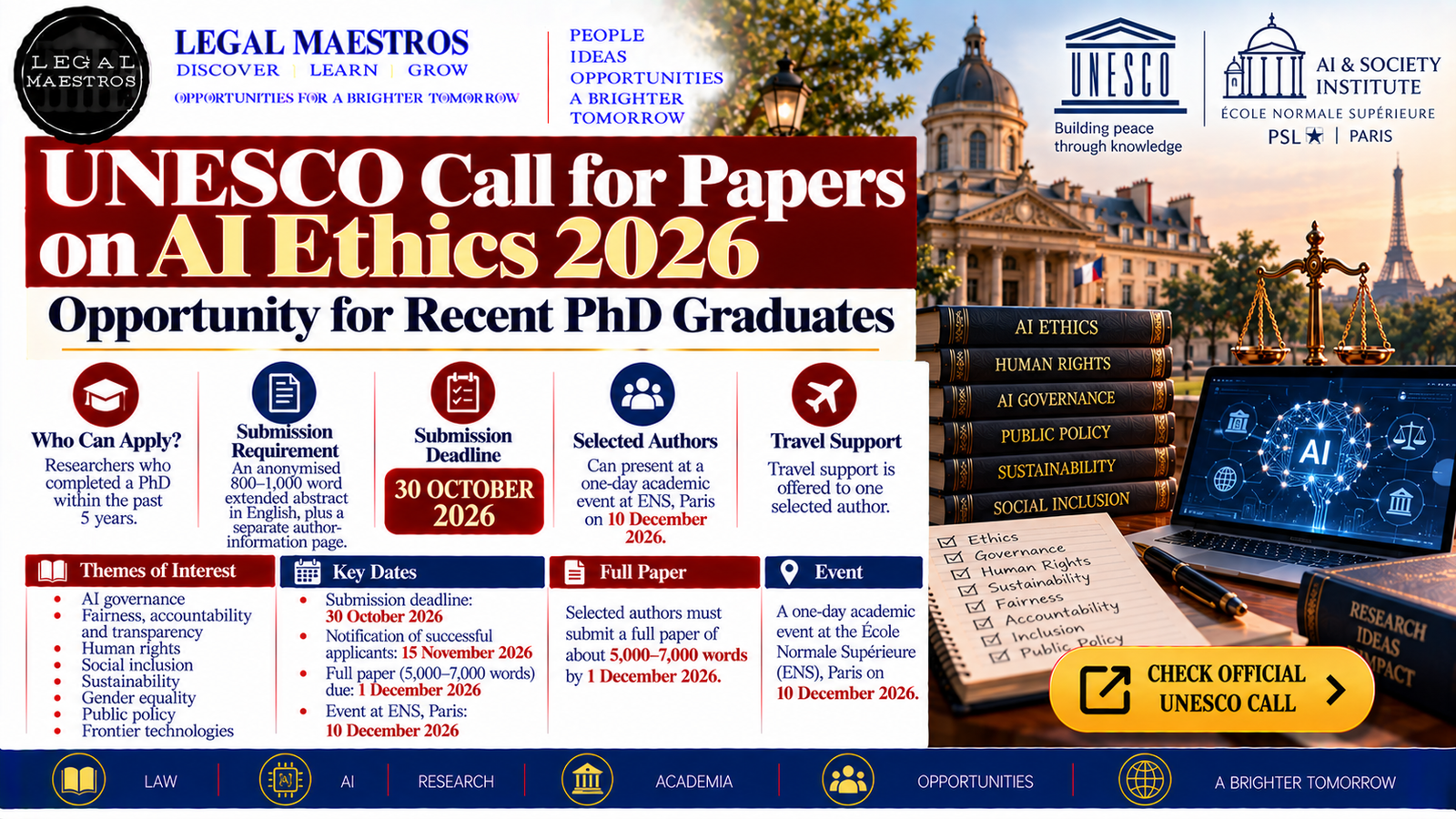
UNESCO and the AI and Society Institute at École normale supérieure (ENS-PSL), Paris, have announced a call for papers on advancing research on the ethics of Artificial Intelligence. The initiative is particularly relevant for lawyers, legal researchers and scholars working on AI governance, human rights, technology regulation and emerging legal issues.
The call is open to researchers who completed their PhD within the past five years. Applications are invited from relevant disciplines and geographic regions, with interdisciplinary and cross-sectoral research perspectives particularly encouraged.
Research Areas
The call is grounded in the UNESCO 2021 Recommendation on the Ethics of Artificial Intelligence and aims to promote emerging research while strengthening connections between academic research, public policy and professional practice.
Proposals may examine areas including AI governance, fairness, accountability and transparency, human rights and AI ethics, AI ethics literacy, social inclusion, gender equality and the protection of vulnerable or underrepresented groups.
Researchers may also explore the relationship between AI ethics and public policy, research and innovation, the Sustainable Development Goals, environment and climate action, culture and knowledge systems, health, mental health, youth, STEM and frontier technologies.
Eligibility for Researchers
The opportunity is open to researchers who have completed a PhD within the last five years and whose research addresses issues related to the ethics of Artificial Intelligence.
Applications are welcomed from different academic disciplines and geographic regions. The organisers particularly encourage theoretical, empirical, comparative, interdisciplinary and practice-oriented research. Co-authored proposals are also permitted, provided that both authors satisfy the eligibility requirements.
For lawyers and legal scholars, the call provides an opportunity to present research dealing with issues such as AI regulation, human rights, accountability, governance, public policy and the legal and ethical implications of emerging technologies.
Submission Requirements
Applicants are required to submit an extended abstract of 800 to 1,000 words, excluding references. The proposal should include the title, research question and its relevance to the call, conceptual or theoretical framework, methodology where applicable, principal findings or argument, contribution to research on AI ethics and three to five keywords.
A separate author information page must include the applicant’s full name, institutional affiliation, country, email address, PhD details and a short biography of not more than 150 words.
The submission must be written in English and provided in Word or PDF format. The extended abstract should not contain the author’s name or other identifying information to facilitate an anonymous review process.
Deadline and Academic Event
The deadline for submitting proposals is 30 October 2026. Successful applicants will be notified by 15 November 2026 and will subsequently be invited to submit a full paper of approximately 5,000 to 7,000 words by 1 December 2026.
Selected authors will have the opportunity to present their research at a one-day academic event at ENS in Paris on 10 December 2026. The event will bring together emerging scholars, established researchers and representatives of academic institutions for thematic discussions and expert feedback.
Travel support will be offered to one selected author to attend the event in Paris. The recipient of the travel support will be identified following the selection process.
Publication and Dissemination
Following the academic event, UNESCO and the AI and Society Institute will produce proceedings containing selected contributions and key discussions from the event.
Selected authors may also be invited to adapt their research for publication in the Tribune of the Conseil de l’intelligence artificielle et du numérique (CIANum). This will provide an opportunity for emerging research on AI ethics to reach a wider academic, public policy and professional audience.
Interested researchers can submit their proposals through the official UNESCO call for papers page.
Application Deadline: 30 October 2026
Academic Event: 10 December 2026, Paris, France