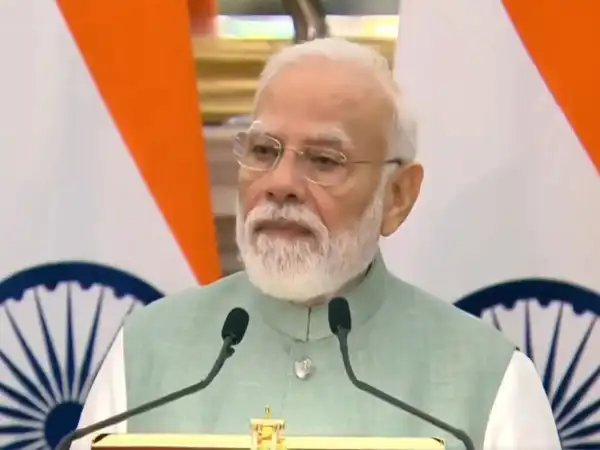
Delhi Traffic Police has issued a traffic advisory for October 7 as a programme to celebrate the completion of 25 years in public life by Prime Minister Narendra Modi is being held by the BJP. The main ‘Seva Jyoti’ programme will be held at the Indira Gandhi Stadium Complex, with a large number of party workers and supporters expected to arrive via processions.
The restrictions were implemented from 5 am to 1 pm on the morning period, announced. Traffic was to be enforced or diverted through key roads such as Bahadur Shah Zafar Marg, JLN Marg, Ring Road, IP Marg and Vikas Marg. Some sections near Rajghat, ITO, Yamuna Bridge and India Gandhi Stadium were also occupied.
So, the real legal question is not merely whether or not traffic is capable of being restricted for a political event. The real legal question is whether the restrictions are reasonable, necessary and proportionate to the needs of public safety and traffic management caused by the event.
Can Police Block Off Traffic For a Political Event?
Traffic powers to control public roads Traffic authorities also have the power to control traffic on a public road where this is appropriate or necessary to ensure the safety of the public, to provide for the effective control of traffic, or to manage an event. These powers do not only apply to public authorities.
Whether the restriction on traffic which is imposed by the venue being a political party, that factor itself would not, in my view, make the traffic advisory unconstitutional. The question to be asked is whether the restriction is related to a legitimate public purpose; and if so, whether the measures taken are in fact authorised by law and are appropriate and adapted to that purpose.
In the current case, the Delhi Traffic Police stated that the restrictions were related to the anticipated flow of participants and vehicles and would be implemented based on the state of traffic flow and operational needs. The police also recommended that traffic be avoided on some designated roads whenever feasible.
The Constitutional Question of Proportionality
The free movement of citizens is guaranteed by the Constitution in Article 19(1)(d), with the restriction of public order laid out in Article 19(5). This does not imply that a citizen may access all public roads at any time without restriction.
Temporary restrictions may therefore be justified constitutionally, where the restriction is imposed in good faith for a public purpose, for example the preservation of public order, the preservation of public safety, a commitment on the part of the Government to achieve a particular goal.
This is where the principle of proportionality comes into play. Whenever possible, you need to weigh up whether there is less restrictive alternative that can further the goal, whether the geographical scope of the restriction is necessary, and whether the restriction period is limited to the period needed.
Was the October 7 Advisory Proportionate?
Based on the open source, the advisory was not to shut down the whole city but only certain roads and for a defined period. Traffic was to be controlled or rerouted on a number of roads, while certain sections were shut, as required. The main shutdown period was from 5 a.m. to 1 p.m.
The targeted and short-lived nature of the measures and the fact that they were geographically targeted can be used to bolster an argument that the police were trying to strike a balance between ensuring the safety of the event and facilitating the daily movements of ordinary commuters. The likely presence of BJP workers/supporters and the processions heading towards the stadium complex makes the purported rational for the traffic restrictions credible.
Proportionality also cannot simply be read off a stated security demand: if restrictions are obtrusively impacting roads well removed from the venue, remain post-participant walk-off or cause significantly more disruption than would have been required, residents impacted by the lockdown may wonder if other less intrusive arrangements were possible.
Public Roads and the Rights of Ordinary Commuters
Public roads are for everyone, including those who go to work, to the hospital, to the school, the courthouse, the train station and other familiar places. A restriction on traffic can thus affect ordinary rights in the everyday.
This tends to get more significant in case main arterial roads are impacted. The October 7 advisory established routes including JLN Marg, IP Marg, Vikas Marg and Ring Road, while commuters had been specifically advised to avoid several of these segments. No-parking restrictions had been put in place on impacted roads, and cars parked there could possibly be towed away, with driver prosecuted.
The legal equilibrium therefore lies between these two competing public interests. Car parking authorities are required to safeguard participants, keep traffic moving smoothly throughout a gathering, and not infringe more or for a longer duration than reasonably feasible on the rights of a layperson to enjoy public parking facilities.
Security Cannot Mean Unlimited Restrictions
The Supreme Court has been repeatedly emphasising that constitutional rights can be reasonably curbed. While exercising administrative powers in the regulatory sector, the delegates of administrative power are not outside the purview of the Constitution and cannot exploit public safety as an open rule.
In a traffic type advisory, the proportionality assessment was to some extent a more generalised version of the analysis: was there a genuine public interest; in what ways were the traffic proposals related to that interest; could less restrictive measures be easily available; and was the burden on commuters excessive in comparison to the public good.
This does not mean the restrictions imposed on the occasion of Prime Minister Modi’s 25 years in public life by the Delhi Traffic Police would, by themselves, have been unreasonable. The more serious legal issue is whether every restriction was really required, and for anticipated flows, security and traffic conditions on October 7.
Delhi Traffic Police still release advisories of an event and route information on their official page for the convenience of commuters so that they can plan their route accordingly.