Recognised in Emergency, Excluded in Intestacy: The Fragmented Property and Succession Rights of LGBTQIA+ Partners in India
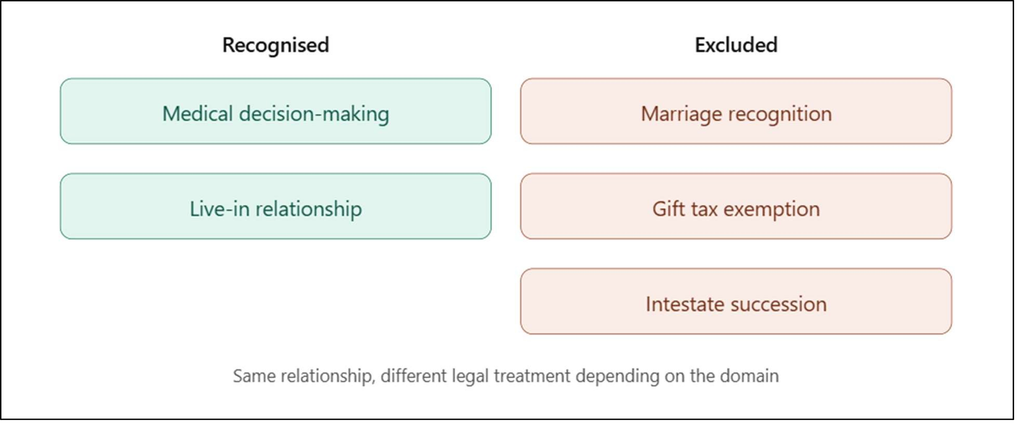
Twists presents itself as the Union Ministry of Health, in Delhi High Court, stated that under Section 14 of the Mental Healthcare Act, 2017,[1] adults can nominate any person (including their same-sex partners) as their designated medical proxy in times of medical emergencies.[2] Allahabad High Court soon followed, affirming adult same-sex partners possess an inviolable fundamental right under Article 213 to live together in peaceful live-in relationships without familial interference.[3] But this wave of positive steps takes a sharp U-turn when confronted with Union Government in Anurag Kalia v. Union of India (Karnataka High Court), actively opposing extension of “spouse” gift tax exemption under the Income Tax Act, 1961,[4] to same-sex couples for not having formal marital recognition.[5]
Such duality in rights for a portion of India’s citizens exposes a socio-legal paradox, you can live together and make each other’s medical decisions but cannot marry or avail basic spousal tax concessions or in matters of property rights, as in such cases they are legal strangers. Supriyo v Union of India[6] declined recognition of non-heteronormative unions under Special Marriage Act, 1954,[7] and with it spousal economic and inheritance protection too legally remain out of reach. For a nation which still works on systems seeped to its core in patriarchal values and where 84.8% of Indians do not have wills made,[8] creates a problem for queer individuals dying intestate as to assume unwritten intentions or informal family understanding will ensure surviving partner’s
protection (even with there being existence of shared cohabitation, mutual care and/or joint financial codependency), is a dangerous misconception.
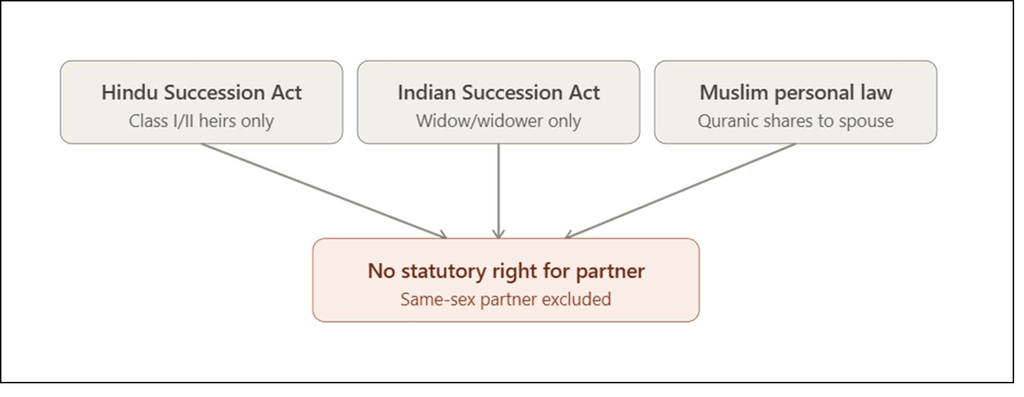
The provisions for spouses to inherit their deceased spouse’s property will not apply due to the lack of formal recognition, and Personal laws in implementation today carry no provision for nonheteronormative partners, regardless of those laws being religion-based or secular. Sections 8 & 15 of Hindu Succession Act, 1956[9] prioritise class-I legal heirs and then class-II heirs, who, to be noted, are strictly heteronormative bloodline/adoption/marriage based, leaving surviving same-sex partners no statutory rank, in turn allowing them to be passed over akin to strangers.
Furthermore, sections 33 & 35 of Indian Succession Act, 1925[10] limit partners to widow, widower/husband and lineal descendants, again creating no provisions for same-sex partners or their unrecognised children, due to the absence of a legally recognised marriage. While there exists an argument that the usage of the words widow and widower may make it plausible for same-sex couples to inherit,[11] but still there remains the issue of formal marriage recognition for it to happen. Even for Parsis (sections 50-56),13 succession matters fare no better, following the same limitations and excluding same-sex partners from matters of inheritance. Then we have intestate succession under Islamic law, which remains anchored in non-negotiable Quranic shares to be distributed
among blood relatives and formally recognised spouses, whereby unmarried/unrecognised partners with no statutory entitlement to the property.
One may argue that creation of a will may provide as a protection for the concerned parties but, for those with wills made and their non-heteronormative partners mentioned there for inheriting the concerned property, still exists the problem of biological/statutory heirs (who may have cut ties with the deceased upon them coming out to them or may have reacted negatively upon learning of their orientation) contest the will alleging “undue influence” “coercion” or “lack of testamentary capacity” and the inheritance is snatched away from the designated person and falling into the hands as per the personal laws in implementation. Even in case of wills, only ⅓rd of the total property can be willed to those unrecognised by Islamic law, for more to be given, all statutory legal heirs need to give explicit consent after the testator’s death.
This limitation doesn’t stop with spouses only but also extends to the children who may not be biologically/legally of the deceased person’s due to same-sex partners not being able to have both their names registered as the parents.
The legal landscape currently in place has various contradictions within it, offering protection on one hand and on the other withholding rights from minority groups which majority holds. The tangled mess affecting the lives of communities impacted needs to be resolved, be it via sweeping overhauls of laws made with the essence of colonial values and the face of Indian values or be it targeted statutory interventions. Some examples are as follows:
- Statutory definitions need to be expanded/amended to ensure the actual needs are met with and there exists no unintentional victims. The language currently in use is purely functional for heteronormative pairings only, leaving non-heteronormative pairings unrecognised and unprotected, definations needs to be changed in laws, be it for tax laws, personal laws, criminal laws, etc., they need to be able to accept the reality and stop looking at things with lenses of victorian morality. Gender-nuetral terms like “partners”, “cohabitant”, “nominated dependent”, or “spouse” needs to be put into implementation, this would help preventing non-heteronormative individuals from being excluded and provide them with statutory provisions governing their rights.
- Should the above suggestion be too much, then there could atleast be a civil union provision created to govern same-sex pairings which would work towards covering the rights of same-sex pairing in matters of marriage, maintenance, taxation, inheritance, etc., without interfering with definations of marriage which is traditionally religion based.
- There should be statutory provision created to ensure cohabitation agreements could be registered, which would help same-sex couples gain protection from biological relatives interfering due to misguided mentality and prevent them from harm.
For a nation trying its best to ensure its citizens get the full benefit and protection of Articles 14[12] and 21,[13] it has left a humongous gap for quite a fraction of its citizens, all because of what, some values which were forced down its throat by people who themselves have abandoned them long ago? Steps need to be taken to ensure justice is done in full and not given out in shades.
[1] Mental Healthcare Act 2017, s 14.
[2] Nupur Thapliyal, ‘Queer Partners Can Take Medical Decisions In Emergencies If Authorised By Patient: Centre Tells Delhi High Court’ (LiveLaw, 16 September 2026) https://www.livelaw.in/high-court/delhi-high-court/centresupports-same-sex-partner-medical-representative-health-emergency-decision-550240 accessed 23 September 2026. 3 Constitution of India 1950, art 21.
[3] ‘Allahabad HC: Interfaith Same-Sex Couple[‘s] Fundamental Right To Live-In Relationship’ (LiveLaw, 19 September 2026) https://www.livelaw.in/high-court/allahabad-high-court/allahabad-hc-interfaith-same-sex-couplefundamental-right-livein-relationship-551035 accessed 23 September 2026.
[4] Income-tax Act 1961.
[5] ‘Same-Sex Partners Can’t Claim “Spouse” Tax Benefits Without Marriage Recognition: Centre Tells Karnataka High Court’ (LiveLaw, 2026) https://www.livelaw.in/high-court/karnataka-high-court/same-sex-partners-spouse-taxbenefits-marriage-recognition-550848 accessed 23 September 2026.
[6] Supriyo alias Supriya Chakraborty v Union of India (2023) 16 SCR 1209.
[7] Special Marriage Act 1954.
[8] ‘India’s Biggest Wealth Planning Problem: Nearly 85% Don’t Have A Will’ Business Standard (2026) https://www.business-standard.com/finance/personal-finance/india-s-biggest-wealth-planning-problem-nearly-85dont-have-a-will-126060300578_1.html accessed 23 September 2026.
[9] Hindu Succession Act 1956, ss 8, 15.
[10] Indian Succession Act 1925, ss 33, 35.
[11] Guest Post, ‘Gendered Beyond Repair: Proposing an Interim Succession Regime for Same-Sex Marriages in Existing Law’ (Indian Constitutional Law and Philosophy, 4 May 2023)
[12] Constitution of India 1950, art 14.
[13] Constitution of India 1950, art 21.