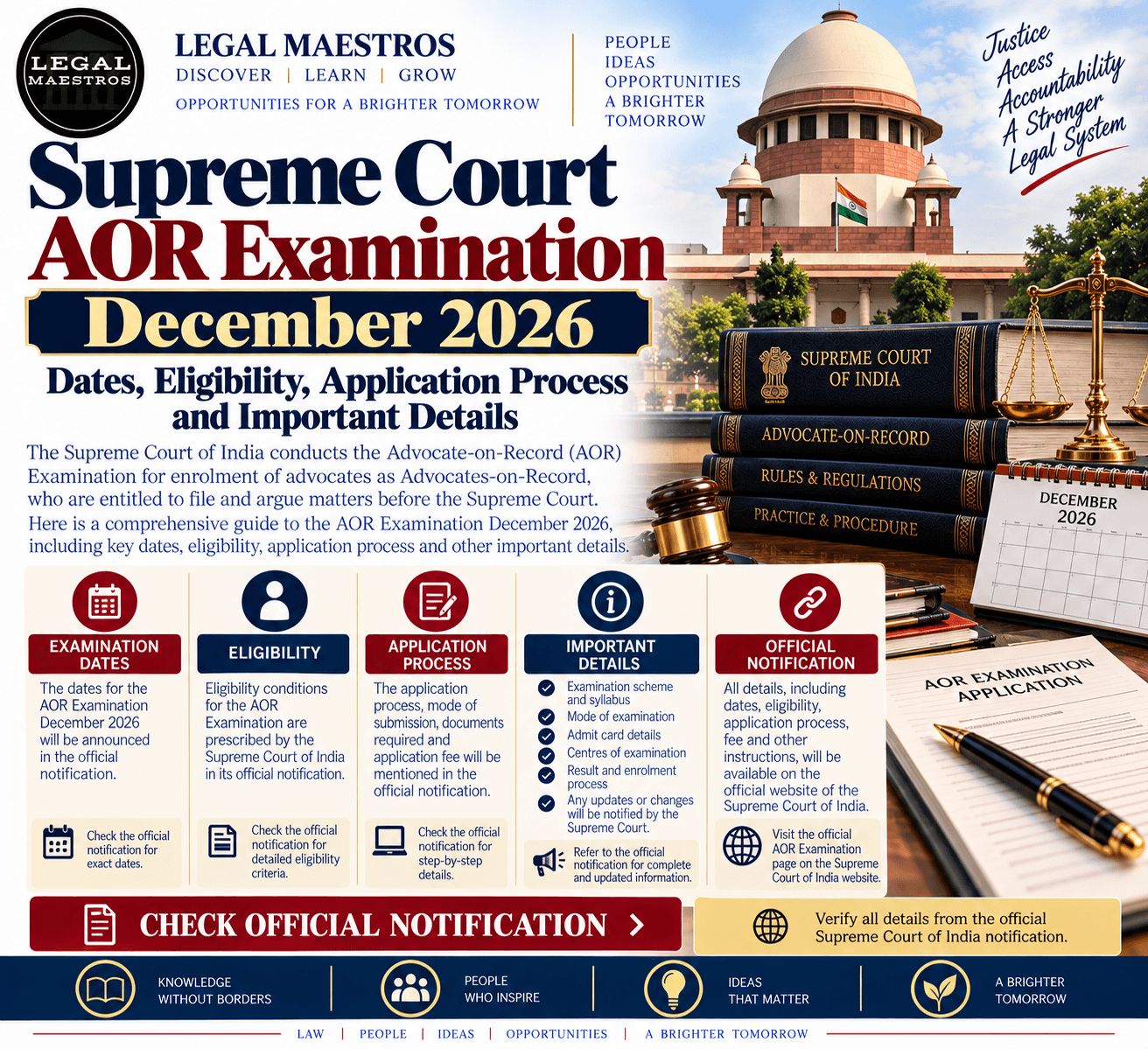
The Supreme Court of India has issued the notification for the Advocates-on-Record (AOR) Examination – December 2026. The examination will be held in New Delhi on December 19, 20, 22 and 23, 2026.
The notification is specifically meant for candidates who are eligible to re-appear under Regulation 11(i) or 11(ii) of the Regulations regarding the Advocates-on-Record Examination, based on their results in the June 2025 examination or earlier examinations.
The notification was issued by the Supreme Court of India on September 25, 2026.
AOR Examination December 2026 Dates
The Supreme Court has scheduled the December 2026 AOR Examination on four days:
December 19, 2026
December 20, 2026
December 22, 2026
December 23, 2026
The examination will be conducted at New Delhi and will be held through pen and paper mode only.
The examination is an important professional examination for advocates seeking registration as an Advocate-on-Record of the Supreme Court of India.
Who Can Apply for the December 2026 AOR Examination?
The December 2026 examination is not open as a fresh examination opportunity to all advocates. The notification specifically states that it is for candidates who are eligible to re-appear under Regulation 11(i) or Regulation 11(ii).
These candidates may have permission to appear in one paper. However, the Supreme Court has also given them the option of appearing in the entire examination afresh.
This choice has to be made while submitting the application form. Once the candidate exercises the option, it will be final and binding.
This makes the application stage particularly important for candidates who have previously appeared in the AOR Examination and are eligible for re-appearance.
Last Date to Apply
Applications for the AOR Examination December 2026 can be submitted from October 1, 2026 to October 15, 2026.
The application has to reach the AOR Examination Cell during office hours. The relevant office is:
AOR Examination Cell
Room No. 308, 3rd Floor, B-Block
Administrative Buildings Complex
Supreme Court of India
New Delhi – 110001
The Supreme Court has clearly stated that applications will not be accepted after 5:00 PM on October 15, 2026.
Candidates sending the documents by post or courier should therefore make sure that the physical application reaches the prescribed office within the deadline. The instructions also state that the Registry will not be responsible for delay in receipt of the application.
Four Papers in the AOR Examination
Under Regulation 4(a) of the Regulations regarding Advocates-on-Record Examination, the examination covers four papers.
The first paper is Practice & Procedure of the Supreme Court.
The second paper is Drafting.
The third paper is Advocacy & Professional Ethics.
The fourth paper is Leading Cases.
The notification has also provided separate notices explaining the scope of some of these papers.
What is Included in Paper II – Drafting?
The Supreme Court has clarified the syllabus for Paper II through Notice-I.
The drafting paper covers petitions for Special Leave and Statements of Cases, along with decrees, orders and writs.
The clarification goes further and specifically mentions petitions of appeal, plaint and written statement in a suit under Article 131 of the Constitution, review petitions under Article 137, transfer petitions under Section 25 of the Code of Civil Procedure, Article 139 of the Constitution and Section 446 of the Bharatiya Nagarik Suraksha Sanhita, 2023.
The syllabus also includes contempt petitions under Article 129 and interlocutory applications. These include applications relating to bail, condonation of delay, exemption from surrendering and revocation of special leave.
Advocacy and Professional Ethics Paper
Paper III deals with Advocacy and Professional Ethics.
The topics suggested by the Supreme Court include the concept and nature of the legal profession, the relationship between morality and professional ethics, the seven lamps of advocacy, public trust doctrine and the exclusive right to practise in court.
The syllabus also covers the history of the legal profession in India and the laws governing advocates. Professional misconduct, criminal and other misconduct, punishment, the Advocates Act, 1961 and the professional code of conduct form part of the suggested study areas.
Candidates are also expected to study the Bar Council of India Rules concerning professional conduct and etiquette. The notification refers to duties of advocates, conflict between professional duties and law, the difference between ethical breaches, misconduct, negligence and crime.
The paper also touches upon the role of the Bar in providing equal justice and the regulation of professional ethics by Bar Councils.
Other areas include lawyer-client relationships, confidentiality, conflict of interest, counselling, negotiation, mediation and ethical considerations concerning an Amicus Curiae. Section 132 of the Bharatiya Sakshya Adhiniyam, 2023, corresponding to Section 126 of the Indian Evidence Act, 1872, is also specifically mentioned.
The Supreme Court practice-related role of advocates is another important part of the suggested syllabus. This includes adjournments, duties of an Advocate-on-Record, the supervisory role of the Supreme Court and contempt of courts.
Leading Cases for Paper IV
Paper IV will consist of Leading Cases. The notification contains a list of 86 cases.
Some of the well-known cases included in the list are Kesavananda Bharati v. State of Kerala, Maneka Gandhi v. Union of India, Minerva Mills v. Union of India, A.R. Antulay v. R.S. Nayak, Indra Sawhney v. Union of India, S.R. Bommai v. Union of India, Vishaka v. State of Rajasthan, D.K. Basu v. State of West Bengal and Rupa Ashok Hurra v. Ashok Hurra.
The list also contains several important constitutional, criminal, commercial, arbitration, insolvency and human rights decisions.
More recent cases include Article 370 of the Constitution, In re, the Electoral Bonds case, Sita Soren v. Union of India, Mineral Area Development Authority v. SAIL, State of Punjab v. Davinder Singh, Aligarh Muslim University v. Naresh Agarwal, Property Owners Association v. State of Maharashtra and Tej Prakash Pathak v. High Court of Rajasthan.
An important point for candidates is that the Head Notes of the Leading Cases will be supplied by the Supreme Court Registry in the examination hall. Candidates will have to return them to the invigilators immediately after the examination. The notification also asks candidates not to underline or mark these Head Notes because they will be used in future examinations.
AOR Examination Fee
The prescribed examination fee for the December 2026 examination is ₹750.
The fee has to be paid online through the Supreme Court’s Integrated Online Payment System (IOPS). The notification provides a step-by-step payment procedure in Annexure-C.
After selecting the AOR Registration/Exam Fees section and choosing the appropriate payment purpose, the system redirects the applicant to the Bharatkosh payment portal.
The applicant is required to provide the necessary personal details and complete the payment through the available payment method.
Documents Required With the Application
Candidates need to submit the duly completed application form along with a recent photograph.
A self-attested and legible copy of the Enrolment Certificate also has to be attached. The payment receipt for the ₹750 examination fee must also be submitted.
The physical documents have to be submitted at or sent by post or courier to the AOR Examination Cell at the Supreme Court’s Administrative Buildings Complex in New Delhi.
The Supreme Court has also made it clear that an incomplete or illegible application form can be rejected.
Rules Regarding Number of Chances
The notification contains specific provisions concerning the number of attempts.
Under Regulation 11(iv), a candidate cannot be allowed more than five chances to appear in the AOR Examination. Importantly, even appearing in only one paper is counted as a chance.
However, the notification refers to a one-time relaxation concerning the December 2021 AOR Examination. That examination will not be counted while calculating the five permissible chances. As a result, an additional chance may be available to eligible candidates depending on the result of the last examination in which they appeared.
Candidates should therefore carefully check their previous examination history before submitting the application.
What Happens If a Candidate Does Not Appear?
The notification contains a significant warning for candidates who receive a roll number but do not appear for the examination.
Such candidates may be treated as having not sufficiently prepared themselves and may be dealt with under Regulation 5(b). They may also be prevented from appearing in a subsequent examination unless they have a good reason and obtain the express permission of the Board of Examiners.
There is another important rule for candidates who fail in all the papers. Under Regulation 11(iii), a candidate who fails in all papers will not be permitted to appear in the next examination. Further, a candidate who does not appear in all papers and fails in the papers in which they did appear can be treated as having failed in all the papers, including those they did not take.
Scribe Facility for Eligible Candidates
The notification also provides guidelines for candidates seeking the assistance of a scribe.
Persons with benchmark disabilities in specified categories, including blindness, locomotor disability affecting both arms and cerebral palsy, can avail themselves of the scribe facility subject to the prescribed conditions.
Candidates in other categories may also be eligible where a medical certificate establishes that they have a physical limitation that prevents them from writing and that a scribe is essential.
The candidate has to arrange the scribe at their own cost.
The scribe cannot be a law graduate or a person pursuing a law course and must have qualifications one level below those of the candidate appearing for the examination. Relevant documents have to be submitted at least 15 days before the examination.
Eligible candidates using a scribe will receive 20 minutes of compensatory time for every hour of the examination.
Important Date for Candidates
For candidates eligible under Regulation 11(i) or 11(ii), the immediate deadline to remember is October 15, 2026, at 5:00 PM.
The application process begins on October 1, 2026, while the examination itself will be conducted in New Delhi on December 19, 20, 22 and 23, 2026. The Supreme Court has also made clear that the examination will be conducted only in pen-and-paper mode.
Candidates preparing for the examination should also go through the detailed notification, including the instructions, application form, scribe provisions, drafting syllabus and complete list of 86 Leading Cases before submitting their application.