supreme court selfie
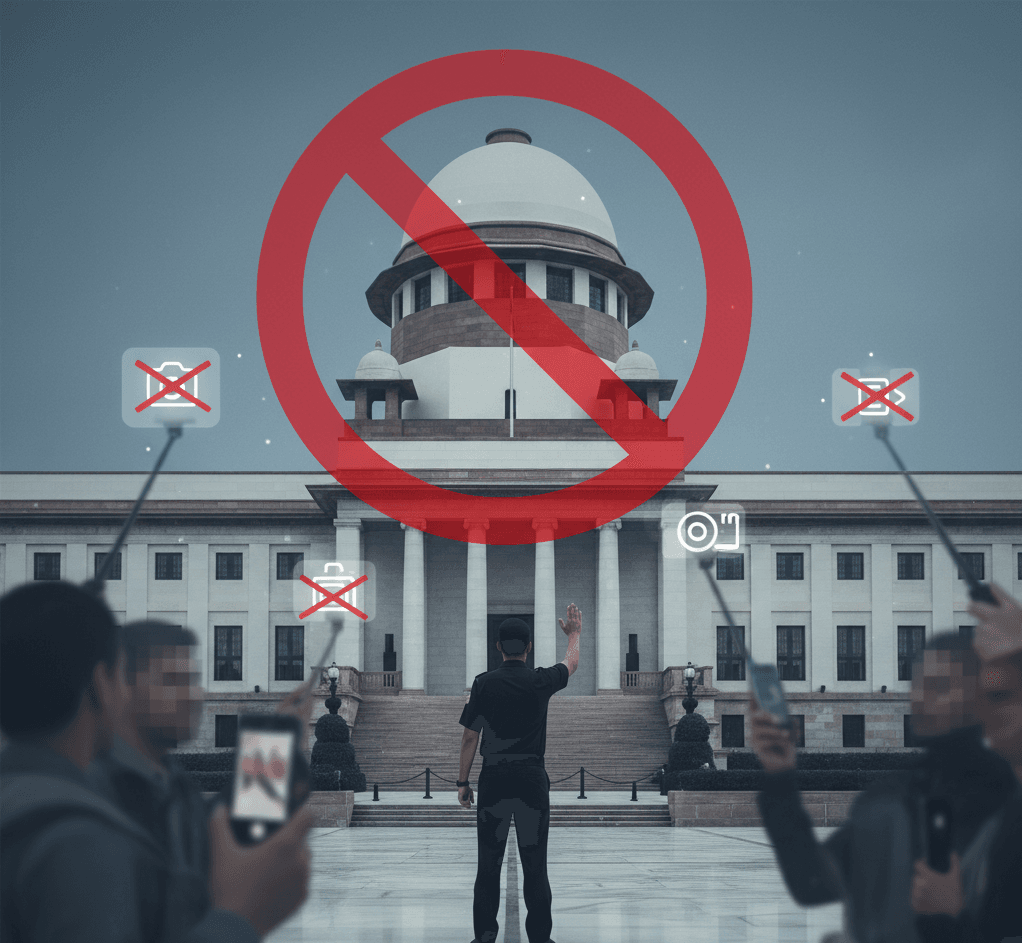
The Supreme Court of India has issued a new directive and this has imposed a strict ban on photography and videography in its high-security zone. This involves making selfies, social media reels and other video contents. This ruling which took effect immediately is a step towards safeguarding the dignity and safety of the court. The circular which was signed by the Secretary General provides clear punitive measures to those who fail to comply with the new rules. This is after legal groups have raised increased concerns over the abuse of court premises in pursuing individual interests and benefits.
Upholding Dignity and Decor
The Supreme Court is not a mere building but is a symbol of justice and the rule of law. It is a place where great issues of national concern are determined. The recent tendency of individuals and lawyers, in particular, to produce informal and sometimes ridiculous content such as social media reels and selfies in its halls was perceived as the serious danger to this sober environment. This kind of activity puts at risk transforming a site of great legal meaning into a stage set to online entertainment. The new ban will help to bring back the nature of decorum and respect that should be attached always with the highest court in the land. This is a very important measure to ensure that the attention is shifted to justice and not to social media attention.
The Security Concerns
In addition to the question of the dignity, the ruling by the court is also a reaction to grave security threats. High security zone of Supreme Court is a sensitive zone. It is the place of judges, lawyers and litigants of high profile cases to meet and confidential discussions to be made. Illegal photography and videotaping may accidentally disclose the identity of witnesses, victims, and other individuals who must not be identified as they are in danger. It may also aid the bad-intentioned people with very useful information. The ban is a necessary step in order to avoid this sort of information falling into the wrong hands and everyone being safe within the premises.
For any queries or to publish an article or post or advertisement on our platform, do call at +91 6377460764 or email us at contact@legalmaestros.com.
Question of the Emergence of “Reel” Culture in Courts.
The prohibition is a direct response to what has been termed by some as the reel and influencer culture that has been finding its way into the courtroom. Creating short, quick videos on platforms such as Instagram and Tik Tok has been witnessed in recent times by a large number of lawyers, along with other individuals who have visited the court. They are frequently in their robes in these videos, as they stroll along the court corridors, or as they stand before its grand entrance. This may not be a big issue but courts such as the Supreme Court Bar Association have sounded alarm bells. According to them, they consider such conduct as a kind of indirect advertisement, which is contrary to the professional ethics that lawyers are to observe.
Ban Implications to the Various Groups.
The new regulations extend to all persons entering the high-security zone such as advocates, litigants, interns, law clerks, and even media personnel. Although the ban is rigid, it does distinguish between low and high security regions. Media professionals are also not prohibited to conduct interviews and live broadcasts, but these can only be done in a prescribed area of the media lawn in the low-security zone. This demonstrates that the court would like to move a balance between keeping its security and decorum as well as ensuring that it has a free press reporting its proceedings. The regulations are simple, no cameras, tripods, selfie sticks, and mobile phone filmings in the restricted area unless it is official.
Penalties for Violators
The circular of the court puts a very definite system of punishment on anyone who violates the new rules. In the case of advocates, litigants, interns and law clerks, disciplinary action will be requested by the concerned Bar Association or State Bar Council. This may include a mere warning or some other more serious repercussions such as suspension. In the case of media people, infraction may result in them (the media people) being restricted to the high-security zone by a time span of one month. The new order also gives the security staff the authority to detain and deny any person the right to make pictures or videos in the restricted zone. This demonstrates that the court takes this new policy seriously.
A Contemporary Evil, An Ancient Remedy.
Such a prohibition brings out a distinct issue of the new era; how to deal with the overlap of the old and the new technology. The judiciary is established on the principles of seriousness, solemnity, and justice whereas social media thrives on fast-paced and attention grabbing content. The ruling of the court is a classic example of an ancient institution taking advantage of its legal powers to shield its fundamental values against contemporary trends which it considers illogical. In returning to the basics of what a court ought to be, an environment of silent contemplation and seriousness, it is attempting to make sure that its image is not damaged in a world that is growing more casual and open.
Beyond the Ban: an Appeal to Professional Ethics.
It is not only the prevention of people to take photos, but it also carries with it a powerful message regarding professional ethics. The Supreme Court Advocates-on-Record Association already protested that advocates were using the court to generate social media content, asserting it was an apparent breach of their code of conduct. The action of the court supports these worries and the notion that the legal profession is a serious one. It serves as a wake-up call to every lawyer showing that his or her job is not to create a personal brand in social media, but law and justice.