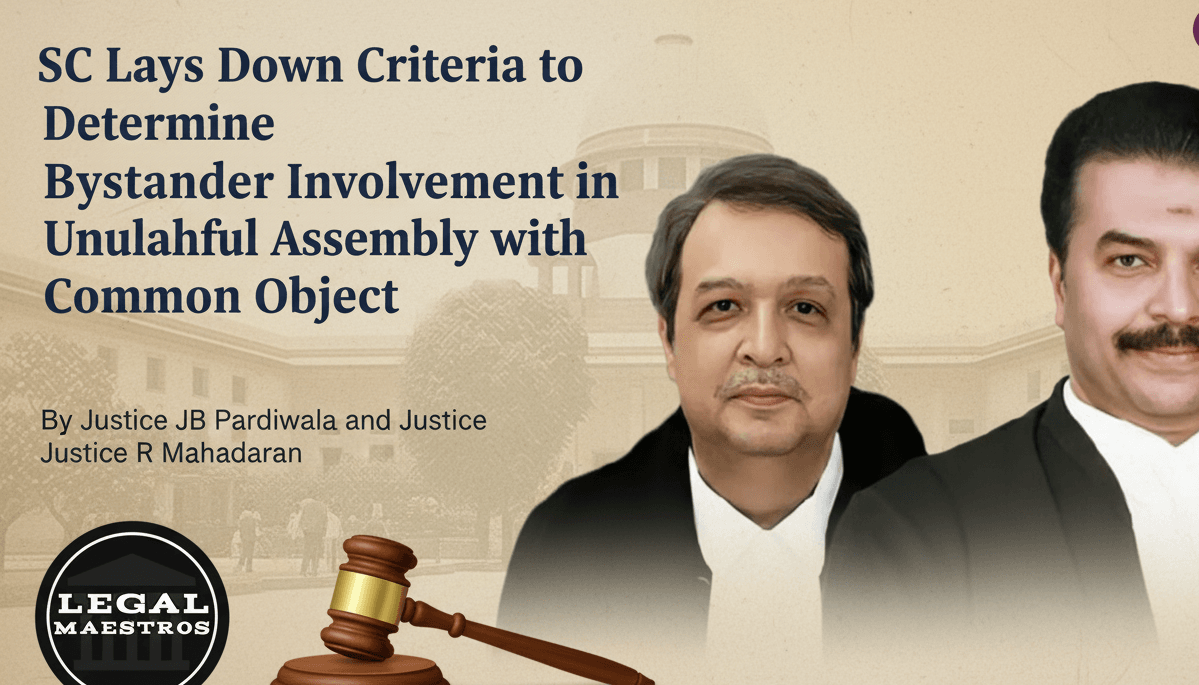
SC Lays Down Criteria to Determine Bystander Involvement in Unlawful Assembly with Common Object By Justice Pardiwala and Mahadevan
A Crucial Distinction: Mere Presence vs. Active Participation
In an important ruling, the Supreme Court of India has established clear and substantial guidelines that can be used when deciding whether an individual was an innocent bystander or a member of an illegal assembly. The subtle matter of criminal responsibility in Section 149 of Indian Penal Code (IPC) was tackled by a bench of Justice J.B Pardiwala and Justice R. Mahadevan. The court eloquently said that the fact that an individual is present at a crime scene does not necessarily imply the person is a member of an illegal gathering and this ruling upholds the tenets of criminal justice.
This ruling was made as the court was adjudicating a 1988 case in Bihar where some people were serving life sentences on murder and belonging to an illegal assembly. The court ruled to acquit them due to the inability of the prosecution to prove the one important ingredient; that each of the accused had to be sharing the common object of the group. This decision is an essential protection to guard against any innocent bystanders or coincidental observers of a mob being falsely accused of the related offenses.
Section 149 of the principle of vicarious liability is an exception to the general rule that an individual is only liable to the actions that he/she took. It makes any member of an illegal gathering responsible in any crime committed by any other member with the aim of achieving a common objective. The new rules adopted by the Supreme Court are aimed at ensuring the absence of the mechanical implementation of this potent law provision, a more rigorous standard of prosecution evidence is required.
For any queries or to publish an article or post or advertisement on our platform, do call at +91 6377460764 or email us at contact@legalmaestros.com.
The bench emphasized that courts are to be extremely cautious when dealing with big crowds and in general allegations. Absence of tangible facts that can connect a person with the criminal motive of the group, there is no way a person can be convicted. This is necessary to avoid a miscarriage of justice in which the guilty and those who are innocent are caught in the process in a mob.
The Test for “Common Object”
The key to the Supreme Court decision is the test that should identify the presence of a common object. It is this common aim which forms the very heart of an illegal assembly indictment. The justices made it clear that it is up on the prosecution to demonstrate, either directly or circumstantially, that an accused individual was not only present but took a proactive role in the illegitimate purpose of the gathering. The personal attitude and the motive are the most important.

The bench provided a number of factors that ought to be taken into consideration to draw an inference of common object to guide lower courts. These involve time and location of group meeting, the behavior and manner of group members at or around the location, and general group activities. The analysis of these situations assists in creating an even more vivid picture of the existence of a common criminal intent of the participants.
Moreover, the court instructed that the criminal purpose of the crime, the manner the situation was conducted, and the type of weapons that were carried or used by the group are crucial clues. The type and quantity of injuries caused on the victims are also very helpful leads as regards to the intentions of the assembly. When these aspects are jointly examined, a court can be better able to draw a line between the passive observer and the active member who knew and subscribed to the groups goal of illegality.
This is a multi-factor test that is created to be a practical test to the judges. It goes beyond a shallow evaluation of being and requires a thorough analysis of the facts and situations of a particular case. It makes sure that the doctrine of constructive liability is not used carelessly but in a wise manner to prosecute whoever can be found at the crime scene.
Safeguarding the Innocent Bystander
The protection of the innocent is one of the main themes of the verdict by Justice Pardiwala and Justice Mahadevan. It was clearly mentioned by the court that a mere bystander, against whom no specific action or role is ascribed cannot be found guilty under Section 149 of the IPC. It is a vital difference that safeguards the freedom of people who might have found themselves at the wrong place and wrong time. ⚖️
The case admits the fact of mob case where it may prove hard to distinguish the people who are actively involved and the ones who are merely in attendance due to curiosity or fear. The court has hence put the prosecution under a great burden to demonstrate that the presence of an individual was not passive. The evidence should be in a clear way that the common object of the assembly was the way the accused person was animated.
The given admonishment is particularly critical in one of the countries, where the cases of mob violence are a common issue. The court serves as a checkpoint to the propensity of massively arresting and accusing a great number of individuals. It compels the investigation agencies to do a more rigorous and person-centered investigation as opposed to the basic round up of people in the area of the crime.
With this reiteration, the Supreme Court reinstates this notion that criminal guilt is an individual matter. Although vicarious liability is a useful instrument in some cases, it cannot be employed as a way of avoiding the basic demand of establishing the guilty mental state of a person or his active involvement. This guarantees that the criminal law net does not trap the really innocent individuals accidentally.
A Rule of Prudence for Courts
What can be referred to as the rule of prudence was also brought up and reinforced by the Supreme Court. It is a court rule that encourages courts to be very cautious handling cases of many people being accused on vague or omnibus evidence. The court of justice cautioned against mass convicting of people without conducting any thorough screening of evidence against an individual.