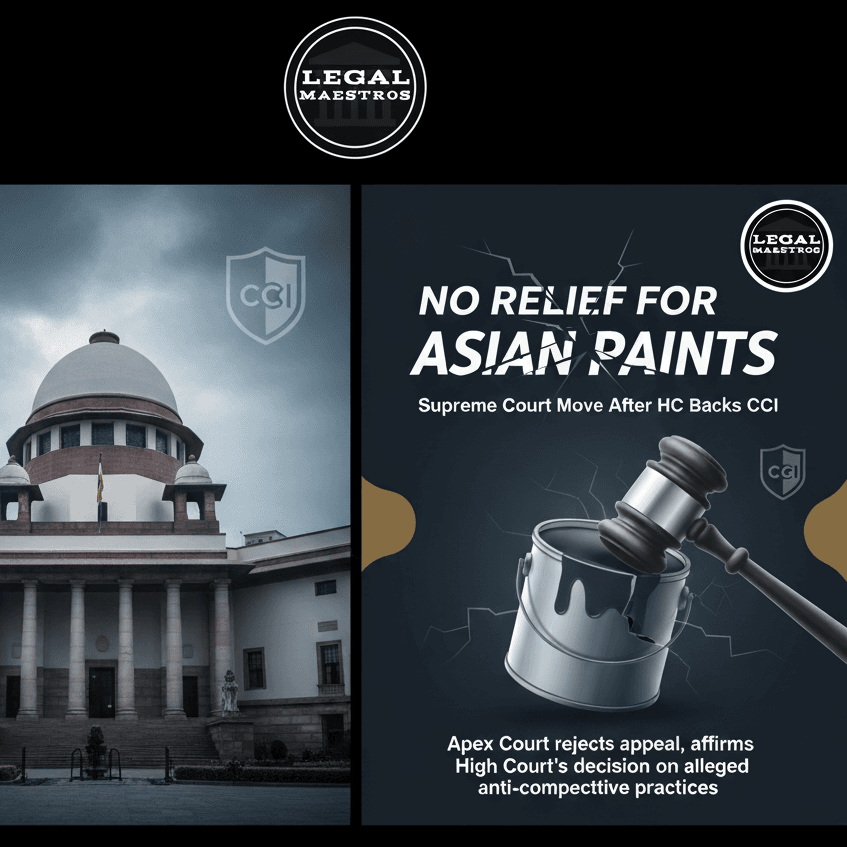
No Relief for Asian Paints: Supreme Court Move After HC Backs CCI on Abuse of Dominance Allegations
The Allegations of Unfair Practices
The core of the problem is that it was alleged that Asian Paints, in its mighty position in the market, was able to suppress competition. The complaint was initially filed by a relatively new entrant into the paint industry with the allegation being that Asian Paints was committing anti-competitive behavior. The company was also alleged to be putting pressure on the paint dealers and distributors to cease stocking or selling the products of other companies especially new companies that were seeking a place in the market.
These claims indicate that Asian Paints used its large distribution system and control over the retailers to put barriers to entry. Particular allegations were the threat to dealers that they would lose their contracts or see their supplies reduced in case they transacted with other brands of paint. Such would be a typical instance of an abusive behavior by a dominant player that may be proven true as a way of holding on to its market share and forestalling a free competition.
The complaint creates an idea of a marketplace in which smaller players and new companies cannot compete in the market practically due to the quality or price of their offerings, but rather due to the supposed restrictive practices of the market leader. These claims were so serious that the CCI, the antitrust watchdog of India, found it necessary to take a closer examination of its claims since its main role is to have a level playing field to all businesses.
For any queries or to publish an article or post or advertisement on our platform, do call at +91 6377460764 or email us at contact@legalmaestros.com.
The Legal Path of the Dispute
The case started with the initial filing of the complaint to Competition Commission of India. Having undertaken a preliminary consideration of evidence and submissions made, the CCI determined that there was a prima facie case that there was abuse of dominance. A prima facie case implies that the evidence is sufficient on the face of it to indicate the possibilities of a violation, and is thus warranting a comprehensive investigation. As a result the CCI instructed its investigative department, the Director General (DG) to investigate the issue in detail.
Asian Paints was not content with this ruling and appealed the decision of CCI in the High Court. The company claimed that the charges were unfounded and that there was no evidence which was enough to initiate the investigation at all. Asian Paints argued that its operations were fair and in accordance with the prevailing commercial business practices and that the CCI had ordered the investigation without exercising the correct mind.

Asian Paints was however not agreeable by the High Court. Having reviewed the case, the court affirmed the decision of the CCI, saying that the competition watchdog was not at all out of bounds to arrange an investigation on the basis of the preliminary evidence. The decision of the High Court was to underline that investigation is not a sentence of guilt but a required measure to collect facts and to make a decision whether some laws are violated or not. This rejection made Asian Paints appeal to the Supreme Court of the country.
The Supreme Court’s Final Say
Asian Paints, being left with no other option but to seek justice in the Supreme Court, it sought to have the order of the High Court, as well as the investigation by the CCI quashed. The company repeated its arguments and the Supreme Court intervened to halt what it viewed as an unwarranted and harmful investigation. The Supreme Court bench was however not convinced to intervene in the issue.
The verdict that was made by the apex court was very simple: there was no need to prevent the investigation at this initial level. The court has supported the arguments of both the CCI and High Court successfully by stating that a regulatory agency such as the CCI has a right to examine claims of anti-competitive behavior. The denial of the relief implies that the Supreme Court has been green-lighting the investigation to go on as scheduled.
This position is in line with the overall practice of the Supreme Court in these cases in which it is not willing to disrupt the procedural operation of specialized regulatory agencies unless there is a conspicuous mistake of law. The top court message is that the powerful companies can never seek to escape or postpone investigation into their business practices through the legal system.
What This Means for Asian Paints and the Market
The implication of the refusal of the Supreme Court to step in can be huge. In the case of Asian Paints, it implies that the investigation by the Director General of the CCI will no longer have any legal impediments. The company will also be expected to cooperate to the fullest with the probe that involves availing documents, records and even making its executives available to question. The research will take a comprehensive look in the relationship between the company and its dealers and how it plans about its competitors.
To the general Indian market, such a ruling is a significant strengthening of the CCI as a powerful antitrust regulator. It gives a big message to all the players in all industries who have become dominant that their actions are being monitored and that any accusations of exercising their market powers abusively will be deeply examined. This will facilitate a more competitive world, and this is in the end the good thing to the consumers, because innovation, high quality and more reasonable prices will be brought forth. 👍
It will now be referred to the CCI whereby the DG will undertake its investigation and make a report. According to that report, it is on the basis of that that the CCI will determine whether or not Asian Paints has violated competition law. Although investigation is not a conviction by itself, the struggle to establish its innocence has now formally started when the leader in the paint market is concerned.