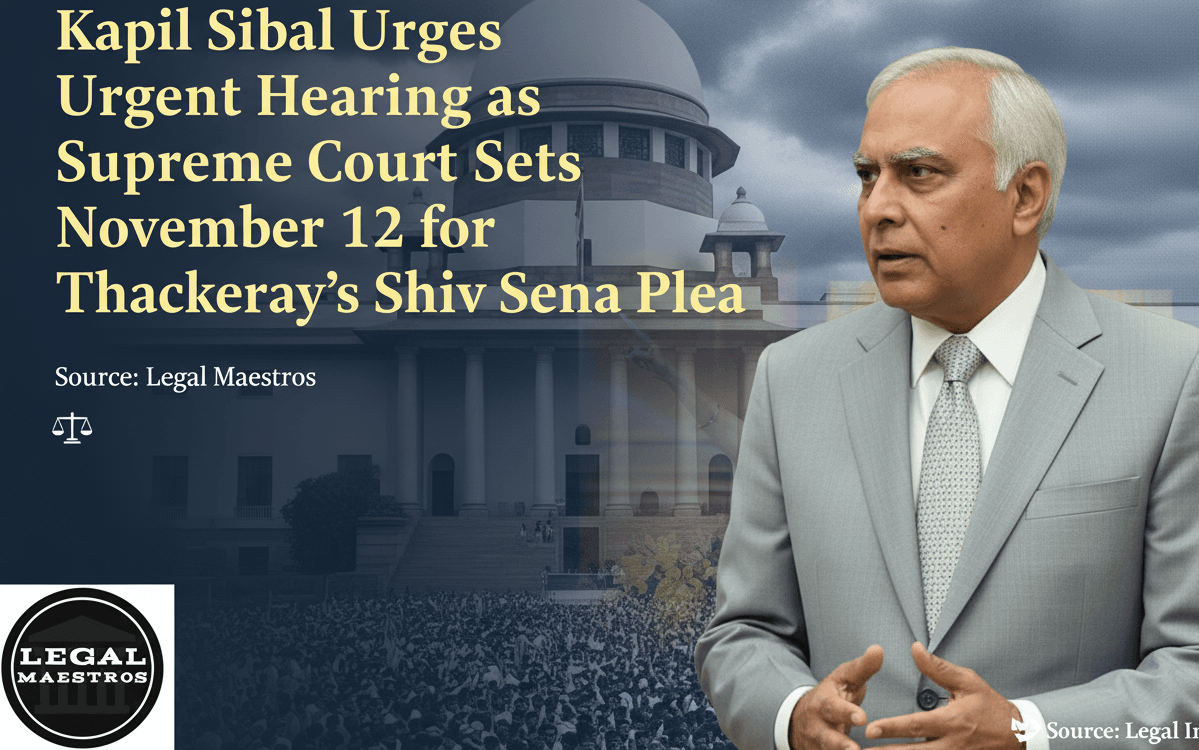
Kapil Sibal Urges Urgent Hearing as Supreme Court Sets November 12 for Thackeray’s Shiv Sena Plea
The Core of the Political Contention
The legal controversy is based on a great political turmoil in Maharashtra which resulted in the division of Shiv Sena party into two groups. One is headed by Uddhav Thackeray, the son of the party founder Balasaheb Thackeray, and another is headed by Eknath Shinde, the present Chief Minister of Maharashtra. After the division, the Election Commission of India (ECI) accepted the Shinde-led group as the rightful Shiv Sena and gave them the right to use the original name of the party and the sacred bow and arrow election symbol.
Uddhav Thackeray group has refuted this ECI order in the Supreme Court, claiming that there is a fundamental flaw in the resolution. In their petition, they argue that the Election Commission was wrong by prioritizing the number of Members of Parliament (MPs) and Members of Legislative Assembly (MLAs) who were in support of the Shinde group. The Thackeray camp still insist that the legislative wing is not the whole political party as there is a large branch of office-bearers, party workers, and party members spread over the state who, they argue, are devoted to the Thackeray family.
This legal struggle is not about a name or about a symbol but it is the battle of the identity and the soul of the political party. To the Thackeray arm, it is a big blow to lose the symbol of bow and arrow, which is a very emotional and historical symbol to the voters of the party. The Supreme Court plea aims at reversing the decision of the ECI as it is seen to undermine the internal organization of the party and the democratic process according to the political organization as rewarding a revolt.
For any queries or to publish an article or post or advertisement on our platform, do call at +91 6377460764 or email us at contact@legalmaestros.com.
The case has critical constitutional issues concerning the authorities of the Election Commission in settling internal party disputes. According to Thackeray faction, the ECI had exceeded its authority by interfering with the internal affairs of the party and the move would be dangerous in future. The verdict in this case is thus being followed keenly because it will have a far reaching repercussion on the manner in which such intra-party disputes are ruled in the Indian political arena.
A Plea for an Urgent Hearing
Representing the Thackeray group, senior advocate and veteran lawyer Kapil Sibal appealed ardently to be allowed to have the case heard at the earliest opportunity possible. He made it clear to the court bench that the postponement in hearing the case was having an irreparable prejudice to his clients. The main issue that Sibal is concerned about is that each day the Eknath Shinde group is strengthening its hold on the official party, claiming the name and the symbol of the Shiv Sena to the political benefits of its faction.

Sibal has based his arguments on urgency also on the realities of the actual sphere of politics such as future local body and municipal elections in Maharashtra. The party symbol is essential in any election as most parties have been recognized by the voters using their symbols. Being denied the right to use their own symbol, Thackeray faction feels that they have been put in a major disadvantage, and the court may take a long time to deliver a verdict on the issue, and the verdict may turn out to be hollow when they finally win the case in court.
The gist of the plea presented by Sibal was that there is no justice like the delayed justice. He argued that the status quo is favorable to the Shinde party which enables the party to act with legitimacy of the order issued by the Election Commission. This, according to his argument, leaves the electorate and the party cadres confused. Urgent hearing was hence requested in a bid to clear up and eliminate further weakening of the political position of the Thackeray side when the case is still waiting on the most superior court in the country.
The Supreme Court’s Schedule
Although there were strong contenders by Kapil Sibal to have the hearing expedited, the Supreme Court bench voted to adjourn the case to November 12. The court did not offer any particular explanation as to why not to grant a date earlier, although such decisions are usually based on the court overloaded schedule and the case complexity, as well as the necessity of giving all involved parties sufficient time to prepare and present their full-fledged legal arguments and materials.
By deciding to have a date in November, it was confirmed that the legal ambiguity on the leadership of the Shiv Sena will at least continue to last a few additional weeks. To the Uddhav Thackeray group, this is a blow to their cause of finding a quick solution. They will now have to compete in the political arena without their official party name and symbol over a longer duration, and they will have to fight the legal battle. Although the scheduling by the court is an ordinary procedural issue, it impacts heavily on the ground in terms of politics.
All political observers will be eager to monitor this legal timeline since the final verdict carried out by the Supreme Court will be a historic one. This case presents a complicated combination of constitutional issues, election laws, and the politics within the political parties. The court will be left with the issue to discuss the standards that the Election Commission applied and whether the test of the majority in legislation is enough to determine who is right to assume the leadership and the legacy and symbols of a political party.
The Broader Political Battlefield
The courtroom drama is a straight continuation of the heightened political power battle that has been going on in Maharashtra since more than a year. The division within the Shiv Sena caused the collapse of the Maha Vikas Aghadi (MVA) coalition government, headed by Uddhav Thackeray, and comprising of the Nationalist Congress Party (NCP) and the Indian National Congress.
Both sides are openly fighting each other to indicate that they are the real heirs of the political ideology of Balasaheb Thackeray. Shinde faction says that it is defending the original principles of Hindutva as held by the founder of Hindutva which they say Uddhav Thackeray betrayed on by forming an alliance with secular parties. The Thackeray camp, in turn, cries foul that the Shinde group was a bunch of defectors who violated the mandate of the party to pursue their own ambition and power.